Space and Physics
 PUBLISHED



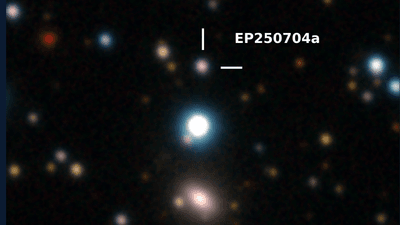


Since the launch of the Einstein Probe space telescope in January 2024, astronomers have spotted mysterious flashes of light in its data. Dubbed fast X-ray transients, they had no obvious source, but now we may have finally linked one to the event that caused it.
The event in question, called EP250704a/GRB 250704B, was spotted by three satellites: the Space Variable Objects Monitor (a French-Chinese mission), the Insight-HXMT (China’s first X-ray space telescope), and the Einstein Probe, which is a collaboration between China and ESA, the European Space Agency.
The first thing SVOM and Insight-HXMT saw was a short gamma-ray burst lasting half a second. This class of event is associated with collisions between neutron stars, the extremely dense products of certain kinds of supernovae. A neutron star packs more than the mass of the Sun inside a sphere the size of a city.
Afterwards, the Einstein Probe witnessed a fast X-ray transient emanating from the same location, lasting for almost 10 minutes. It had been previously been suggested that there was a connection between neutron star collisions and these unusual X-ray flashes, but evidence was sparse because the signals faded too quickly.
"This is the longest-lasting prompt X-ray flash ever observed from a neutron star merger,” co-author Niccolò Passaleva, who led the follow-up observations using the Very Large Telescope, said in a statement. “It is an opportunity to have a front-row seat to the most extreme forces of the Universe and discover more of its secrets.”
Passaleva, based at the University of Rome Tor Vergata, was on a train when he got the event alert, and he rushed to his laptop to request immediate time on the Very Large Telescope X-Shooter instrument.
He and his team first looked for a supernova, which are more usually associated with longer gamma-ray bursts but can produce the kind of longer-lasting x-ray emission the Einstein Probe had recorded. They found no evidence of a massive star succumbing to an explosion.
They could, however, estimate that the X-rays from this event had crossed 6 billion light-years to reach us.
From the combined data, including the observation of the gamma-ray burst, the most likely explanation was a collision between two neutron stars. This created another neutron star, but a special one with a prodigious magnetic field: a magnetar.
“Magnetars are rapidly spinning neutron stars with huge magnetic fields. When they dump their magnetic power into the surroundings, they can make any explosion brighter and longer-lasting. When I saw the X-ray data from this new event, I realized something was up," said Professor Eleonora Troja, who is part of the Einstein Probe European collaboration and co-corresponding author of a paper describing the findings.
The team hopes to find a lot more of these events to better understand this possible formation mechanism for magnetars.
Not all neutron star collisions end like that. One observed through the gravitational waves it produced ended up forming a black hole. At the same time, maybe not all fast X-ray transients are produced in these kinds of collisions.
A paper describing this discovery was published in the journal Science Bulletin.