Space and Physics
 PUBLISHED



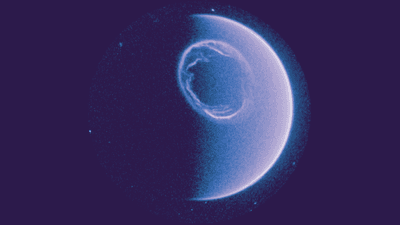


Even if you've seen the northern lights before, we guarantee you've never seen them like this. This is the view from a camera on Smile (Solar wind Magnetosphere Ionosphere Link Explorer), a new spacecraft studying how the solar wind affects Earth.
The northern lights are caused by charged particles from the Sun colliding with gases in Earth’s upper atmosphere. Earth’s magnetic field steers many of these particles towards the poles, where they can trigger the glowing curtains of light we know as aurorae.
The image above and video below are the first official releases from Smile’s ultraviolet aurora imager (UVI). UVI is the first instrument in almost two decades to capture the full ring of the northern lights, and it can observe the phenomenon continuously for up to 45 hours at a time.
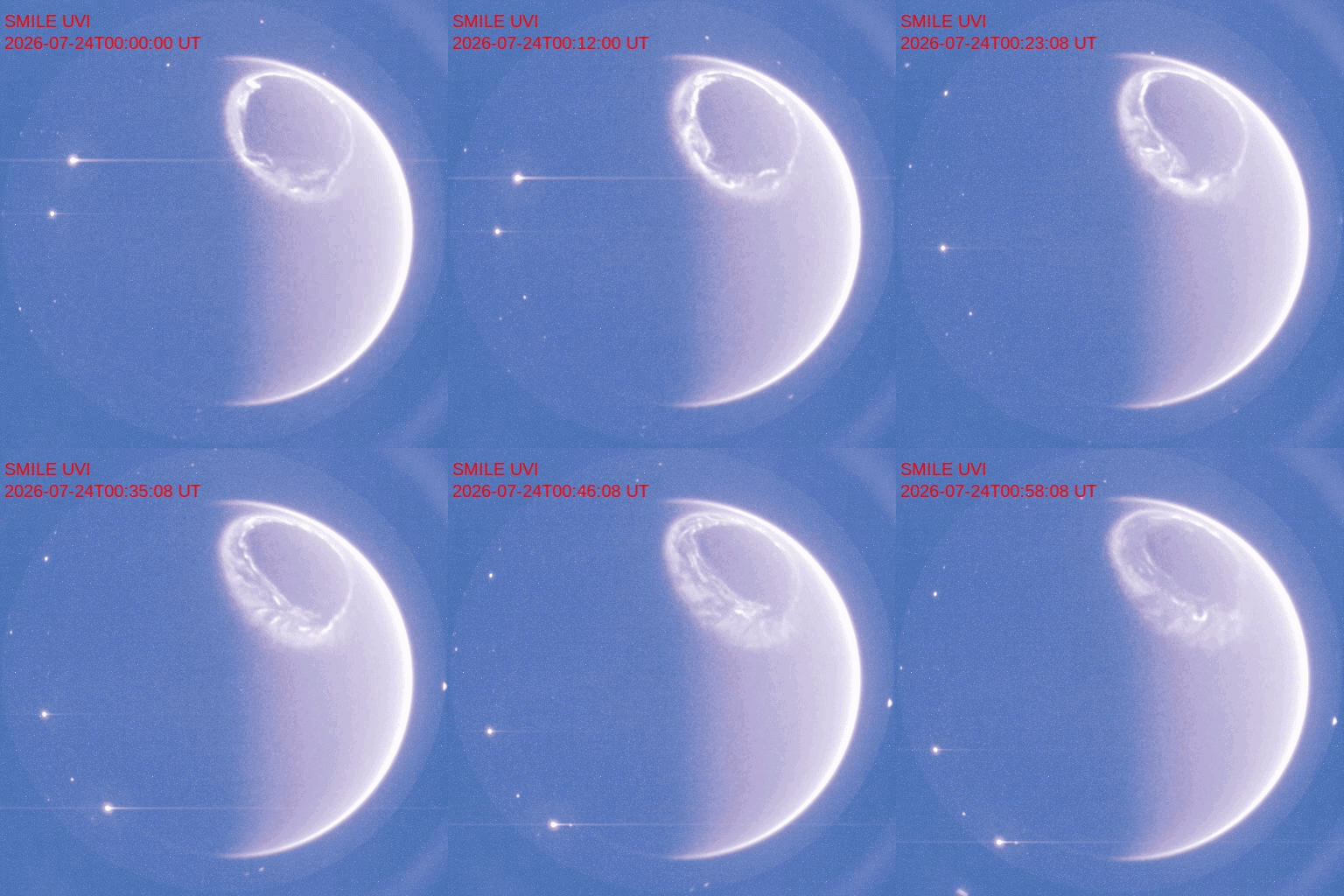
You'll notice Earth doesn't have its familiar green and blue hue in these images. The continents and oceans are invisible, and that’s because the atmosphere is opaque at ultraviolet wavelengths.
This is a good thing from our perspective on the ground: you don't want too many of those dangerous ultraviolet rays from the Sun making it to the ground.
It's also great for Smile: because it records in ultraviolet, UVI cuts out the day-glow of Earth and delivers an extraordinary view of the northern lights even on our planet's sun-facing side
What you can see here is an auroral substorm, a disturbance of Earth’s magnetosphere that looks like swirling ink in water. These events are caused by variations in the flow of energy from the solar wind and can make the aurora suddenly brighten and change shape.
The footage was taken on 24 July 2026, just two weeks after UVI was switched on and roughly a month after Smile launched from Guiana Space Center in French Guiana on May 19.
The mission is a collaboration between ESA (European Space Agency) and the Chinese Academy of Sciences, and it's expected to measure over 300 aurorae during its three-year-long primary mission.
.jpg "Two images. One shows a speckled orange-black image with with about five or six small, light-orange spots. The biggest spots are at the centre of vertical crosses. Around one of the spots is a white circle labelled N132D. the other shows an orange-black image with with a light orange cross at the centre. In the middle of this cross is a bright spot. Another much smaller cross sits to the upper left of the bigger cross. The background is a patchwork of about 35 orange squares in a 7x5 arrangement, with the squares becoming darker the further away from the cross. Covering the whole image is a grid of thin light blue lines that suggest a coordinate system.")
Because a spacecraft never quite behaves the same in space as it does on the ground, the European and Chinese teams have spent the time since Smile entered orbit getting its instruments ready and checking everything operates as expected, according to an ESA press release.
“The Smile mission is a testament to the trust built between our teams, their dedication to excellence and their determination to find solutions whatever the challenge,” Professor Carole Mundell, ESA Director of Science, said in the release.
"Smile is now approved to begin science operations. This is a very important milestone – a true pleasure to announce – and I am sure our excellent collaboration will deliver ground-breaking data to scientists around the world.”
With lesser fanfare, the mission X-ray camera (SXI) has also been switched on. This instrument is designed to study the magnetopause, where the solar wind meets Earth's magnetosphere.
The device will also photograph the northern polar cusp, one of two holes in the magnetosphere located at the poles. That’s where the solar wind particles get pulled towards Earth. Unfortunately, light conditions right now aren't optimal, so images aren't expected until later in the year.
In the meantime, SXI snapped two supernova remnants known for their X-ray emissions, one called N132D in the Large Magellanic Cloud and the other Cassiopeia A, located in our galaxy.