Space and Physics
 PUBLISHED


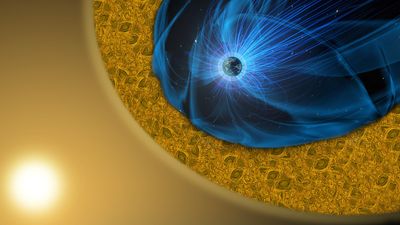


The magnetic field of our planet produces a tailed bubble that mostly protects us from cosmic and solar radiation. This is the magnetosphere. As the solar wind – the flow of charged particles from the Sun – approaches our planet, it interacts with the magnetosphere and creates a bow shock region. Between the bow shock and the magnetosphere sits the magnetosheath, and new research shows that some peculiar electric and magnetic activity is going on inside it.
Recent studies have revealed that the magnetosheath is made of turbulent plasma and influences the bow shock Sun-side, and the magnetopause Earth-side. The new work adds to that understanding. NASA's Magnetospheric MultiScale (MMS) mission (a four-spacecraft constellation flying in a pyramid shape) can measure the activity in the space environment around Earth.
The observations reveal that the motion of electrically charged particles, plasma, around the magnetosheath gives rise to a dynamo – the electric energy of that moving turbulent plasma generates magnetic fields.
“We discovered regions where magnetic fields are amplified by plasma flows, and others where the fields weaken and fold back,” lead author Dr Zoltan Vörös, from the Austrian Space Research Institute, said in a translated statement. “These features are consistent with long-standing theoretical predictions and numerical simulations, but have never before been observed so clearly in space.”
Our planet is not an isolated system. It is deeply influenced by what goes on with the Sun and its 11-year-long cycle of activity. This is even more important for our technology, such as satellites, radio communications, and power grids, which can be harmed by powerful electromagnetic events from the Sun and around the Earth.
Space weather is something very important to monitor, but our limited understanding of the environment around our planet is detrimental to that kind of forecasting. This new study provides timely and important insights into that particular region around the Earth. It is a combination of on-location measurements, lab experiments, and simulation of how plasma might behave in such an environment.
MMS is measuring particles and fields around the Earth, producing a three-dimensional map at the highest resolution yet and 100 times faster than previous missions. Next week, a new mission will join the quest. Smile, a spacecraft from the European Space Agency and the Chinese Academy of Sciences, will study the interaction between the solar wind and the Earth’s magnetosphere.
The study is published in the journal Nature Communications.