Space and Physics
 PUBLISHED





Another week, another record for SpaceX and their seemingly unstoppable mission to expand humanity's presence beyond our little planet's rocky surface.
This weekend's record breaker
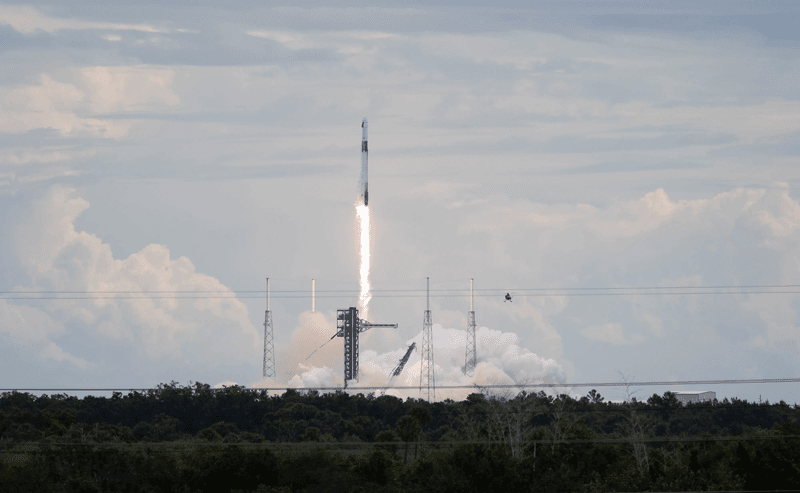
On Saturday evening, August 15, SpaceX launched two Falcon 9 rockets just a little over 38 minutes apart.
The first launch was at 9:12 p.m. EDT from Cape Canaveral Space Force Station in Florida, while the other occurred at 9:50 p.m. EDT from Vandenberg Space Force Base in California, according to SpaceX.
The back-to-back blast-offs mark the company’s shortest period between two launches to date, beating their previous record, achieved in August 2024, by an impressive 27 minutes.
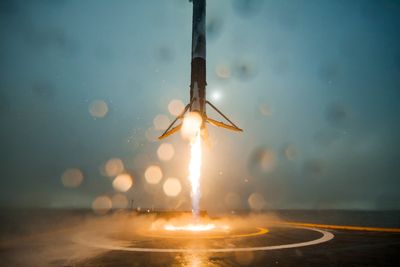
Falcon 9, one of SpaceX's flagship rockets used in the twin launches, is partially reusable. After launch, the first-stage booster (the rocket's larger lower body) returns to Earth. In this weekend’s launches, the East Coast rocket settled at a designated Landing Zone at Cape Canaveral and the West Coast one landed on the uncrewed “Of Course I Still Love You” droneship, stationed in the Pacific Ocean.
Both of these missions used the same rocket design, but they had slightly different objectives. The first launch from Florida, called Globalstar 2-R Launch 1, involved putting a set of eight telecommunications satellites into orbit.
Meanwhile, the second launch, code-named USSF-366 mission, was reportedly a classified mission for the US Space Force steeped in mystery. In all likelihood, though, it probably involved the release of a satellite or another piece of equipment into low-Earth orbit.
SpaceX keeps upping the ante
The rate at which SpaceX is launching rockets into space is pretty staggering. As per NextSpaceFlight, the company has launched 709 missions in total, including 99 so far in 2026 alone.
Many of these have involved satellites that are indispensable for everyday life in the 21st century, including telecommunications, navigation, banking, weather forecasting, scientific research, and national security.
It’s estimated that the number of satellites has more than doubled in less than a decade, primarily thanks to the launches of “mega-constellations” like SpaceX’s Starlink. By the latest count, there are over 18,000 satellites in orbit at the moment, and that number continues to creep up and up every few days.
Satellite rush hour in low-Earth orbit
The good news: the world is more connected than ever. Advances like SpaceX’s Starlink mean that vast swathes of the world, including far-flung regions of Africa and the Amazon rainforest, can now have a reliable internet connection.
The bad news: satellite traffic is getting very crowded. Astronomers have frequently warned that this will inevitably hamper their efforts to observe space, all while increasing pollution and the risk of falling debris.
The probability of getting hit by space junk has been incredibly low in decades gone by, but the odds are rapidly increasing.
Scientists estimate there’s roughly a 10 percent chance that one or more casualties will occur over the next decade, which is striking since only one person in history has ever been confirmed struck by falling space debris.
With every launch, those odds creep upwards ever so slightly.