Space and Physics
 PUBLISHED


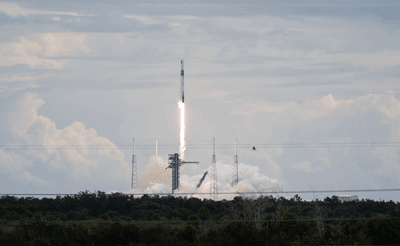


For the first time, a crewed US spacecraft has made the journey to the International Space Station (ISS) in under 8 hours. Yesterday, the Crew-13 mission, flying on a SpaceX Crew Dragon, arrived at the ISS in 7 hours and 55 minutes.
This is the fastest trip to the ISS by an American spacecraft and a new record, according to NASA. The previous record was set by SpaceX's Dragon cargo spacecraft in 2024 at 12 hours and 33 minutes. The previous record for a crewed American spacecraft was 14 hours and 43 minutes, set last year in August 2025.
The new crew is led by NASA astronaut Jessica Watkins, the first Black woman commander to lead a crew to orbit. Watkins is also the first person to have published a scientific paper from Space, among several other records.
Together with Watkins, the Crew-13 mission is made up of NASA’s Luke Delaney, the Canadian Space Agency's Joshua Kutryk, and Roscosmos cosmonaut Sergey Teteryatnikov.
"We got lucky this time," Julianna Scheiman, director of NASA Science and Dragon Programs at SpaceX, said during Crew-13's post-launch press conference yesterday.
"The space station was in an opportune spot in space, and the orbital mechanics, the physics of it all, worked out for it to be the shortest launch-to-docking time we've had to date."
Not the fastest overall record
The record is very exciting; gone are the days when it would take literal days to reach the International Space Station. It does not, however, beat Russia's Soyuz record.
Roscosmos’s Soyuz has been using different orbital configurations for almost a decade, which dramatically dropped its cruising times from days to hours.
Back in 2018, a Soyuz bringing cargo was able to get to the ISS in 3 hours and 40 minutes, becoming at the time the third fastest launch-to-docking ever from Earth to setup in orbit.
The second fastest was Gemini 11 in 1966, which took 1 hour and 34 minutes, and the Kosmos-186/188 experiment in 1967 had a launch-to-docking of only 1 hour and 8 minutes.
Just two years later, the Soyuz began bringing cosmonauts and the occasional NASA astronaut up to the ISS in just 3 hours and 3 minutes.
Still, the improvement is a significant step forward for US access to space, especially as NASA hopes to ramp up the number of launches to both low-Earth orbit and then to the Moon in the context of the lunar base.
“Our steady cadence of commercial crew launches demonstrates the essential role the International Space Station plays in sustaining our presence in Earth’s orbit and sharpening the tools we’ll take forward to the Moon and Mars,” said Dr Lori Glaze, associate administrator of NASA’s Human Spaceflight Mission Directorate, in a statement.
“Each space station mission adds to our blueprint for exploration, and the work our crews carry out guides our plans while ensuring we keep pushing the boundaries of what’s possible in human spaceflight.”
Crew-13 is expected to stay in space until March 2027.