Space and Physics
 PUBLISHED
 1
1


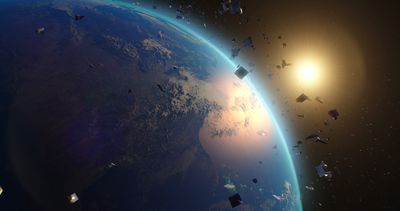


Modern life provides enough for us to worry about without having to add space junk to that list. Unfortunately, it is becoming more and more of a concern, certainly to our civilization's use of space, and with a creeping risk that one day soon, a piece of space junk will hit someone and harm them.
Guinness World Records reports that only one person has ever been hit by a piece of falling space junk. Her name was Lottie Williams, and on January 22, 1997, she was walking around a park in Turley, a suburb of Tulsa, Oklahoma, when a 12.7-centimeter (5-inch) long piece of black fiberglass hit her on the shoulder, bouncing off and rolling into the grass.
The piece was extremely light, weighing about an empty soda can, and despite its quick entry velocity, by the time it reached Williams, it had slowed down a lot. Instinctively, we could think that this is all very silly. A piece of space debris that doesn’t even leave a bruise might not seem worth talking about.
However, it was not the only piece that broke off from the original source, the second stage of a Delta II rocket. The biggest piece was a 250-kilogram (551-pound) propellant tank, which landed only 50 meters (164 feet) from a farmhouse near Georgetown, Texas.
Williams and her friends actually saw the second stage reenter, in what they reportedly described as looking like a shooting star. The rocket had been launched on April 24, 1996, and that piece of rocket was simply left in orbit to slowly decay and burn in the atmosphere during reentry. The reentry was clearly uncontrolled and did not burn it completely, spreading debris across Texas and Oklahoma.
Almost 30 years later, the situation is significantly different, for both the better and the worse. There is a lot more awareness of the dangers of uncontrolled reentry and creating space junk. The European Space Agency, for example, has a mitigation policy aiming to reach a "Zero Debris" goal. While outer space remains poorly regulated, the existence of such a policy is not law, but experts in the sector say it has long-reaching influence.
The focus of this policy is less about protecting us down here and more about making sure that all orbits remain safe for missions. The concern here is something known as Kessler syndrome. If a piece of space debris hit a working satellite, it would create a cloud of space debris. Those have the chance to go and hit more objects, creating more debris, and so on, until an entire orbit is no longer safe to inhabit or traverse.
Kessler syndrome is not a direct concern for people on the ground, as often those fragments are so small that they’d burn in the atmosphere. It is a concern for our way of life, however, because space debris might affect telecommunications, GPS, and weather satellites – cornerstones of our civilization. There are also large satellites that risk coming down in an uncontrolled reentry, though fortunately, some technologies are being developed to deal with them.
Believe it or not, but that was the more hopeful part. The more distressing part is how quickly our poorly regulated access to orbit has shifted. In 1996, there were 77 orbital launch attempts, resulting in several dozens of new satellites. In 2025 alone, over 4,000 new objects were placed in orbit. Today, around the Earth, there are over 18,000 satellites, and more than half belong to the SpaceX megaconstellation Starlink.
The risk of space junk hitting the ground has been increased by the sheer number of launches. Just one mishap could produce a vast amount of debris. A large portion of a SpaceX rocket was found on a farm in Canada, and the explosion of one of the company’s Starships during a test rained debris over the Turks and Caicos Islands in the Caribbean. Twice.
The company wants to send 1 million satellites into space, which will not only alter our view of the night sky but also risk exacerbating the problem of space junk. There is opposition to this proposal, and there are ways to make one’s opinion heard.
Even when objects are designed to both burn up and fall into the ocean away from people, something might survive. A family from Florida took NASA to court over a piece of space junk that not only hit their house, but also went through the roof and could have seriously hurt someone. This is now a serious concern given that just a few months ago, a flight in the US was hit by a flying object, and one of the hypotheses (albeit remote) was that the object was piece of space junk. It turned out to likely be a weather balloon.
Recent research, focusing on data between 1992 and 2022, estimated that of 1,500 de-orbited rocket bodies, over 70 percent de-orbited in an uncontrolled manner. Combined with population models, they estimate that there is a 10 percent chance that someone will be hit by space junk by 2032.