Space and Physics
 PUBLISHED
 2
2




What you'll discover in this article
- Researchers studied five solar storm events that have reached Mars
- In one of them, they found a link between this celestial shower of particles and a global dust storm.
- PhD researcher Lana Williams of Lancaster University told IFLScience the team saw a significant amount of heating in the Martian atmosphere.
The Sun is a major driver of weather. Sunlight warms the Earth, and it is the power behind the water cycle and atmospheric circulations. But what if the Sun’s activity, its powerful solar storms, could also affect a planet’s weather? Evidence from Mars suggests that this is a real possibility.
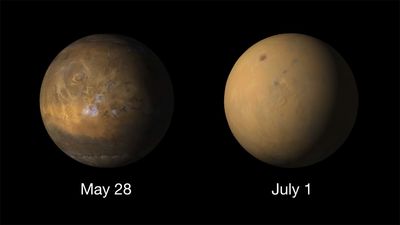
We need to turn the clock back to 2018. A global dust storm spread across the surface of Mars, ending for good the 15-year-long adventure of NASA rover Opportunity. Researchers have now linked this to a solar energetic particle (SEP) event happening at Mars.
SEP events have been previously linked to upper atmosphere events seen at Mars. NASA’s MAVEN (Mars Atmosphere and Volatile EvolutioN) has spotted patchy and diffuse aurorae associated with SEP events in the upper atmosphere of the Red Planet.
The effect of SEP events in the lower atmosphere of the planet has been poorly characterized. We know that particles can certainly reach it, as rovers have measured in recent years.
The team used the European Space Agency’s Trace Gas Orbiter (TGO) to study the effect of five SEP events in the lower atmosphere. The ESA craft can measure temperatures, and out of those five, the team found a strong increase in the temperature during a 2018 SEP event, happening at the same time as the global dust storm.
“We found that there weren't a lot of interactions apart from this one event where we saw quite a significant amount of heating,” Lana Williams, a PhD researcher at Lancaster University, told IFLScience.
The team saw an increase of about 50°C (90°F) at about 75 and 125 kilometers (47 to 78 miles) of altitude. A July 2021 SEP event showed a more modest increase in heat, between one tenth and one fifth of that. The team focused on this single 2018 event.
It is important to not make wide-reaching claims about the connection between the celestial and the terrestrial (or at least, the Martian). Still the work raises the possibility that this could be the case, and it is very important to investigate it further.
One challenge is the fact that MAVEN was unfortunately lost last December. The craft experienced an anomaly as it went behind Mars, and the team was not able to reestablish contact there. Still, there might be plenty of work to be done in follow-ups.
I just want the general public to know that it isn't just this barren planet.
Lana Williams
These five events were all between 2018 and 2021, and the team is still waiting for data analysis from 2022 onwards by TGO. It would be particularly interesting to see if some of the very active solar events of this solar cycle have had an effect on Mars.
“It is a case of we just don't have the data at the minute to look further into it, but it would be interesting to look at the 2024 solar storm,” Williams told IFLScience.
In that event, the shower of particles from the Sun was visible in the camera observations from Curiosity on the ground. It will be interesting to see how the whole atmosphere was affected.
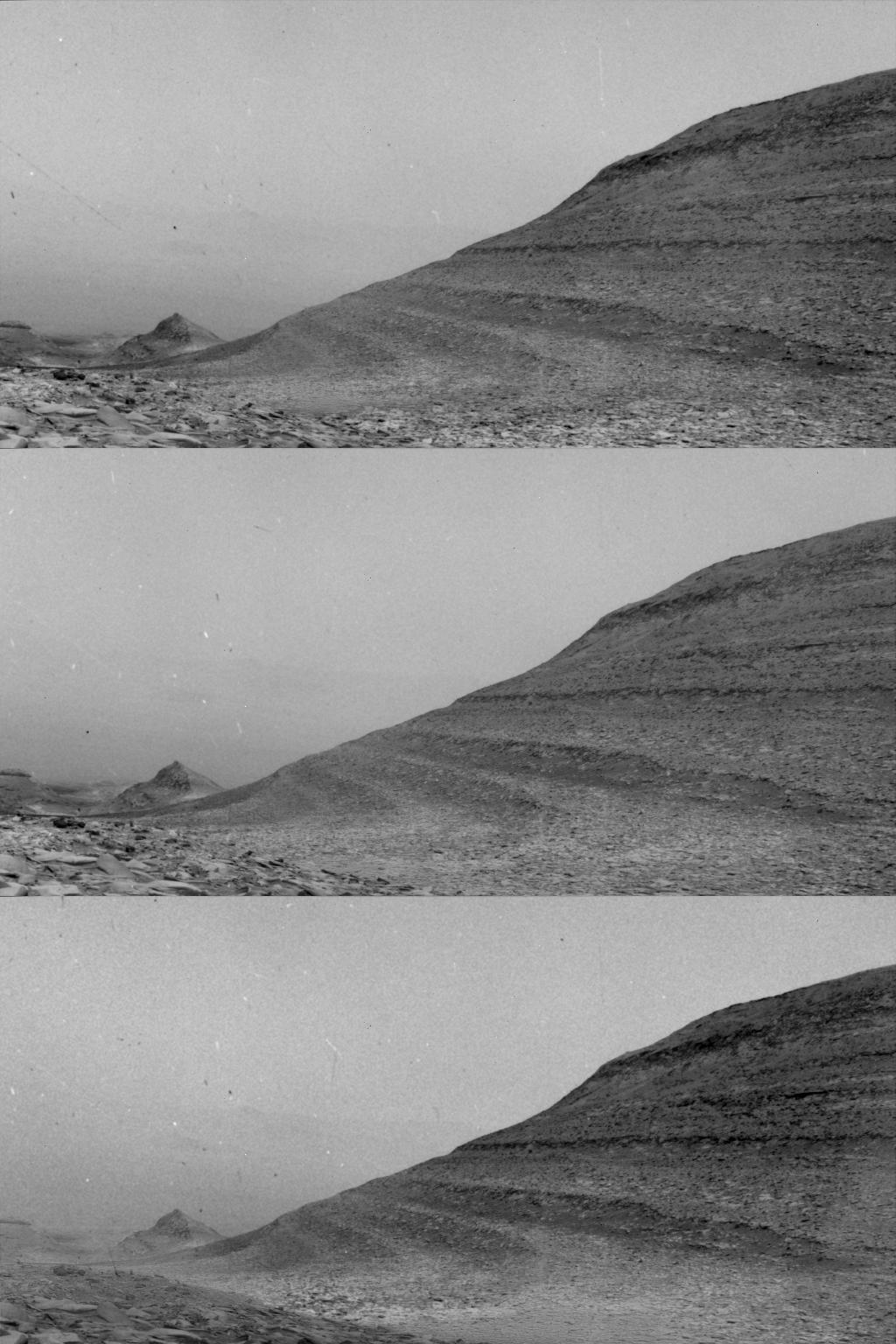
The work confirms that Mars is a very active world, shaped by internal and external factors alike.
“I just want the general public to know that it isn't just this barren planet,” Williams told IFLScience. “There's so much going on and so much we can explore and look into with it.”
The work was presented at the Royal Astronomical Society's National Astronomy Meeting 2026 in Birmingham, UK.