


 Space and Physics
 PUBLISHED




What you'll discover in this article
- The magnetic field in the early Solar System was thousands of times stronger than it is today between planets.
- Scientists just found evidence of that in a meteorite dust grain.
- “We just scratched the surface,” researcher Professor Benjamin Weiss told IFLScience.
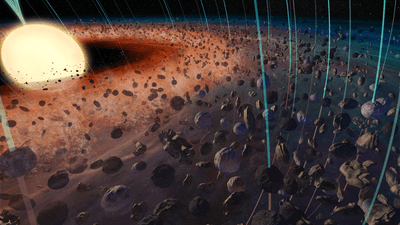
Stars and their planets form from large clouds of gas and dust. Gravity plays a major role in pulling material onto the protostar and flattening the round-ish cloud into a disk, but scientists believe that magnetic fields, too, are important.
Thanks to a meteorite fragment, researchers have now estimated how strong the magnetic field was just 200,000 years into the formation of the Solar System.
The team from the Massachusetts Institute of Technology (MIT) looked at the DOM 08006 meteorite, one of the oldest meteorites known. In particular, they looked at these tiny structures called calcium-aluminum-rich inclusions, or CAIs, which formed very early in the history of the Solar System.
Those grains hold ferromagnetic elements that were affected by the primordial magnetic field of the Solar System. The fossilized signs provide insights into how magnetic fields helped turn the primordial cloud into the protoplanetary disk from which the planets formed.
“We had the idea to see if we could find records of this process in our own Solar System, recorded in meteorite samples that are really primitive from the first stages of the formation of the Solar System, the oldest known materials in particular,” senior author Benjamin Weiss, the Robert R. Shrock Professor of Earth and Planetary Sciences at MIT, told IFLScience.
“The question we wanted to ask was, what forces formed the Sun and planets in particular? Was it just gravity, or did magnetic fields also play a role?”
A significant force!
The measurement suggests that in the early years of the Solar System, there was a strong magnetic field in the gas cloud, stronger than Earth’s own magnetic field today and a lot stronger than the interplanetary field that we can measure now.
The magnetic field of the Earth is around 50 microtesla, and the interplanetary magnetic field around Earth is about 1,000 times weaker. The primordial field is estimated to have been between three and 10 times as strong as Earth’s today.
This magnetic field was crucial in slowing down the early Solar System material; with gravity alone, the grains would have simply kept orbiting the nascent Sun. But because something slowed them down, they fell inwards, adding mass to the Sun until a fully-fledged star was born.
“What's long been suggested is that magnetic fields could help this happen so that you can actually form the central star,” Professor Weiss told IFLScience.
This is one meteorite from one type of asteroid. There's a whole diversity [...] out there.
Professor Benjamin Weiss
Weiss and his team plan to do a lot more. Other colleagues are trying to look at magnetic fields in other baby star systems, something easier said than done.
Weiss is also involved in the exciting Psyche mission, which will reach the metal-rich asteroid Psyche. It might be possible, depending on formation scenarios, that Psyche holds a magnetic record of its own.
But the crucial next step is to look for a lot more fossilized magnetic signals in a lot more meteorites.
“We just scratched the surface. This is one meteorite from one type of asteroid. There's a whole diversity of CAIs out there,” Professor Weiss told IFLScience.
“We want to basically explore that full record. We might be able to go back a little bit earlier in time.”
The team could track the magnetic field over different time periods and even turn the question on its head and use the magnetic fields to study the formation of these CAIs.
The study is published in the Proceedings of the National Academy of Sciences.

 1
1