Space and Physics
 PUBLISHED


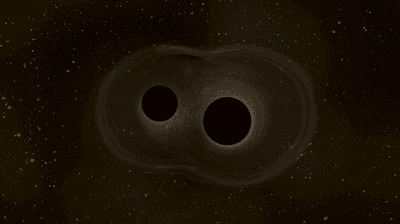


In 2023, Earth's gravitational wave observatories spotted something truly peculiar. Two large stellar black holes (as massive as these objects are expected to get) collided, forming an even bigger black hole in the biggest merger ever observed. Now, new research suggests that we are all being tricked by something that the detectors couldn’t see.
Based on the interpretation of the signals, called GW231123, there were once two stellar black holes (objects formed by stars going supernova), one with 103 times the mass of the Sun and the other with 137 solar masses.
Black holes that form in supernovae, the explosive demise of massive stars, are not expected to be any bigger than around 150 times our Sun, so our two black holes are already on the large side.
The colliding pair created an object between 190 and 225 times the mass of the Sun. At this mass, this object would be considered an intermediate mass black hole, something too big to come directly from a star but still significantly smaller than the supermassive black holes at the center of galaxies, which range in the millions of times our star's mass.
A trick on us all
On one hand, the black hole might be the product of previous mergers, as it has been identified in other cases. A new paper suggests instead that none of these black holes were as massive, and we were all deceived by a curious gravitational phenomenon: gravitational lensing.
A massive object can warp space-time in such a way that it magnifies the light of background objects. The same happens with gravity.
Researchers worked out several scenarios that could explain the detection and some of the peculiarities of the observations thanks to the presence of a massive object in the line of sight between us and this black hole merger.
This hypothesis is intriguing. One possibility is that we have seen the event gravitationally lensed by a single massive object. This would have to be around 1,000 times the mass of our Sun, which suggests another intermediate-mass black hole.
While such an object would solve some of the peculiarities of the observations, there are other objects that could produce a similar effect. The center of a globular cluster, a spherical collection of many stars or another collection of stellar-mass objects, could deliver a similar effect.
The study is not saying that the lens hypothesis is without limitation, far from it. Still, it is worth keeping in mind.
As more gravitational wave events are detected, it might become easier to spot hints of possible magnification and more. Or the hierarchical formation of small intermediate-mass black holes is a thing, and this system was simply one of the first spotted.
The study is published in The Astrophysical Journal Letters.