Space and Physics
 PUBLISHED





Physicists at CERN have reported new results in the ongoing hunt for exotic physics beyond the Standard Model, identifying discrepancies in a rare kind of particle decay that hint at the possible influence of an as-yet unknown particle or force.
The Standard Model is physicist's best working theory for how particles and three of the known fundamental forces (electromagnetism, the strong nuclear force, and the weak nuclear force) behave.
It isn't a perfect description of the universe, since it hasn't been able to give us much insight into the fourth fundamental force, gravity, or the still-hypothetical dark matter and dark energy, but it has proven to be "unreasonably good" at describing and predicting what is going on at the subatomic scale.
For example, the Standard Model predicted the existence of particles such as the Higgs Boson long before they were actually discovered. It's a classic case of suffering from success: despite knowing the model is incomplete, experimental results that disagree with it are hard to come by.
This has forced researchers to devise ever more complex experiments that probe increasingly subtle predictions of the model, looking for holes that might reveal new physics.
It's into this context that a new challenger approaches, and this time it is a "beauty" turning into something "strange." These are the names given to two types of quarks, the family of fundamental particles that include the up and down quark that make up protons and neutrons at the center of atoms. Basically, they are the stuff that makes up the stuff that makes us.
Beyond the up and down quark, there are four more exotic types of quarks. These are known as the charm, strange, top, and bottom. To make things even more confusing, the top quark is sometimes alternatively called the truth quark, and the bottom one is occasionally called the beauty quark.
You can think of the beauty and strange quarks as heavier and more unstable versions of the quarks that make up regular matter; specifically, they are like more exotic variants of the down quark. Because they are unstable, they decay quickly, transforming into more stable combinations of particles soon after they are formed.
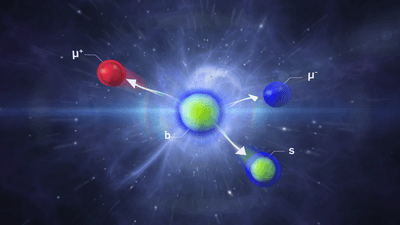
Particles containing a bottom quark are known as beauty particles, and some of these particles will decay into particles containing a strange quark, as well as a muon (μ+) and an antimuon (μ–). What exactly a muon is isn't super important for the purposes of what's going on here, but you can think of it as a heavier cousin of the electron.
These specific kinds of decay events are rare. Only one in every 10 million beauty particles turns into a particle with a strange quark and a muon pair, and the process is known as the b→sμ+μ– transition.
Scientists at the Large Hadron Collider (LHC), part of CERN, working on the LHCb and CMS experiments, measured the number of these decays compared with theoretical expectations, in the hopes it would show up some deficiency in what the standard model is able to predict. They found that there was a consistent difference between theory and practice.
That said, this isn't a “we have found the hole in the standard model” moment. It's more of a “this is worth more investigation” kind of situation.
The reason for the discrepancy could be an interaction with an unknown particle or force, the much hoped for "new physics" that researchers are so eager to find. But It could also just be a result of an interaction with a particle we already know about. While the Standard Model is great, the calculations are very difficult, and so the explanation could come from either side.
“Although far from conclusive, the signs of possible tensions with the Standard Model provide a strong motivation for further investigation of the b→sμ+μ– transition. As researchers are able to take increasingly detailed measurements of rare processes, hints of the unknown may one day become clearer,” CERN wrote in a press statement.
Both experiments have more observations from more recent runs of the LHC with which to expand their data analysis, hoping to improve their statistics and reveal more about this currently unexplained discrepancy.
The results were presented at the recent International Conference on High Energy Physics (ICHEP).