Space and Physics
 PUBLISHED



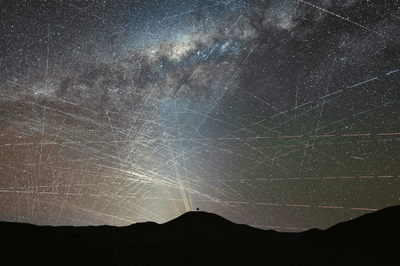


The number of satellites in space continues to increase, and space companies appear to be doing very little to make sure that these objects are not adding to the light pollution in the night sky.
A new paper delivers evidence of a “systemic non-compliance” by satellite megaconstellations.
The team wanted to see how many satellites were brighter than the recommended limit from the International Astronomical Union. According to this, the satellites should have a visible magnitude of 7 or more, meaning that they are invisible to the naked eye.
Ever-expanding constellations
Researchers used six cameras to observe the sky at the Elginfield Observatory in Ontario, across 36 nights from October 7 to November 11, 2024. They tracked 24,812 trails from 5,118 unique satellites in Low-Earth Orbit (LEO).
They found that two-thirds of all observed satellites exceeding the brightness limit were from the Starlink megaconstellation, the worst offender when it comes to absolute numbers.
Starlink has by far the largest number of satellites in space accounting for over 10,000 out of 16,000 objects in orbit. This is up from around 6,000 in 2024.
However, the team stressed that when it comes to the percentage of worse offenders, the situation is slightly different. Only a quarter of Starlink passages were above the limit, while 50 percent of the Guowang constellation were.
The Chinese megaconstellation is designed to rival Starlink. At the time of the study, the constellation only had 12 satellites in orbit, which has since risen to just under 300.
“Starlink dominates in the absolute number of satellites brighter than the IAU limit. This is true even though only about one in four possible Starlink passages exceeds the limit; the sheer size of the constellation causes it to dominate,” the author wrote in a paper.
And if ambition is anything to go by, things are only set to get worse. Earlier this year, Musk put forward a plan to have one million satellites in space.
Astronomy at risk
The number of satellites is now affecting astronomical observations on Earth and in space.
Light pollution is now affecting every part of the world, even in areas where there are no artificial lights. This has negative impacts on plants and animals, and serious health effects on humans. Recently, light pollution was linked to early-onset dementia.
Just a few months ago, IFLScience spoke to astronomer Olivier Hainaut, who has estimated that if the satellites are kept under the visible limit, we could have up to 100,000 of them without any major effects.
But in some scenarios, such as having over a million of them or in which they are too bright, the picture has been described as disastrous.
“Disastrous can mean that we lose 100 percent of our data; basically, it kills the telescopes,” said Hainaut.
From the first deployment, we've seen how satellite streaks photobomb observatories around the globe, even putting at risk long-term campaigns like the Legacy Survey of Space and Time by the Vera Rubin Observatory. The work suggests that one in three exposures at twilight for Rubin might be contaminated.
Under certain scenarios, the dark skies where observatories are present would become as bright as a suburb, without the need for a single lightbulb.
“Overall, non-compliance with astronomical brightness standards is the norm rather than the exception for the current LEO population, it is concentrated in precisely the hours which matter most to ground-based astronomy, and its observational cost can now be predicted quantitatively for any instrument,” the authors wrote in the paper.
“The success of some operators in producing fainter satellites provides a clear and actionable benchmark for the rest of the industry.”
The paper is currently in press with Nature Astronomy and available on ArXiv.