


 Space and Physics
 PUBLISHED





What you'll discover in this article
- The European Space Agency’s Euclid mission is creating an incredibly detailed map of the universe.
- The map will be used to solve some of the biggest mysteries: what is dark matter and dark energy?
- “In just a few hours, it can observe an area 270 times larger than Hubble’s field of view, with comparable resolution,” members of the team told IFLScience.
Our best understanding of the universe as a whole is the standard model of cosmology, and through this we know of only about 5 percent of its contents.
This is composed of matter that makes up all humans, planets, and stars, along with the radiation in between. The other 95 percent, named dark matter and dark energy, is an enthralling mystery. We don't know what this is made from, but we see its effects all around us.
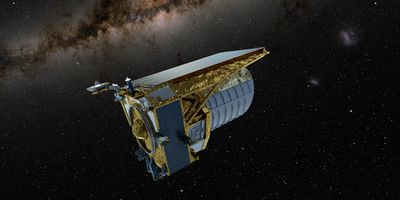
Enters Euclid, the European Space Agency’s Dark Universe hunter. Its goal is both simple and daunting. It will observe billions of galaxies across 10 billion light-years to create the most incredible map of the large structure of the universe.
Euclid will observe about 10 billion astronomical sources, measuring the effects of dark matter on space-time. As far as we know, dark matter only interacts gravitationally, and any substance with mass warps space-time.
“Euclid will help us measure the indirect effect of dark energy and dark matter so that we can better understand how they function and how they work,” ESA's Director General Dr Josef Aschbacher teased us in 2024 during an exclusive interview with IFLScience just after the mission launch.
“We will still not see them, but we can measure their impact indirectly. And this is actually quite exciting!”
Finding the invisible in what we can see
The approach that Euclid is using is called weak gravitational lensing. The spacecraft will measure the subtle warp produced by this invisible substance for over 1 billion objects with a precision 50 times greater than what we can observe from the ground.
“Think of the wine glass analogy: you know the wine glass is there, you know its shape, and you know its thickness by looking at the distortion through it,” Professor Andy Taylor from the University of Edinburgh and the Euclid gravitational lensing lead told IFLScience.
“Using just geometry, we can reconstruct where the dark matter is.”
Creating this map is fundamental if we want to begin to fully understand what’s going on with dark matter and dark energy. Despite many hypotheses on their nature, we still don't know what they are, and some people even argue that they don't actually exist.
“We have a good cosmological model thanks to general relativity. It only works because we have two components in it, dark matter and dark energy, that are set just right to make it work,” Marc Sauvage, the interim lead for the Euclid Consortium, told IFLScience.
“None of those have a satisfying physical explanation.”
This is why the newest generation of observatories are pushing at the very edge of what we know about these dark universe components. Euclid, the Nancy Grace Roman observatory, the Vera Rubin Observatory, and others are pushing against our ignorance.
In November 2026, the consortium will release all the raw data for 1900 square degrees of sky. The complete first data release is expected for mid-2027.
Euclid will mostly focus on galaxies up to 10 billion light-years away (or in astronomer lingo, at a redshift of 2), but it will also be able spot bright objects that are much further away whose light comes to us from the first billion year after the Big Bang (at a redshift of 7 or higher).
“The data release will contain about 2,000 square degrees of images and spectra of objects of the universe,” Sauvage told IFLScience. That’s an area equivalent to 10,000 full moons.
“There will be objects near and far, stars from our galaxies to quasars at redshifts of seven or eight even. There's lots of science that you can do with that, not only cosmology.”
Hunting the faintest quasars
Quasars are the active state of supermassive black holes in certain galaxies, and can become so extremely bright that they outshine their host galaxies.
Yet despite their brightness, these objects are rare. This means discovering them is important to understanding crucial phases in galaxy evolution.
It’s particularly important to study these phases so early in the history of the universe, and Euclid is particularly good at discovering those early quasars.
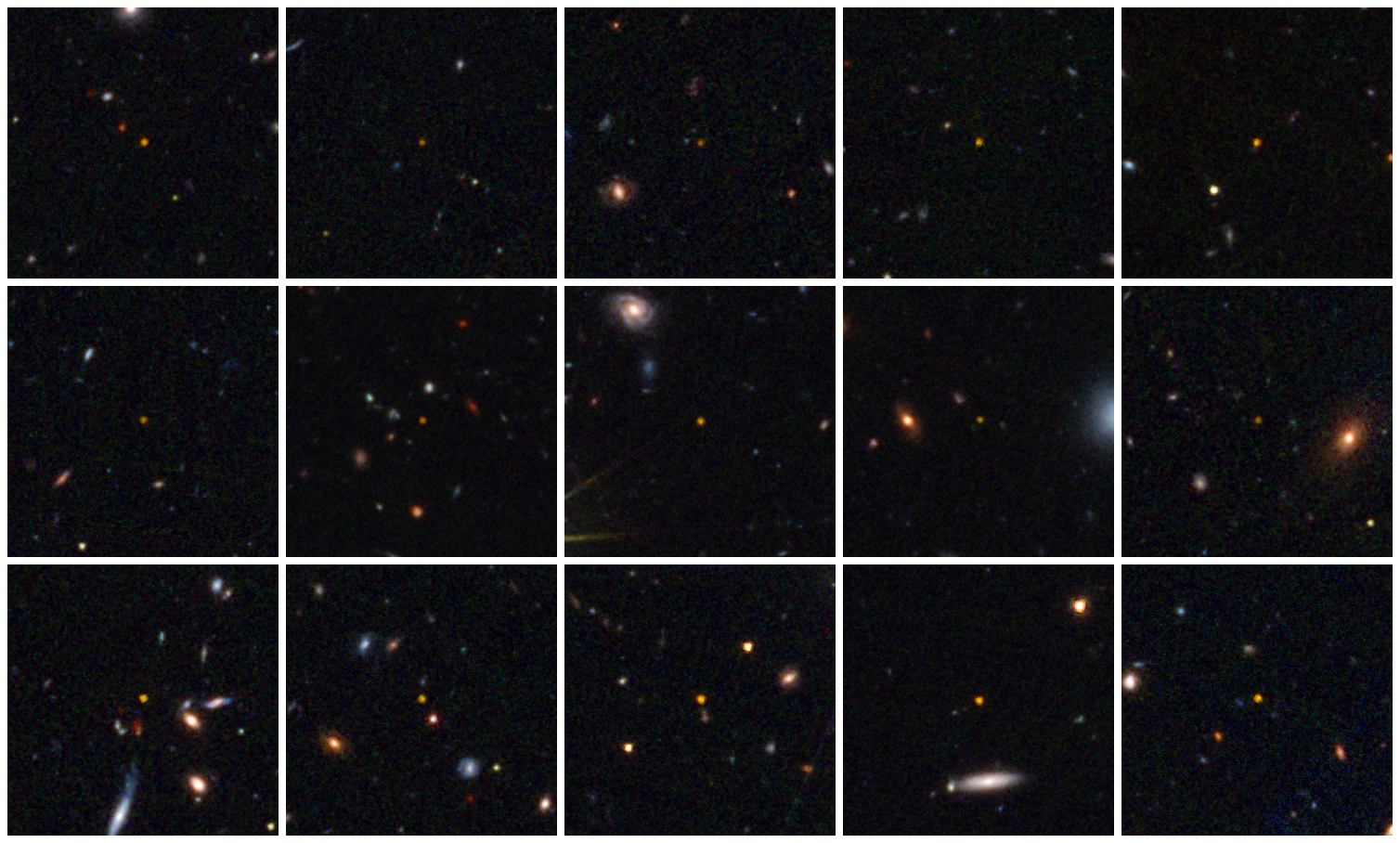
“Euclid combines both wide coverage and depth: it surveys a large area of the sky while maintaining excellent resolution,” ESA Euclid Project Scientist Valeria Pettorino told IFLScience in July.
“In just a few hours, it can observe an area 270 times larger than Hubble’s field of view, with comparable resolution.”
Thanks to its fast and precise observations, Euclid will deliver not just the brightest and most distant quasars, but also a fainter population of quasars that had been missed so far.
“In addition, Euclid observes not only in visible light but also in the near-infrared. Because of redshift, very distant quasars become extremely faint in the visible range, while remaining detectable in the near-infrared,” Pettorino continued.
One person’s anomalies are another person’s treasure
When you create the most incredible map of the universe, you're going to collect a lot of data.
Some of this data might not seem relevant to the main objective of studying the dark universe, like the incredible photo of the core of our own galaxy featuring 60 million individual stars. But the team always had a holistic approach in mind.
The telescope is out there to observe and collect data, and then scientists will do what they do best and look through it.
“We're really lucky because we can keep all that data,” Professor Taylor told IFLScience. “All that data is imaging data. We can never utilize that all ourselves. We isolate the bits we're interested in, but it really does mean that there are prospects of finding things, new objects.”
“Just seeing things we'd never seen before.”
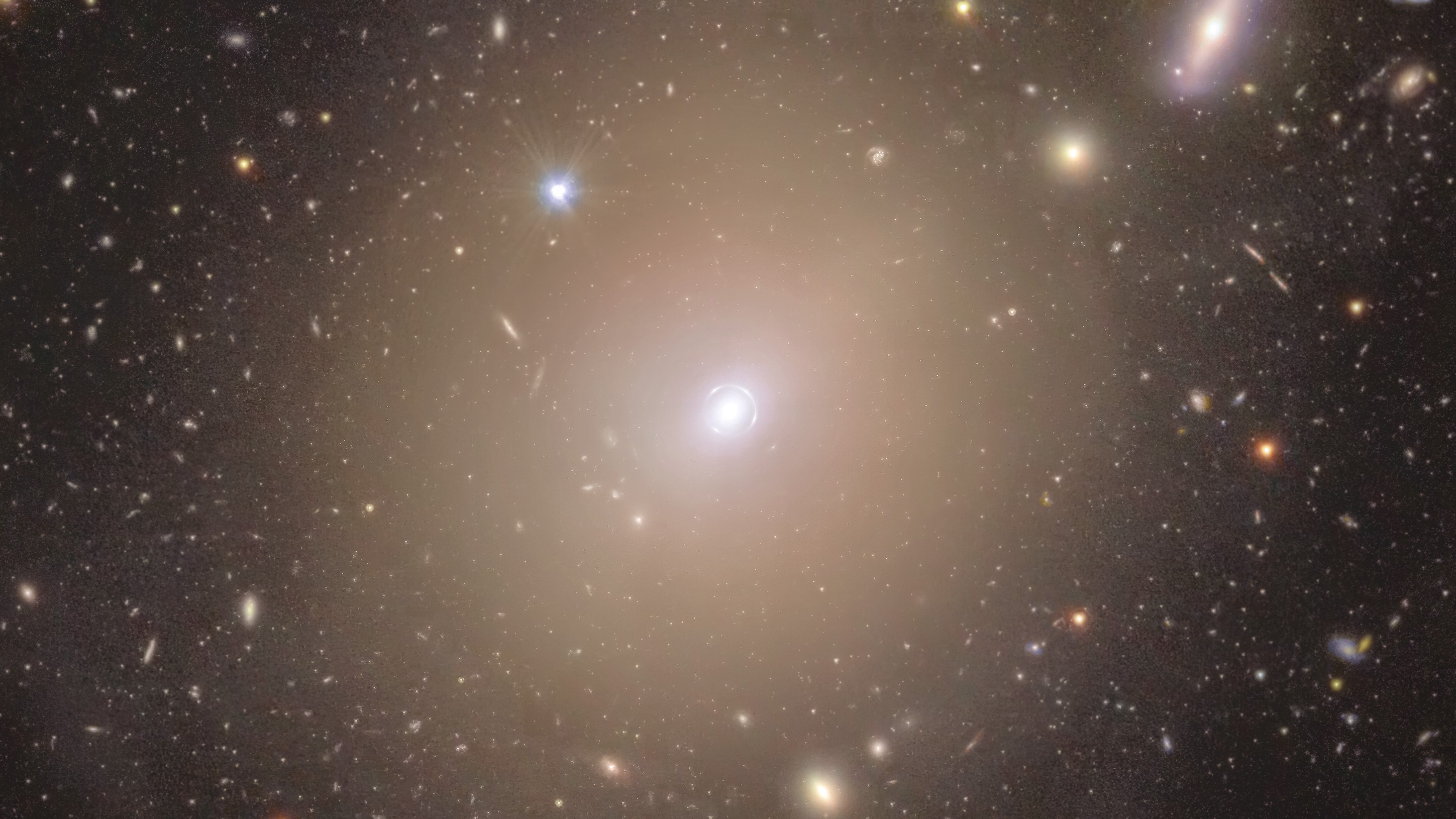
The space oddities have often come in a serendipitous way. Someone stumbling onto the bizarre while looking for something else.
With billions of expected detections, the Euclid team has also been looking into automating the discovery of anomalies using systems such as the Method AnomalyMatch.
“There are about 950 million sources across the 2,000 square degrees of Euclid DR1, and we're actually able to process all of that,” David O'Ryan, Euclid research fellow at ESA, told IFLScience.
“We're able to create the images of every single one of those sources, feed them into AnomalyMatch, and classify them in between 5 and 10 days.”
The system is trainable, so the definition of anomalous or peculiar can remain incredibly personal. From the first anomalies, the users can train the model to find more or the same or other oddities that might lead down different paths.
Euclid’s data will be a treasure trove well beyond its cosmology targets.
This is just the beginning
Euclid is designed to deliver the mission goals based on collecting data for six years. It will then take a few more years to have the data analyzed, processed, and published. We are at an exciting time on the cusp of new insights and discoveries being delivered by this exceptional instrument.
“We're not talking about a long time to try and get the data and get the answers we need,” Professor Taylor continued.
“It's very exciting because we've basically done two years of observation, so we've just been processing the first years of data. And it looks wonderful.”
If the data looks wonderful, we really can’t wait to see all the yet-to-be-shared images!


 1
1