Space and Physics
 PUBLISHED


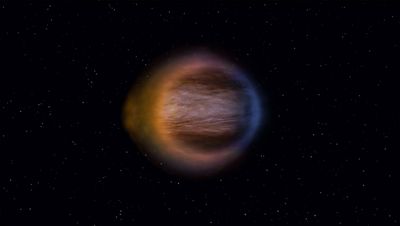


Astronomers have applied a new mapping technique to the atmosphere of a peculiar exoplanet. WASP-17b is a hot Jupiter, a gas giant orbiting extremely close to its star. So close, in fact, that the planet is tidally locked: one side is always in daylight, the other always in darkness.
Other hot Jupiters orbiting even closer have been deformed by the intense gravity of their parent star. For the close-but-not-too-close, there were open questions about the shapes of their atmospheres.
The “transmission string” method pioneered in this work tracked the planet as it passed in front of the star. The planet blocks some of the starlight, and its atmosphere filters some more. Thanks to the extraordinary sensitivity of JWST, researchers were able to spot changes in the atmosphere at different moments in its orbit.
This translates to seeing different regions of the atmosphere from different angles.
Researchers were able to determine that the atmosphere of WASP-17b is mostly circular but asymmetrical with a more extended side. Confirming the theoretical prediction, the work shows the effect of intense winds and incredible temperatures on a planet stuck half in light and half in darkness.
“This is proof of concept that planets are in fact 3D objects, and that consistently, as they go around their star, what we predict should be happening is happening. To move beyond computational exercises and see it for real is a different matter,” Dr Lili Alderson, from Cornell University, said in a statement.
On the “evening” side of the planet, there are jets of winds bringing heat to the night side of the planet. In that region, the atmosphere is inflated compared to the “morning” side of the planet.
“Planets are temperamental, their atmospheres complex and chaotic. The fact that all of these numbers came together and showed us this very structured, dynamical picture of this giant world over 1,000 light-years away was just really exciting,” co-author Dr Hannah Wakeford, Associate Professor in Astrophysics at the University of Bristol, explained.
“Theory predicts that the morning and the evening sides should have a strong temperature difference, and WASP-17b fits really nicely in that trend – pretty much bang-on what we thought it would be,” Dr Alderson added.
There are over 6,000 known confirmed exoplanets, and the number of candidate worlds is several times that. This technique opens a window to be able to understand the complexities of these distant worlds’ atmospheres.
WASP-17b, also known as Ditsö̀, has about eight times the volume of Jupiter while packing between three-quarters and half the mass. It is an extremely puffy planet, orbiting its star every 3.7 days, about 1,300 light-years from Earth.
The study is published in the journal Nature Astronomy.


 1
1