Space and Physics
 PUBLISHED





What you'll discover in this article...
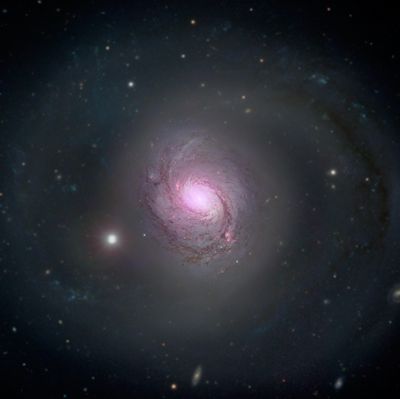
- A new paper has proposed an explanation for the odd properties of a cosmic neutrino emitter, the central black hole of a galaxy 35 million light-years away.
- The signal from this galaxy has been tricky to square with theory because it's stronger than what we would expect based on some of the galaxy's other properties.
- “Our main result is that the neutrinos must be produced in a very compact region close to the black hole,” lead author Abhishek Das told IFLScience.
Back in 2022, scientists from the IceCube detector in Antarctica reported evidence of neutrinos coming from the galaxy NGC 1068, also known as M77, or the Squid Galaxy.
From the beginning it was clear this source wasn’t like other cosmic neutrino emitters, because it had peculiar gamma-ray emissions that didn’t match expectations. Now new work presents an intriguing explanation for this galactic weirdness.
Neutrinos are also known as ghost particles because they have a tiny mass, no electric charge, and interact only through the weak nuclear force, allowing them to travel pretty much undisturbed through the universe. Almost nothing has an effect on them, and they have nearly zero effect on anything else. Every second, 100 trillion neutrinos from the Sun fly through each of our bodies, and we don’t even register it.
Neutrinos are produced in certain nuclear reactions, such as those happening in the cores of stars or in nuclear power plants. More unusual cosmic sources include supernovae and the environment around active supermassive black holes.
Our main result is that the neutrinos must be produced in a very compact region close to the black hole.
Abhishek Das
Before the IceCube detection, NGC 1068 was considered a possible source of neutrinos. The thinking was that bright X-ray sources, which NGC 1068 was known to be, should also produce plenty of neutrinos.
The observations from IceCube, though, left scientists puzzled. According to our best understanding of how high-energy neutrinos form, the strength of the gamma-ray emissions should roughly match the strength of the neutrino emissions. That was not the case here – the gamma rays were far weaker.
The edge of a black hole
To explain how NGC 1068 could be a “hidden” source of high-energy neutrinos, researchers looked at where and how these particles might be created.
“Our main result is that the neutrinos must be produced in a very compact region close to the black hole,” lead author Abhishek Das, from Pennsylvania State University, told IFLScience.
The supermassive black hole in question is about 8.6 million times the mass of the Sun, and its event horizon is about 50 million kilometers (30 million miles) across. Half of this value is known as the Schwarzschild radius.
According to this work, which challenges a previous suggestion, the neutrinos are produced in interactions involving protons. These are either collisions between two protons (proton-proton interactions) or between protons and very energetic light (proton-photon interactions).
If it’s the former, it would happen in a region tens of times the Schwarzschild radius; if the latter, between 3 and 10 times. These distances are comparable in size to the planetary orbits of the solar system, and while that is big for us, it is tiny when it comes to the sphere of influence of black holes.
The black hole is surrounded by a donut of material that measures between 7 and 13 light-years across. The source of neutrinos, by contrast, might be only light-minutes to a couple of light-hours away from the black hole. Its size is consistent with another feature near the black hole: its X-ray corona, the source of its powerful X-ray emission.
“[The neutrino source region] is comparable to the expected size of the X-ray corona. X-ray observations suggest a corona of order ten Schwarzschild radii, so the scale inferred from the neutrino and gamma-ray data naturally points toward the corona as the likely site of neutrino production,” Das told IFLScience.
Blame it on magnetic fields
The corona isn’t just the right size. The team suggests that strong magnetic fields there are crucial too. In a highly magnetized region, much of the energy that would otherwise come out as gamma rays is instead released as lower-energy radiation – which would explain why the gamma rays are so faint.
“The picture that best fits the data is that high-energy protons are being accelerated in or around the X-ray corona close to the supermassive black hole. They then interact with either the intense radiation field or surrounding matter to produce neutrinos,” Das told IFLScience.
“We cannot yet determine exactly which acceleration mechanism is operating, or whether proton-photon or proton-proton interactions dominate, but the observations point toward the immediate magnetized environment of the black hole as the origin of the neutrinos.”
The work showcases the incredible physics involved in studying neutrinos. The principal investigator of IceCube, Francis Halzen, won the Nobel Prize in Physics just last week.
A paper describing the results was published in The Astrophysical Journal Letters.