Space and Physics
 PUBLISHED



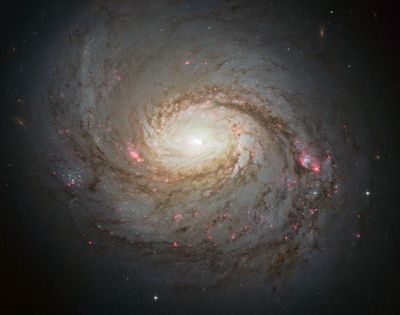


Messier 77 is a galaxy known to emit a lot of neutrinos, the ghostly particles that can easily pass through a planet. There are other galaxies whose neutrino release can also be detected on Earth, but Messier 77 emission is like no other. Researchers have now got a potential explanation for what’s going on.
The galaxy, also known as NGC 1068 or the Squid Galaxy, is a barred spiral galaxy located 47 million light-years away. Neutrinos are fundamental particles with no electric charge and with a mass so small, we are not exactly sure what it is. They only seldomly interact with matter, that why every second, a constant stream of trillions of neutrinos coming from the Sun passes through your body, without you being aware.
Large detectors such as IceCube in Antarctica can snap the occasional interaction and work out where the neutrinos come from. Since they have no charge, they move in a straight line from their source. Neutrinos from active galaxies are usually generated in the active core, where a supermassive black hole is feeding and creating a powerful jet. In the interaction between protons in hydrogen atoms and light, neutrinos and gamma rays end up being produced.
But the Squid Galaxy is an odd one. The gamma-ray emission is a lot lower compared to the neutrino emission. The team suggests that helium too can be accelerated in the jet of a supermassive black hole, and when those atoms crash into photons, the particles of light, protons and neutrons in the helium atom can be disrupted.
The free neutrons are unstable and they decay, releasing neutrinos without a strong emission of gamma rays like other galaxies. If this is the case, the team might uncover a novel insight into the extreme environments surrounding supermassive black holes.
“Hydrogen and helium are the two most common elements in space,” first author Koichiro Yasuda, from the University of California Los Angeles (UCLA), said in a statement. “But hydrogen only has a proton and if that proton runs into photons, it will produce both neutrinos and strong gamma rays. But neutrons have an additional way of forming neutrinos that doesn’t produce gamma rays. So helium is the most likely origin of the neutrinos we observe from NGC 1068.”
“We don't know very much about the central, extreme region near the galactic center of NGC1068,” added co-author Professor Alexander Kusenko, from UCLA and a Senior Fellow at Kavli IPMU. “If our scenario is confirmed, it tells us something about the environment near the supermassive black hole at the center of that galaxy.”
This work once again showcases the revolution that is happening in astronomy. With the detection of neutrinos from beyond the solar system as well as the observations of gravitational waves from a variety of sources, we are now in the era of multimessenger astronomy. It is not just light anymore.
“We have telescopes that use light to look at stars, but many of these astrophysical systems also emit neutrinos,” said Kusenko. “To see neutrinos, we need a different type of telescope, and that's the telescope we have at the South Pole.”
A paper describing this mechanism is published in Physical Review Letters.