Space and Physics
 PUBLISHED


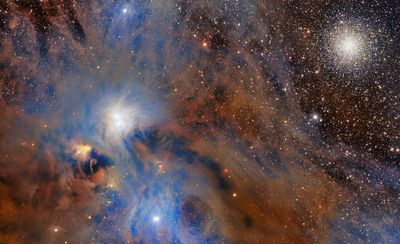


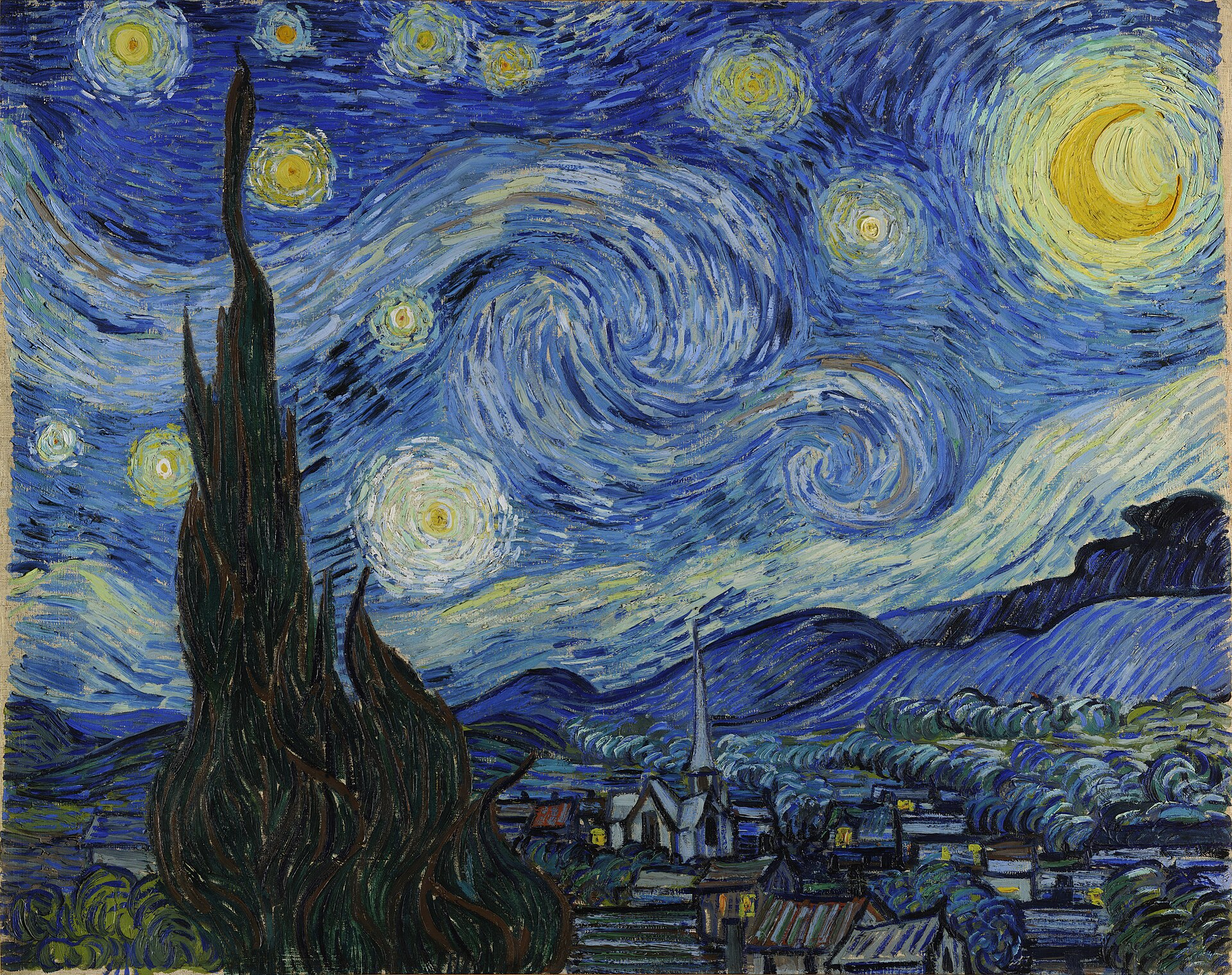
Astronomers pointed the 570-megapixel Dark Energy Camera at one of the nearest star-forming regions to Earth and took a beautiful image of nebulae, stars, and star clusters from the Southern Hemisphere. They compare the composition to Van Gogh’s post-impressionist masterpiece The Starry Night, and the analogy is pretty spot on.
While in the painting, the stars tremble due to air turbulence that makes clouds swirl, in this particular cosmic object, it is the stars themselves that influence a large and important nebula: the Corona Australis Molecular Cloud.
At just 430 light-years away, it's one of the closest star-forming regions to the Sun, which is just peanuts in celestial terms. In the massive nebula, new stars are being formed, some of which have now been able to push the gas that blocks our view away and become visible to us.
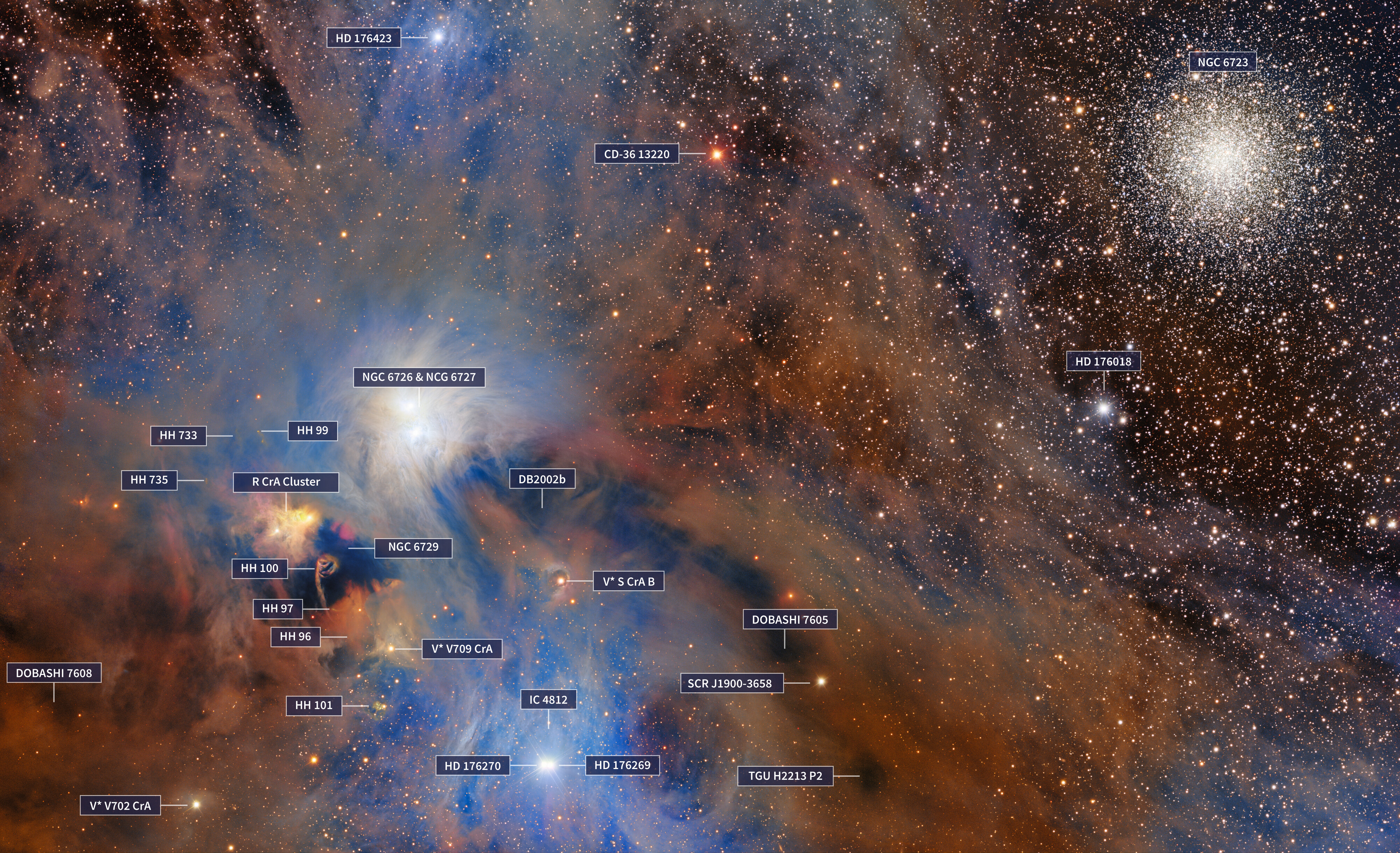
The whole system is in the constellation Corona Australis (the southern crown), and two of the most prominent nebulae within the Molecular Cloud are being illuminated by the baby stars in question: R Corona Australis.
R Corona Australis is a binary system, and the two stars are a fair bit apart, going around each other every 43 to 47 years. The smallest of the two is a red dwarf. This class of stars is the smallest of all the hydrogen-fusing stars as well as the coolest (in terms of temperature but they are also pretty awesome) and the ones that live the longest.
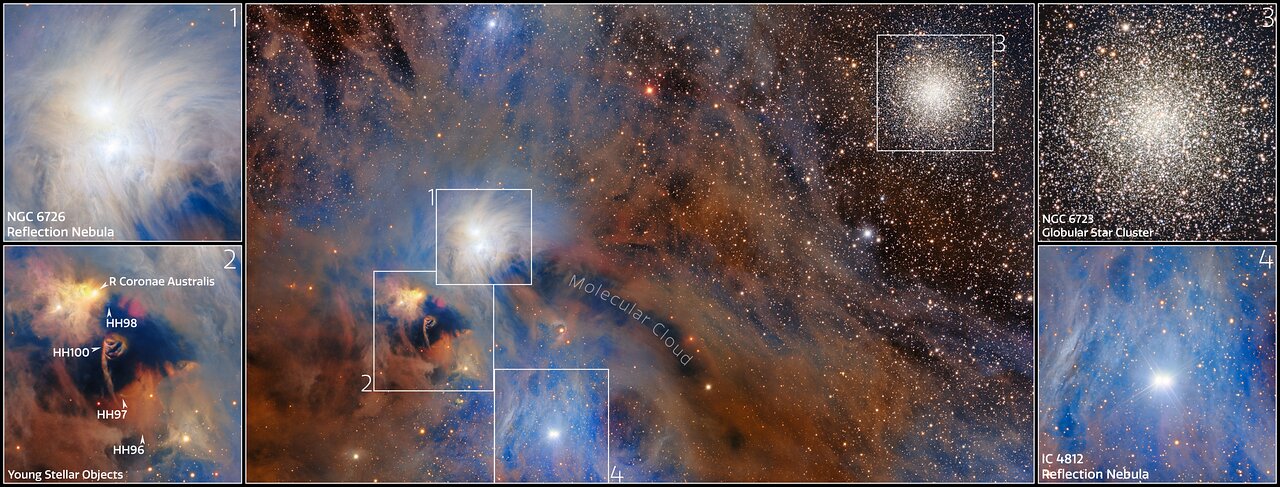
Its companion is, instead, a more massive star, but despite having accumulated almost all of its mass, it has not yet begun fusing hydrogen at its core. It is a pre-main-sequence star. Only once its core starts fusing will it become a fully fledged star.
Still, its light is energetic enough to make the celestial cloud around it glow. That area is known as emission nebula NGC 6729. There are many more baby stars and glowing nebulas around the system. It wouldn't be much of a stellar nursery with just one new star.
The other brilliant – quite literally – subject of this photo is the globular star cluster NGC 6723, AKA the Chandelier Cluster, seen in the top right of the image.
Shining brightly to the side of the Corona Australis Molecular Cloud, this collection of stars features between tens of thousands and millions of members. Many of them are also pretty young stars.
Despite the apparent proximity in the sky, it is completely unrelated to the Corona Australis group. NGC 6723 lies much farther away, about 29,000 light-years from Earth.
The spectacular picture was taken with the 570-megapixel Dark Energy Camera mounted on the NSF Víctor M. Blanco 4-meter Telescope at Cerro Tololo Inter-American Observatory in Chile. It's not the only observatory that has captured this part of the sky recently.
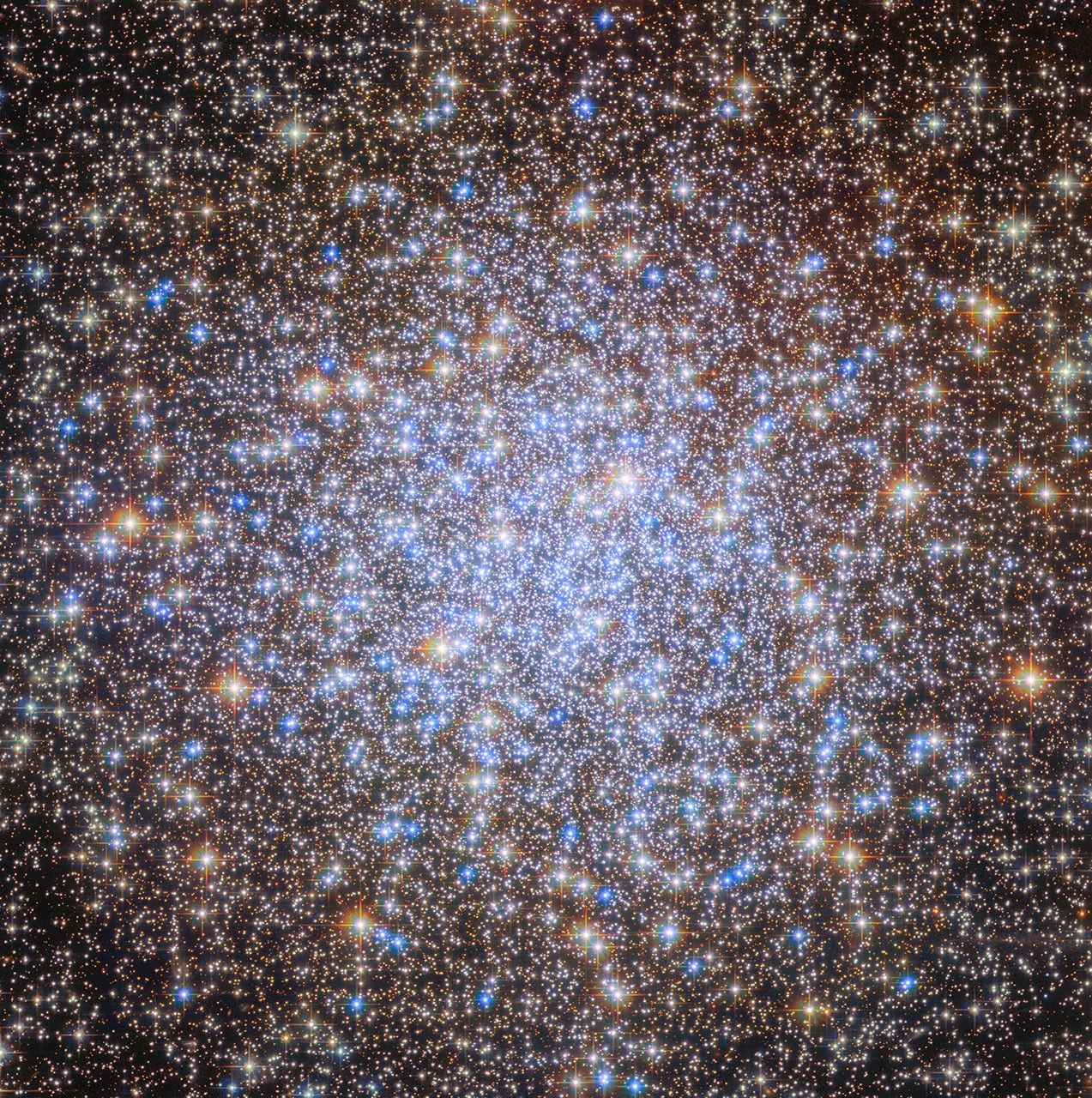
Hubble recently delivered this stunning image of NGC 6723. Astronomers used to think all stars in globular clusters formed at the same time in one go and so would all be the same age. Now, thanks to Hubble we know they are much more complex.
Globular clusters like NGC 6723 have some of the oldest stars in the galaxy. Their ages can exceed 10 billion years, nearly as old as the universe itself.