Space and Physics
 PUBLISHED




What you'll discover in this article
- This is the first exoplanet to have an atmosphere detected directly, a necessary condition for life as we know it.
- This could be the closest we've got yet to finding a planet that could support life.
- Co-author Dr Shreyas Vissapragada stressed to IFLScience the excitement around the discovery, while there is “a lot left to learn.”
One of the biggest quests in the search for life beyond Earth is looking for planets like our own. This is easier said than done for several technical and physical reasons, but since the discovery of the first exoplanet over three decades ago, we have made leaps forward. A further leap comes now, with an exciting new discovery.
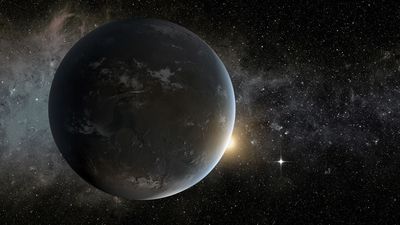
Astronomers have been familiar with exoplanet LHS 1440 b. It is a rocky world with a radius 1.73 times that of the Earth and a mass 5.6 times larger. It goes around its star in just 24.7 days, but since that very star is a lot weaker than our Sun, this super-Earth is within the habitable zone.
I want to be super clear that we have a lot left to learn!
Dr Shreyas Vissapragada
A hint of a potential atmosphere had been captured before, including with JWST, but now researchers report the best evidence yet.
Using the ground-based Magellan Clay telescope at Carnegie’s Las Campanas Observatory, astronomers report the detection of a helium leak from the planet. And most excitingly, the emission is variable.
“We observed helium escaping from the upper atmosphere of this exoplanet in 2024, which is a strong indication of an atmosphere on a rocky, habitable-zone exoplanet,” co-author Dr Shreyas Vissapragada, from Carnegie Science, told IFLScience.
“The helium detection in 2024 indicated that the atmosphere is present, whereas the non-detection in 2025 indicates that it is changing.”
The team believes that the helium emission is due to stellar X-rays and extreme ultraviolet light from the star.
Red dwarfs such as this are a lot more active than our Sun, which raises questions about the habitability of planets around these stars. These are the most common stars in the galaxy, so it is a big deal.
The question of habitability is certainly on the mind of the researchers. The presence of an atmosphere is a necessary condition for life as we know it, but it is not the be-all and end-all.
There are too many unknowns yet about the possible chemical species that might be present or absent, and the researchers obviously do not want to speculate on hypotheticals.
“We don't know enough about the lower atmosphere of the planet yet to even know the full story of what species the atmosphere is made of, let alone knowing anything about the surface (or lack thereof) or the presence or absence of liquid water,” Dr Vissapragada told IFLScience.
“I want to be super clear that we have a lot left to learn!”
In fact, the team is already planning follow-up observations to continue to characterize the changes in helium from this world. That alone might provide some important insights into the planet and its relationship with its star.
“At the very least, we'd like to continue following the planet up with helium observations to try and understand the variability a bit better, and figure out what the atmosphere is changing in response to,” Dr Vissapragada told IFLScience.
Will this work still happen in the future?
Dr Vissapragada is part of a team led by Harvard University’s Collin Cherubim. Vissapragada stresses the importance of ground-based astronomy, which was pivotal in this work.
We can actually do a lot with facilities we already have on the Earth as long as we are creative with our experimental designs.
Dr Shreyas Vissapragada
This comes at a particular moment where we are years away from the coming online of a new class of telescopes such as the Extremely Large Telescope and the Giant Magellan Telescope. They might be able to directly image rocky exoplanets.
On the other hand, the increase in light pollution from space satellites places ground-based astronomy in jeopardy.
“This particular measurement was enabled by a new high-resolution spectrograph that was installed on one of the twin Magellan telescopes, and demonstrates that we can actually do a lot with facilities we already have on the Earth as long as we are creative with our experimental designs,” Dr Vissapragada told IFLScience.
The quest for an Earth twin continues, but thanks to skill and dedication, astronomers continue to push the envelope on what insights we can glean into distant worlds. An exoplanet with an atmosphere within the habitable zone of its star is a phenomenal discovery.
The study is published in the journal Science.