Space and Physics
 PUBLISHED
 5
5



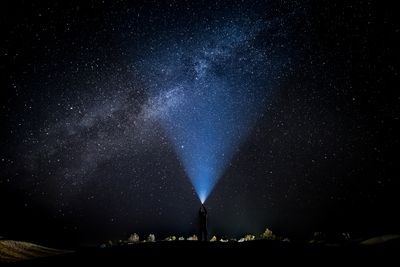


The United States’ Federal Communications Commission (FCC) has approved Reflect Orbital’s plan to place a reflecting satellite into orbit that will bring sunlight to places on Earth that are in the dark. The startup hopes that this will be the first of as many as 50,000 mirror satellites in orbit.
The idea is that a thin steerable reflective mirror in space could be used to cast a five-kilometer (three-mile) wide beam onto the ground during nighttime. The company claims that this could then be used to provide sunlight for solar power plants and light up disaster areas at night.
The initial proposal generated around 1,800 comments, most of which were negative over concerns that such a satellite would create gross amounts of light pollution, produce dangerous conditions, and have a significant impact on Earth-based astronomy.
Light pollution affects the circadian rhythm and is detrimental to human health, as well as negatively impacting the natural behavior of both plants and animals, from turtles to tigers.
“We are calling on the FCC to require a full environmental review of these satellite proposals before granting approval,” Ruskin Hartley, CEO and Executive Director of Dark Sky International, told IFLScience ahead of this approval.
This has been ignored by the FCC.
Instead, the FCC approval reads, “The Communications Act states that it is the policy of the United States to “encourage the provision of new technologies and services to the public,” and Reflect Orbital’s demonstration satellite is an example of a potentially groundbreaking technology that the Commission has found is in the public interest to support.”
The American Astronomical Society (AAS) highlighted many risks that a mirror in space might have on people unaware of the space mirror, as well as the impact on astronomy facilities.
“AAS discussed the concerns of the astronomical community regarding this application for a single satellite, including the potential for eye damage to amateur astronomers looking through reasonably sized telescopes; temporary "flash blinding" of drivers and pilots; and negative impacts on the scientific research being carried out by federally funded astronomical facilities,” Dr Roohi Dalal, Deputy Director of Public Policy of the AAS wrote to the FCC.
But the FCC disagrees with those risks. It also states that evaluating the risks is, actually, beyond the scope of the FCC anyway. Which begs the question of who, if not the FCC, should be assessing these risks?
“We find the risks of harm raised on the record regarding Reflect Orbital’s solar reflector are unrelated to the Commission’s role in authorizing use of radiofrequency spectrum, and even if the Commission had authority to review and condition these operations (which it does not), these harms are unlikely to occur,” the FCC writes.
This comes in the wake of a detailed analysis of the impact of this proposed constellation published in a new paper just last week, and a presentation at the European Astronomical Society annual meeting.
One of the biggest problems is that light doesn’t stay localized when it passes through the atmosphere. As any curious child who has asked why the sky is blue knows, sunlight scatters. This means that any satellite reflecting sunlight down onto Earth at night will brighten the sky far and wide.
Olivier Hainaut conducted simulations showing a variety of scenarios.
The Reflect Orbital proposal of 50,000 mirror satellites would bring more light to literally everywhere on the planet. Dark sky sanctuaries will be as bright as suburbs, and the few stars visible in cities will be gone. Astronomy from the ground might become impossible.
“Disastrous can mean that we lose 100 percent of our data; basically, it kills the telescopes,” Hainaut told IFLScience at the time.
This is only one approved satellite, but it sets a precedent of what’s allowed by a single company of a single nation to do in space, despite it potentially affecting everyone on this planet.
And it’s not like the United States has no stakes in the cutting-edge astronomical research, either. The revolutionary Vera Rubin Observatory’s Legacy Survey of Space and Time has just started. The Extremely Large Telescope and the Giant Magellan Telescope are under construction, with the promise of seeing better than any other telescopes before (and maybe even directly imaging an Earth-sized world!).
The potential of these ground-breaking projects might never be realized if clear regulation for space satellites is not brought in.
Reflect Orbital's first satellite, Eärendil-1, is expected to launch in the coming months.