Space and Physics
 PUBLISHED
 4
4




It often comes as a surprise that outer space is not as regulated as many people think. The extent of space laws is found in the Outer Space Treaty, a two-page document from 1967 that regulates the activity of states beyond the Earth. "States" is a pretty important word there, as the changes happening in outer space today are mostly driven by private corporations.
In the United States, it is up to the Federal Communications Commission (FCC) to authorize satellite launches and operations. The agency is now looking at two proposals that could massively affect the night sky. One is mirrors in space that would reflect sunlight on demand during the night. The other, from Elon Musk’s SpaceX, is an unprecedented request for a 1-million-satellite megaconstellation.
Either proposal would affect the natural darkness of the planet in dramatic ways. In recent years, due to LEDs and the exponential growth of the number of satellites in orbit, light pollution has increased faster than thought. Light pollution affects plants and animals, and it has also been linked to an increasing variety of human health conditions, including Alzheimer’s disease.
We consider this proposal to be the single greatest threat to space sustainability in history.
Dr John C. Barentine
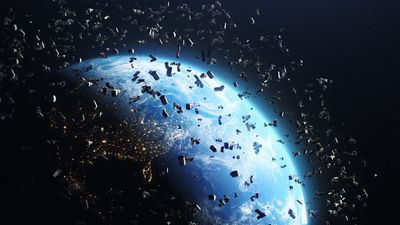
Beyond our health, and the health of plants and animals on which we depend, satellites in space also affect astronomy. Advanced observatories have seen satellite streaks photobomb their observations, and even telescopes in space are not safe. There are over 18,000 satellites in orbit at the moment, and more are being added every day.
Even if we were to disregard human health and astronomy and focus exclusively on the importance of space exploration, this proposal would be seen as a threat. Previous research suggests that there are serious safety and long-term sustainability challenges in the current approach of just sending satellites into space. There is also the constant risk of sparking Kessler Syndrome.
Objects in orbit move fast, several kilometers per second. The more objects there are, the higher the chance they will hit each other. The idea behind Kessler Syndrome is that a single collision in space would create debris and that debris would create more collisions, leading to a cascade where the debris field would make it impossible to be in, and maybe even to cross, that area of space.
In the first six months of 2025, Starlink satellites performed 144,404 conjunction risk mitigation maneuvers. Each satellite had to perform several dozen of these orbital changes. With a 100-fold increase in the number of satellites from SpaceX alone, these numbers would have to grow dramatically.
“The SpaceX proposal is a fundamentally different issue than everything else we have encountered to this point in the story of rapidly rising commercial activities in space. From the space environmental perspective, we are most concerned about the orbital debris situation this proposal represents,” astronomer Dr John C. Barentine, co-founder of the Center for Space Environmentalism, told IFLScience.
Musk has stated that the goal of the constellation is to create an orbital data center to power its current AI needs. Musk’s AI is called Grok, and it has recently faced global scrutiny by government and regulators as it was used to create sexualized deepfakes of women and children. Google's CEO also wants a data center in space to harness solar power for its enormous energy requirements.
[China is] kind of quite specific about the fact that it's not so much they're putting data centers in space because that's a better place for data centers to be.
Russell Hills
There are many challenges when it comes to data centers in space, beyond the launch of an enormous number of satellites. An actual test is happening in China, with the Chinese government launching, last June, its Three-Body Computing Constellation. This constellation aims to assess the capabilities of an in-orbit data processing center.
“They're kind of quite specific about the fact that it's not so much they're putting data centers in space because that's a better place for data centers to be. It's because there is a need for data centers and AI to be in space to work on space-based data,” Russell Hills, a spacecraft systems engineer, told IFLScience a few months ago.
Basically, the AI is there to do analysis on space data. Instead of sending a lot of data down to be refined by an AI to produce a useful output, the space AI does the analysis in orbit and only sends down the useful stuff, freeing bandwidth and consuming fewer resources. At least, if it works.
There are also wider environmental issues. Satellites tend to be sent back into the atmosphere to burn up. One million satellites burning up could affect our atmosphere in ways we do not yet understand. There is also the plan to possibly push some of the satellites into dead orbits, massively increasing the amount of space junk. And there's the problem of the launches themselves.
“To the extent that supplying and maintaining a population of so many objects would require potentially dozens of launches per day sustained over many years, there are real risks to the atmosphere in terms of emissions of black carbon, water vapor, and other substances,” Dr Barentine told IFLScience. “As a result, we consider this proposal to be the single greatest threat to space sustainability in history.”
The concerns are very real. DarkSky International is asking people to submit comments about the proposal to the FCC, and has prepared a guide on how those public comments can be submitted.
“We are calling on the FCC to require a full environmental review of these satellite proposals before granting approval. Submitting a comment is one of the most direct and effective ways to take action and ensure your voice is heard at this critical moment for the future of the night sky,” Ruskin Hartley, CEO and Executive Director of Dark Sky International, told IFLScience.
It has been highlighted that the current chair of the FCC, Brendan Carr, is an ally of Elon Musk. The comments might not stop the approval of the process, but they are still deemed important in the long term fight to protect darkness, astronomy, and access to space.
“All US policymaking in this realm is right now being made in agencies like the FCC, not by Congress. Even the courts are of comparatively little use as there isn’t a great deal of case law about these kinds of uses of space that may guide judges’ decisions, and many judges may not want to interfere in what they think should be matters left to the legislative branch,” Dr Barentine explained to us.
“The FCC will act on the shortest timescale, and it wields great influence in terms of how companies like SpaceX will ultimately act. So FCC comments are where, for now, the public has the greatest influence over regulatory decisions. And if litigation ultimately results from this or any other space activity, FCC comments form part of the public record on which court cases may depend.”
There have been more calls for an update to the Outer Space Treaty in recent years, to better regulate what goes up in space. Space is above all our heads, and the decision of a single country, a single company, a single billionaire, may end up affecting all of us.