Space and Physics
 PUBLISHED




The presence of a third star in the Theta Eridani system has been used to explain why what currently looks like a very undistinguished star to the naked eye was once considered among the brightest in the sky. In work yet to pass peer review, two authors propose material being drawn from one star to another was heated by orbital dynamics so much it outshone both its star of origin and its destination.
When Ptolemy cataloged the brightest stars in his Almagest almost 1,900 years ago, he put familiar names like Sirius and Vega in the top 13, but included Theta Eridani (also known as Acamar) as well. Today it does not even make the top 100.
Some have suggested mistaken identity or a transcription error, but Hipparchus had referred to Theta Eridani as particularly bright eight years earlier, although without ranking it. Eight hundred years later Abd al Rahman al-Sufi’s The Book of Fixed Stars also described Theta Eridani as close to the brightest.
By 1598, however, Theta Eridani was classified as just another third magnitude star, similar to how we see it today. The invention of the telescope quickly revealed a double star, which amateur astronomers today enjoy “splitting” – that is, seeing the two distinctly. However, as both appeared be stable, that didn’t explain the ancient reports.
Now, however, an answer to the mystery has been offered in the form of a third star, so close to the brighter of the two visible components that its light was only recently separated.
Evidence for a third member of the system was reported more than a century ago, based on spectral lines from Theta Eridani A inconsistent with two stars rapidly circling each other.
Dr Idel Waisberg and Professor Boaz Katz of the Weismann Institute of Science noted that the difference between Ptolemy’s ranking and modern assessments is the largest of any of the stars in the Almagest. They argue it once really was that bright, and the explanation lies in interactions between the two close components, which they call Aa and Ab, although small letter designations are more often given to planets.
Based on observations using both space and ground-based telescopes, Waisberg and Katz conclude the components of Theta Eridani A are about a 12th as far from each other as the Earth is from the Sun. Both are also bigger and more massive than the Sun, leaving little space between them.
Moreover, the pair argue, Theta Eridani Aa has just passed the transition point between being a main sequence star, fusing hydrogen in its core, and the subgiant phase where fusion occurs in a surrounding shell.
Until recently, Waisberg and Katz conclude, the stars’ mutual orbit was more eccentric than it is now, bringing the stars together and pulling them apart around every four days. Theta Eridani Aa was so puffed up enough from its fusion shift that during their close passages, material would have flowed to its companion. The orbital energy between the stars would have been transferred to the material moving between the two, causing it to become very bright.
Despite the authors estimating only about a 20th of the Sun’s mass moved between the stars, over the period in which this occurred they think it emitted more light than either of these large stars, let alone the Sun.
Naturally, such brightness cannot be sustained. Tidal dissipation of energy rounds highly eccentric orbits, and as this happened the authors argue the stars stopped coming close enough for mass transfer. As a result, the system faded to the brightness we would expect of three stars if they were of the same mass, age, and distance as the Theta Eridanus system, but were not interacting in such an unusual way.
Stars suddenly brightening because of mass transfer within a system is a common phenomenon, causing novae, but usually it takes place between a main sequence star and a white dwarf. Moreover, that enhanced brightness usually lasts weeks or months, not close to a thousand years, so if the explanation is right, it’s something we have not seen before in this form.
Waisberg and Katz acknowledge Theta Eridani would have been at the observed brightness for only about a millionth of its roughly billion-year age.
“Therefore, it is hard to escape the fact that this was a rather remarkable event to happen within one of the ∼ 1,000 naked eye stars, especially considering that only a small minority of them are close eccentric binary systems that would be susceptible to our proposed mechanism,” they write.
Nevertheless, they argue that all previous explanations for the described brightness are even less likely, and propose a search for more distant stars engaged in a similar dance.
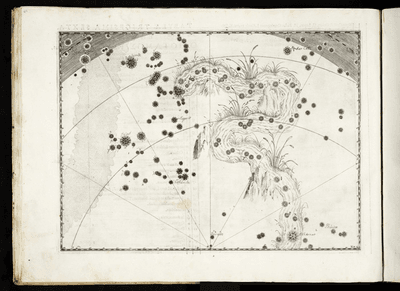
When Ptolemy wrote the Almagest, Acamar was the only thing that saved Eridanus (the river) from being an undistinguished constellation, far outshone by its neighbor Orion. Later, as European explorers ventured further south, they added Achernar, invisible from most of the northern hemisphere, to the constellation and designated it Alpha Eridani.
It’s not clear why Theta Eridani, now approximately equal second in brightness, was given the eighth letter in the Greek alphabet when formal designations were made – perhaps for a time it was fainter than today.
Among the fainter stars vaulted to an earlier letter than Theta is Epsilon Eridani, which has become famous because, at 10.5 light years away, it is one of the closest stars to be sufficiently sunlike to raise hopes of habitability.
The preprint of the paper is available open access via arXiv.