Space and Physics
 PUBLISHED



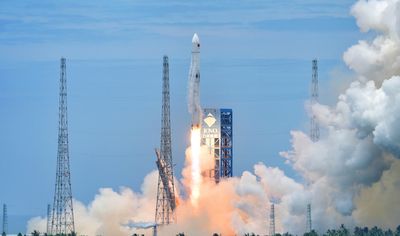


China's Long March 10B rocket had its inaugural launch today, successfully taking its payload to low Earth orbit (LEO) and, on top of that, landing intact on a floating platform, ready to be used again.
Long March 10B is the first Chinese reusable, orbital-grade rocket that has achieved a safe landing. In this inaugural flight, its first stage flew up into the atmosphere before coming back down and landing vertically within a "net capture" structure on a boat.
According to the China Aerospace Science and Technology Corporation (CASC), a state-owned company that is the main contractor for Chinese space operations, the launch took place at the Hainan Commercial Space Launch Site at 12:15 pm Beijing time.
Hainan is an island and the southernmost province of China, located in the South China Sea. The first stage of the rocket and the second stage separated after 6 minutes before descending to earth.
“The rocket, in its maiden flight, sent the payload into the preset orbit," a CASC press release reads.
"After the separation of the rocket's first and second stages, the first stage returned and was successfully captured on a seaborne platform via a net-capture system. Both the launch and the first-stage recovery were successfully completed.”
“This mission marked China's first successful controlled recovery of a carrier rocket's first stage, representing a major breakthrough in the country's reusable rocket technology.”
Before this, only two other companies, SpaceX and Blue Origin, had successfully landed an orbital-grade rocket vertically. SpaceX’s Falcon 9 fleet has been reused in this way hundreds of times by now, resulting in reduced costs for sending material into orbit. China is now aiming to emulate that success.
The Long March-10B is 63 meters (207 feet) tall and has a diameter of 5 meters (16.4 feet). That's shorter and wider than the standard configuration of the Falcon 9, giving it a comparable LEO payload capacity of 16 metric tonnes (17.6 tons) in reusable mode.
SpaceX is supposed to retire Falcon 9 once Starship becomes fully operational, although given the many setbacks experienced by the vehicle, that might not be for a while yet.
Long March 10B isn't the only reuseable rocket in the works at CASC. Two more, Long March 12A and Zhuque-3 (built and operated by Beijing-based company Landspace), launched successfully last December but didn't make it back to the ground.
Another potentially reusable rocket, Long March 12B, had its first launch at the start of June but did not attempt a landing.
Other Chinese companies are planning their own reusable rockets, which could make the market there extremely competitive for access to space, should they succeed in actually sending them up and landing them back down again.
The first stage of this particular Long March 10B rocket is expected to be reused in a launch by the end of the year.



 1
1