Space and Physics
 PUBLISHED


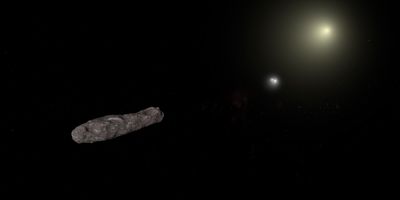


Just over a year ago, interstellar comet 3I/ATLAS was discovered. It was seen crossing into the inner Solar System and into our hearts. The comet has delivered and continues to provide insights into what was it like to be formed around a much older star than the Sun. It also raised a question: does the Sun produce its own interstellar objects?
The answer is yes, and some might be like boomerangs. Scientists are calling them quasi-interstellar objects.
In a new paper that is awaiting peer review, researchers look at the possibility of the Sun throwing its own interstellar objects (ISOs) into space before they make their way back into the Solar System. Such a possibility was raised after the discovery of the very first ISO, 1I/’Oumuamua, though it turned out to be a real interloper from across the stars.
What would be the chances of us seeing a quasi-ISO instead of a true ISO? Could we distinguish between them, were we to eventually discover them? There are answers to both questions.
The team’s statistics rely on certain assumptions about the Oort cloud, the region around the Solar System where most long-term comets come from. The main assumption based on other statistical considerations is that about 95 percent of all comets and asteroids created in the Solar System have been lost to interstellar space. We're talking about 10,000 trillion objects larger than a skyscraper.
They will eventually spread out in a stream that stretches around the galaxy, but the region of the Sun can continue to exert a gravitational pull. So, something can come back. But if it did, it would not look at all like an ISO.
The team estimates that quasi-ISOs are a lot slower than the speed that ‘Oumuamua, Comet 2I/Borisov, and 3I/ATLAS showed while crossing the Solar System.
“We show that quasi-ISOs are dramatically different from bona fide ISOs in essentially every way, which means that mistaking one for the other is very unlikely,” the authors wrote in the paper.
“The second reason to expect quasi-ISOs to be distinct in the observational sample is that quasi-ISOs are likely far rarer than ISOs.”
The number of pieces of the Solar System thrown into interstellar space is huge, but the fraction that comes back is much smaller. The number of objects from other stars is instead enormous.
The astronomers estimate that there is less than one of these quasi-ISOs within the orbit of Jupiter every year. So even the very exciting Legacy Survey of Space and Time (LSST) at the Vera Rubin Observatory that started just last week, which is expected to find several ISOs over a decade, is unlikely to discover one quasi-ISO.
“Quasi-ISOs are likely to be rare, and may be difficult to distinguish from the much larger population of nearparabolic Oort cloud objects, therefore we expect the positive identification of a quasi-ISO to be unlikely even with LSST,” the authors wrote.
There is also the risk that if we do find one such object, we might not distinguish it from the much more common long-period comets that travel from the Oort cloud following a disturbance.
The quasi-ISOs seem to be both rare and difficult to find, but knowing of the possible existence of them might be very useful in the future.
The preprint has the excellent title of “There and back again: the quasi-interstellar objects”, and it is available on arXiv.