Space and Physics
 PUBLISHED



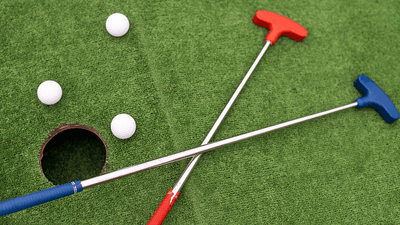


A YouTuber known as Constructive Chaos has constructed a miniature golf course (aka "crazy golf" in the UK) that makes it virtually impossible not to get a hole-in-one, using some fairly simple math.
Miniature golf is generally designed to be difficult, with features like an opening and closing clown mouth there to irritate you as your number of strokes mount up. As Lisa Simpson taught us, the basis of the game is simple geometry, which you can use to your advantage in what Bart declares to be the first "practical use for geometry."
Know enough about angles and have a straight enough shot, and you can significantly improve your score – or still end up hitting the clown in the chin.
But if you know a little about geometry and also have the advantage of building the course yourself, it turns out you can hit hole-in-one after hole-in-one while your ignorant, math-averse opponent sobs and gets double bogies. It all comes down to circles and their slightly squished friend, the ellipse.
Circles are easier to deal with, so let's start there. Creating a perfectly circular miniature golf green (with no hole) allows you to take advantage of the Awesome Power Of Circles.
In a circle, every point around the edge is the same distance from the center, as you are likely perfectly well aware. You may also be aware of the law of reflection. This is the rule that when a ray of light reflects off a surface, the angle of incidence (the angle between an incoming wave and an imaginary line drawn perpendicular to the surface the light hits) is equal to the angle of reflection.
The great thing about circles is that if you place a ball at the center and hit it in any direction, the angle of incidence is 0 degrees. As such, the angle of reflection is also 0 degrees, meaning that you can hit the ball from the center in any direction and the rebound will always pass back through it (ignoring factors like spin and imperfections in the green, of course).
This isn't too useful for a golf course, though, as the hole and the tee would both have to be right in the center in order to guarantee holes-in-one, which is impossible. But here is where ellipses are useful.
Ellipses (for example, the path that planets trace on their orbit around the sun) have two focal points, or "foci."
"What's cool about these two points is that anything that bounces off the wall of an ellipse starting from the one focus will always end up at the other focus, no matter what direction you hit it," Constructive Chaos explained in a video.
"But it also makes it so that if you start anywhere other than the focus, then it's nearly impossible to hit it into the hole – if you're doing a bank shot."
So in order to create a mini golf course that makes it near-impossible to miss, all you need to do is create an ellipse and tee off from one focal point with the hole placed at the other. Smack the ball into a wall (not so hard that you induce an unpredictable bounce) and it is always going to end up plopping itself neatly into the hole.
That doesn't make a very good golf course, however. And worse, your opponent could simply tee off from the same position as you and achieve the same result. What you want to do, and what Constructive Chaos achieved, was to make the course more complicated by adding in a few more half-circles around the starting focus of the ellipse.
As well as making the course look less suspicious to a math-hating opponent, this retains the feature that it is practically impossible to miss if you start at one focal point. If you hit it right at the ellipse wall, it will go straight in, or you can hit it at the semi-circle, and this will put it on a path which will let it pass back through the focus and onto the ellipse wall, and again go straight in.
After a little tinkering around, the YouTuber was able to create a course that worked almost every time for himself, with the advantage that any unsuspecting opponent who placed their own ball away from the teeing focal point would find their shots missing the target nearly every time. Despite being reasonable at math, he was left with a little mystery at the end of it.
"It totally worked. But what's especially weird is that a lot of the time it didn't even cross over the middle focus, which is so strange because it would still make it in," he added. "I don't even know how to explain this. But it worked."
In short, if you want to cheat at mini golf, it is possible, but it involves a little geometry and creating your own course. Which still beats practicing, to be fair.