Space and Physics
 PUBLISHED



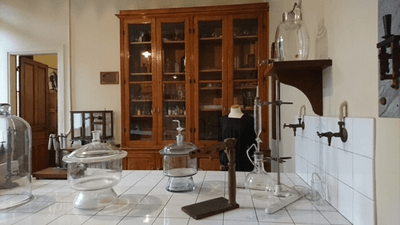


If you are interested in the history of science, Marie Curie’s lab is a definite attraction. As the first person to win two Nobel Prizes, Curie was one of the true scientific giants, and as an experimentalist there is much to see – not just the desk a theoretician would leave.
Moreover, you don’t need to go anywhere remote – it’s in central Paris in what is now called the Curie Museum.
There’s just one problem: Curie died of aplastic anaemia, almost certainly caused by radioactivity of the elements she discovered.
She was so radioactive when she died that her body was placed in a lead-lined coffin. Even Curie’s notebooks are still so dangerous you need special protection just to view them.
As the Christian Science Monitor archly noted, “Many library collections use special equipment, such as special gloves and climate-controlled rooms, to protect the archival materials from the visitor. For the Pierre and Marie Curie collection at France's Bibliothèque Nationale, it's the other way around.”
If that much radiation is still being released by the notebooks, you might understandably think the lab itself must also be a death trap. And yet today visitors can walk through it unconcerned.
As SciShow notes, “Today, you could wave a Geiger counter around [in the lab] and get almost no signal above background levels.”
A little of that safety is due to the passage of time. Every radioactive isotope has a half-life, and if the half-life is short, then most of the element will disappear within the space of a few years.
However, if all that was required to make the Curie Lab safe was to wait a few years, then you might think that the notebooks would be equally accessible.
Although some of the radium Curie worked on had a half-life of either 3.6 or 11.4 days, depending on the isotope, and would have largely vanished by now, most of it was radium-226. With a half-life of 1,600 years, more than 90 percent of any radium-226 that got stuck to items in the lab should still be around.
What Made The Curies’ Lab Dangerous
Marie and Pierre Curie discovered radium and polonium through the decay of uranium. But to get enough uranium, they needed to process one of its naturally occurring ores called pitchblende.
The uranium is what makes pitchblende radioactive, but it decays so slowly that you need a fair bit of it for it to become dangerous. Unfortunately, in order to get enough of the elements they were seeking to study, the Curies processed a lot of pitchblende.
This left them with elements that are much more dangerous. For example, radium is more than a million times more radioactive than the uranium whose decay produces it.
Nevertheless, the biggest dangers the Curies faced in the course of their work were neither radium nor polonium, but the element that comes in between.
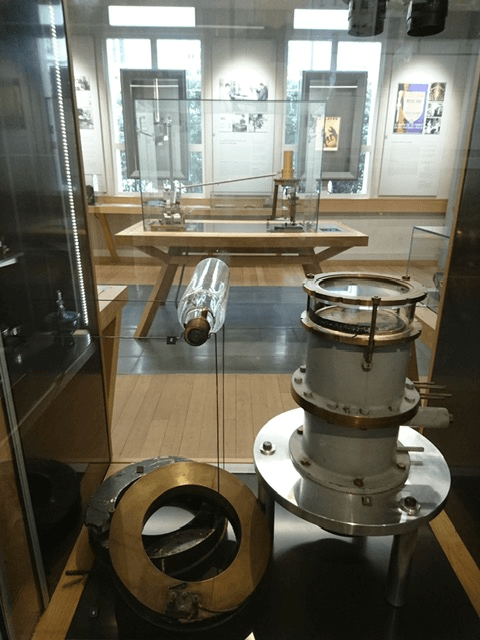
Radium-226 undergoes α particle decay to radon-222, which then becomes polonium-218 through the same process. Alpha particles are stopped by skin, so they mainly pose a danger when we breathe them in or if they get into food or drink. Radium and polonium are both solids at room temperature, and while dust particles sometimes get where they shouldn’t, most won’t end up inside you.
Radon, however, is a different matter. Discovered by Rutherford and Owens after following up on the Curies’ work, it’s a noble gas with a boiling point below 0°C (or 0°F, for that matter). This means it's gaseous at room temperature, and although radon-222 has a half-life of just 3.8 days, that makes it very easy to inhale.
It’s also colorless, odorless, and tasteless, so you won’t even know you’re consuming something you shouldn’t.
Once inside your lungs, the gas also undergoes α decay, and with nothing to protect your delicate internal tissues, the alpha particle causes havoc in surrounding cells. But that’s not even the end of the story, because there are still further decays before it eventually becomes lead-206, which of course also isn’t great to have in your body for other reasons.
The α decays from radium to radon, and from radon to polonium are also accompanied by gamma radiation. Gamma radiation is much harder to stop than alpha particles, and in many situations is the most dangerous form of radiation.
However, for radioactive sources inside the body, including radon that has been breathed in, it’s the alpha particles that do most of the damage.
The main issue with the lab space and the equipment, including Curie's notebooks, is that particles of radium had settled on them and become embedded. As the radium then decays over time, it is a constant source of new radon being released.
How The Lab Was Made Safe
When the Institut Curie realized how many people wanted to see the lab, it turned out that some of the work to make it safe had already been done for them. This is because Marie Curie did her most dangerous work not in what later became her official lab, but in a nearby shed which had already been demolished during her lifetime.
Nevertheless, the Curie lab was still too radioactive to expose the public to without risk.
The first move was to remove all the objects and furniture. This included the cabinets and workbenches, which couldn’t be decontaminated because the radium particles had worked their way deep inside the wood. Visitors might regret not being able to see the lab in its entirely natural state, but not nearly as much as they’d regret a dangerous dose of radiation.
Getting rid of the most dangerous objects is obviously good for the public, but you might wonder about the workers who undertook the clean-up. Were they effectively sacrificed like the firefighters who stopped the Chornobyl disaster? You won’t be surprised to know that the answer is no.
Hazard suits and other forms of personal protective equipment are little use against high levels of gamma radiation, but in a situation like this, where the danger came mostly from inhaling radon, they are highly effective.
Once removed, the items could then be treated with now-standard protocols for radioactive waste, which cover everything from spent nuclear reactor fuel to medical equipment only slightly too radioactive to dump in landfills.
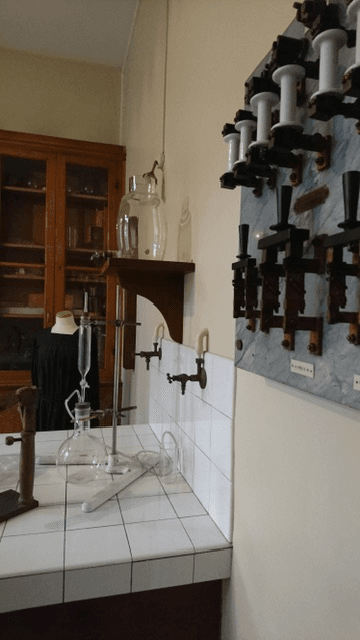
Items with impermeable surfaces could simply be cleaned, sometimes with arduous scrubbing, although in rare cases this was not done.
For example, Curie’s handprints remain on items such as doorknobs and are still very much radioactive, but at a rate low enough to pose less threat to visitors than a stratospheric airplane flight. The prints are valued for providing a direct link to Curie.
That left a limited number of items that were too precious to destroy, but unsuited to cleaning. The lab notes represent a perfect example. Solutions of radium salts or radioactive dust had fallen on them and become incorporated into the paper, which is still now steadily turning into dangerous radon gas. This is why these items have been kept in lead-lined boxes.
Those who want to see them must dress themselves accordingly and sign disclaimers, allowing them to reverently turn the pages of the genius whose work destroyed her.