Space and Physics
 PUBLISHED



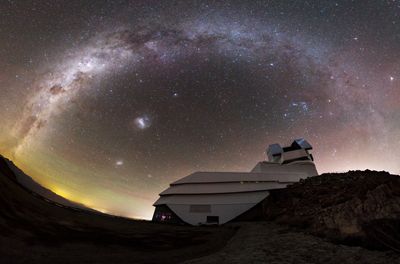


Last week, the Vera Rubin Observatory began its crucial work. For the next decade it will observe the night sky like never before, providing an enormous amount of data on transient phenomena like supernovae, discovering millions of new asteroids, and helping to solve some of the fundamental questions about the universe.
The team refers to the Legacy Survey of Space and Time (LSST) as a 10-year-long movie of the universe, and they're right.
The observatory is designed to repeatedly map the whole visible sky from Chile over the course of this decade with exquisite sensitivity.
“Rubin's Legacy Survey of Space and Time is unique because it combines capabilities that no previous astronomical survey has achieved simultaneously: wide sky coverage (half the sky), exceptional imaging sensitivity, and repeated observations over a decade,” Željko Ivezić, the Head of LSST, told IFLScience.
But how will this be done? Thanks to a clever technological setup and the world’s largest digital camera.
The observatory has an impressive 8-meter (26-foot) wide mirror, but its most innovative aspect is how it's designed to combine its primary and tertiary mirrors into a single surface. This is the first time this has been done, and makes it much easier to move. This is critical if you want to be constantly shifting "your eye to the sky".
In fact, the telescope has the fastest-moving mount of any large telescope, shifting position in just five seconds with minimal vibrations. So the telescope is quickly able to observe different parts of the sky.
.png "LSST Camera Deputy Project Manager Travis Lange shines a flashlight into the LSST Camera. The camera is a black cylinder much bigger than him")
But the beating heart of this observatory is its incredible digital camera. It has 3,200 megapixels, and it weighs 3,000 kilograms (6,600 pounds). This means each image will cover an area of the sky as wide as 45 full moons.
What’s groundbreaking, though, is the resolution. The images are so detailed that you could resolve a golf ball from around 25 kilometers (15 miles) away. To see the photos properly, you would need 378 4K ultra-high-definition televisions in a grid.
“Individually, none of these capabilities is unprecedented, but their combination is transformative,” Ivezić continued. “For example, the combination of wide sky coverage and imaging sensitivity will enable LSST to detect and characterize about 40 billion celestial objects.”
“For the first time, an astronomical survey will catalog more objects than there are people living on Earth.”
This incredible technological feat will truly be a game changer. While the data from the survey will be released yearly, millions of notifications will be sent out nightly whenever the observatory spots something odd in the sky.
Some of the exciting oddities that will be discovered are more interstellar objects (ISOs), like comet 3I/ATLAS. It is hoped that, with some luck, Rubin might find tens of them!
“Searching for ISOs is like looking for yellow-colored needles in a haystack – there are very few of them, they're small, hard to see, and from afar look just like stars or galaxies, and the haystack (the sky, in our case) is big,” a spokesperson for the observatory previously told IFLScience.
“The reason Rubin will be great at finding them is because it can image the entire visible sky to great depth, and do so repeatedly, allowing it to identify the one thing that makes objects passing through our Solar System stand out from the background: their motion. The combination of depth, width, and repeated observing makes Rubin a uniquely capable ‘ISO hunter.’”
Rubin was designed to revolutionize our study of space, and to truly appreciate this technological marvel we’ll just have to wait and see.