Space and Physics
 PUBLISHED



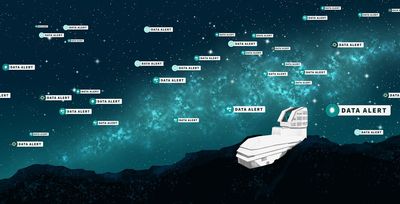


The Vera Rubin Observatory was designed to be a game-changer. Its 10-year-long Legacy Survey Of Space & Time survey is intended to see so much and record so many things it could revolutionize our understanding of everything from nearby asteroids to the mysteries of the universe.
It is also poised to give us unprecedented insights into transient events, objects and phenomena whose appearance in the night sky changes rapidly.
This week the telescope revealed its first real-time sky alerts, issuing 800,000 alerts for transient events in just one night, February 24, 2026. Some of these were variable stars – which go through changes in brightness – while others were supernovae or asteroids that suddenly appeared in its field of view.
The number is a testament to what the observatory can do, thanks to the largest digital camera ever created. And yet it’s just the beginning. The team plans to go up to 7 million alerts per night.
“The search for surprises is designed into Rubin: any instrument that surveys the sky this deeply, this fast, and this often is almost guaranteed to find phenomena we did not explicitly set out to look for,” a spokesperson at the observatory told IFLScience.
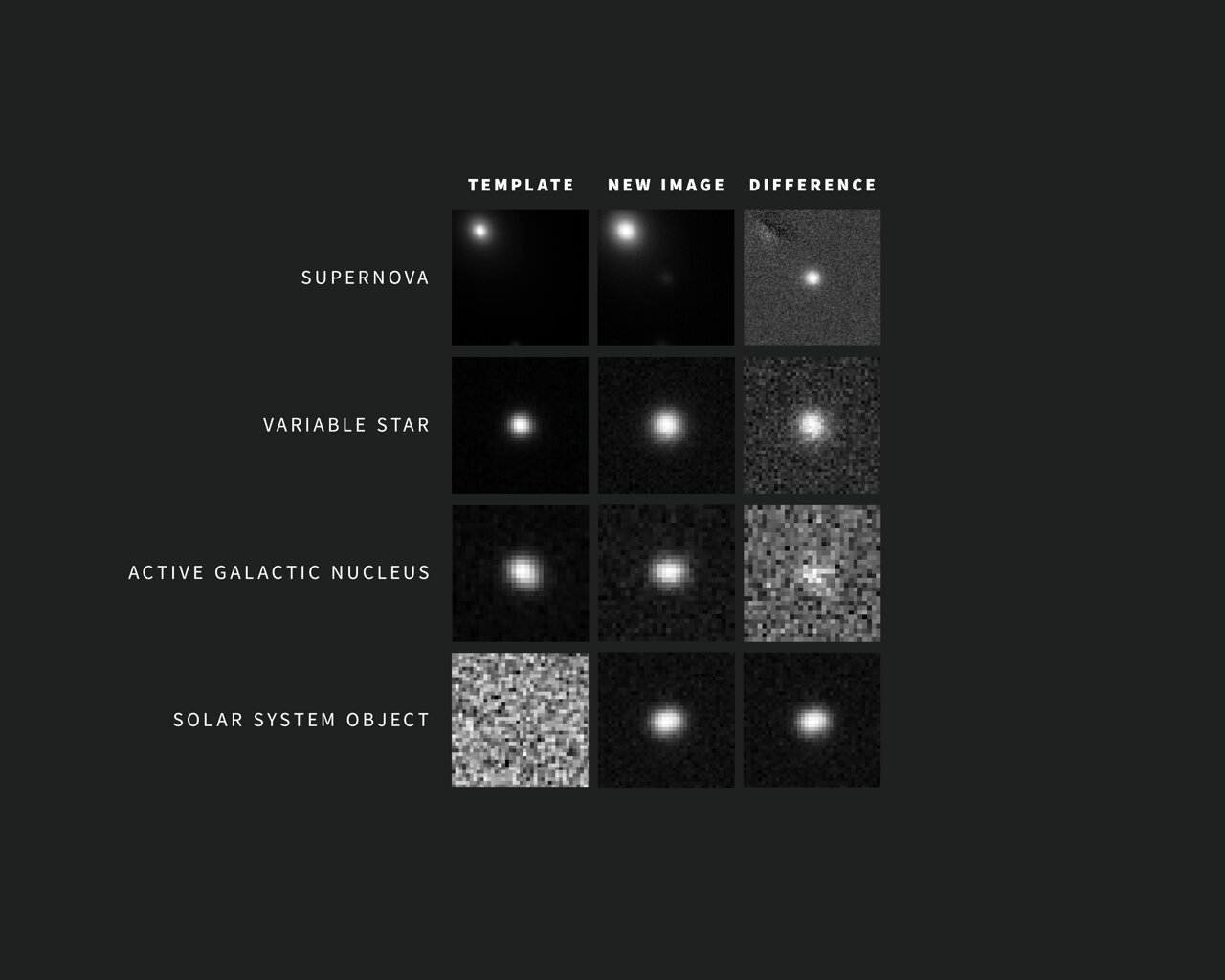
Rubin captures an image of a specific area of the night sky every 40 seconds. That data is sent to the U.S. Data Facility (USDF) at the SLAC National Accelerator in California, where it undergoes initial processing. Changes between a new image and an old one trigger an alert.
“The scale and speed of the alerts are unprecedented,” Hsin-Fang Chiang, a SLAC software developer leading operations for data processing at the USDF, said in a statement. “After generating hundreds of thousands of test alerts in the last few months, we are now able to say, within minutes, with each image, ‘here is everything’ and ‘go’.”
The system can recognize variable stars, supernovae, asteroids, and comets, as well as changes in active galactic nuclei, the bright cores of galaxies where a supermassive black hole is actively feeding.
“The extraordinary number of alerts that Rubin will produce presents an exciting challenge for both astronomers and software engineers,” explains Tom Matheson, Interim Director of the Community Science and Data Center (CSDC).
Rubin will see so many objects and events that even the rarest of them could become mundane. With an expected 40 billion objects and 30 trillion observations, oddities are commonplace. If an event or object has a one in a million chance to exist, Rubin will spot thousands. Even a one in a billion would deliver dozens of them!
“What’s revolutionary about Rubin is its ability to capture both rapid changes and long-term evolution in the sky,” explains Rosaria Bonito, a researcher at the Italian National Institute for Astrophysics (INAF) in Palermo, Italy, and co-chair of the Rubin LSST Transients and Variable Stars (TVS) science collaboration. “Young stars, for example, are highly dynamic and can experience sudden bursts of brightness caused by infalling matter. These events are often short-lived, and scientists can easily miss them without continuous monitoring. Rubin will allow us to detect these changes as they happen right there, right now, and also to track the evolution of stars over a decade.”
Observatories from around the world are ready to join in the search. The alert system is publicly available, so anyone, no matter their background, can access the data through the dedicated seven official community brokers, as well as two downstream services. For example, the Southern African Large Telescope (SALT) will follow up selected Rubin alerts.
“This is an exciting moment for South African astronomy,” Prof Rosalind Skelton, NRF-SAAO Managing Director, said in a statement. “Rubin Observatory is transforming how we discover dynamic events in the Universe, and SALT is ideally equipped to investigate them in detail, building on an existing highly successful transient programme. Our ability to respond quickly to these alerts ensures that South Africa will play a leading role in the scientific return from this global endeavour.”
Many telescopes will follow suit. Rubin will also collaborate with citizen science platforms such as Zooniverse, so anyone in the world can contribute to the incredible science that will come from this telescope.