Space and Physics
 PUBLISHED
 1
1



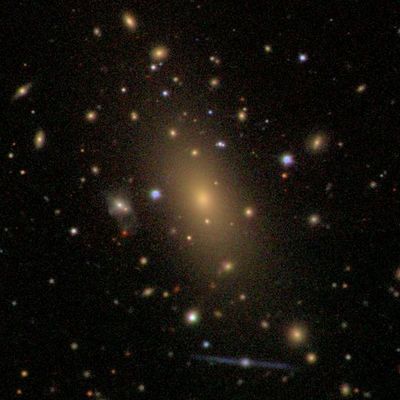


At the center of the galaxy cluster Abell 2029 sits an enormous galaxy shaped somewhere between an ellipse and a spiral. Its name is IC1101, and it makes galaxies like ours seem like peanuts. New observations set out to perform the most sensitive search of its outskirts and discovered two things: the galaxy is larger than previous estimates, and it hasn't stopped growing.
The central galaxies in a cluster are always the biggest, and collisions with other galaxies help them grow. So, it isn't surprising that IC1101 is big. But it is still a cut above the rest.
New observations obtained with the Isaac Newton Telescope in the Canary Islands allowed researchers to see where the edge of this galaxy is. Galaxies are just large collections of stars, so they don't have a distinct edge, but you can approximate one because, beyond a certain distance, the number of stars drops off massively.
For IC1101, the diameter is now estimated to be 1.7 million light-years (520 kiloparsecs), significantly larger than previous estimates of around 370,000 light-years (114 kiloparsecs). Galaxies are surrounded by structures called halos, so the extent including that is much larger, but this new work provides a better estimate of where most stars in the object are.
For comparison, our galaxy is around 110,000 light-years across, so this galaxy is 15 Milky Ways wide. By volume, almost 4,000 Milky Ways would fit in IC1101.
“In this study, we performed an ultra-deep imaging and photometric analysis of IC 1101. Our goal was to characterise the extension of this massive system. Based on sharp structural changes in its radial profiles (surface brightness, surface mass density, colour, ellipticity, etc), this study provides a measurement of the galaxys edge,” the authors wrote in the paper.
IC1101's stellar mass is also enormous. Within that volume sits 3.4 trillion solar masses' worth of stars, between nine and 34 times the mass of the stars in our own galaxy. You'll notice that number isn't quite so impressive relative to its diameter and volume, and overall IC1101 is comparatively less dense with stars than the Milky Way.
The work also showed that IC1101 continues to be the biggest of them all. Using the Chandra X-ray telescope, the researchers looked for what else was going on in the cluster, as the scope's X-rays can help trace the gas within the region.
It showed that there are a lot of disturbances around IC1101, probably from some recent uptake of material. In other words, this massive galaxy hasn't finished growing yet.
“With a confirmed diameter of around 520 kpc, IC 1101 stands as the largest galaxy known to date; yet, its outskirts show clear signatures of ongoing mass assembly, indicating that its spatial extent is still growing,” the authors wrote in the paper.
The galaxy cluster is located just over 1 billion light-years from Earth. It also sports a supermassive black hole that is among the biggest known to date, tens of billions of times the mass of the Sun.
The work is accepted for publication in the journal Astronomy & Astrophysics and available on the ArXiv.