Space and Physics
 PUBLISHED


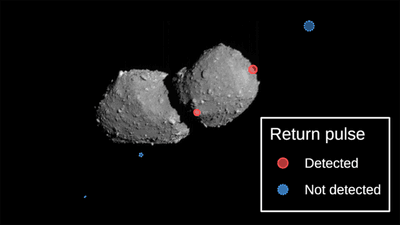


The Japan Aerospace Exploration Agency (JAXA) has begun firing lasers at asteroid Torifune from 15 kilometers (9.3 miles) away, in the latest episode of a long, extended mission for Hayabusa2.
Hayabusa2 has been on quite the journey, first heading to asteroid Ryugu to collect samples, before returning those samples to Earth, where they have been regularly surprising the scientists studying them.
But the probe itself wasn't done. In 2020, slightly prior to the samples being sent home, JAXA announced that they had found a new target for the spacecraft, extending the mission into the 2030s.
"The destination will be the small asteroid 1998 KY26. This is a long-term mission that exceeds 10 years and, after an itinerary of various events, we aim to rendezvous with the rapidly rotating 1998 KY26," JAXA said at the time.
"We may also attempt particular challenges, such as dropping a target marker or touchdown."
An unusual world-first
The first of those targets, also known as Torifune, was seen up close on July 5, 2026, as Hayabusa2 finally flew past it at speed. During this flyby of an asteroid the spacecraft was never intended to visit, the team achieved a world first: using lasers to measure the distance to an object while hurtling by it at relative speeds of around 5 kilometers per second (3.1 miles per second).
Sizing celestial objects using LiDAR (Light Detection and Ranging) is pretty useful to astronomers. Though there is no haze in space, due to a lack of atmosphere up there, it is difficult to distinguish between a small object close to you and a larger object further away. The old "this space cow is small, this space cow is far away" problem.
By bouncing lasers off an object and timing when the light is reflected back, you can get yourself a distance, helping you to figure out other things like the object's size. This technique, demonstrated by Hayabusa2 for the first time, could be especially useful for planetary defense.
A new tool for planetary defense
"If the ranging data can be obtained at multiple points in time, this can be combined with the spacecraft tracking data to determine both position and velocity of the celestial body with high accuracy, thereby improving the accuracy of orbital predictions," a translated JAXA statement explains.
"Such information about asteroids is particularly important not only for planetary exploration, but also for planetary defence—namely understanding and responding to impacts of celestial bodies on Earth."
The team was able to fire lasers successfully at the asteroid when it was just seconds from its closest approach, hitting it twice from the distance of 20 kilometers (12.4 miles) and 15 kilometers (9.3 miles).
The laser hit a very small portion of the asteroid, and the team is working to determine where exactly the laser struck.
An unusual new target
Following this successful first, Hayabusa2 is on its way to visit an unusual asteroid, 1998 KY26, in a mission which may be a little more difficult than anticipated. In 2024, a team of astronomers expected to confirm previous estimates of the object's size and mass, but found that it may be a little more tricky to land on than we thought.
“We're surprised to discover that the object looks completely different from what was expected; it was much smaller, three/four times smaller than expected. It's spinning faster, twice as fast. And also the composition itself… It's much brighter," lead author Dr Toni Santana-Ros, a planetary scientist at the University of Alicante and University of Barcelona, explained to IFLScience.
"The funny thing is that the object is about 11 meters in diameter, and the spacecraft itself is 6 meters [20 feet]. So it's more than half of the object it’s going to visit. It's quite a funny thing!”
With the object's size still unclear, a little LiDAR is sure to settle things. Hayabusa2 has just shown it is more than up for the task. Having collected samples from Ryugu, it is clearly up for this task, too.