Space and Physics
 PUBLISHED
 1
1


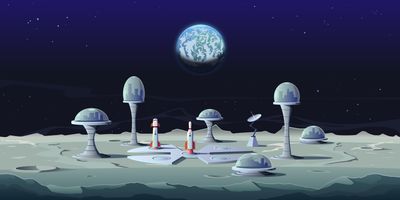


In all the sci-fi visions of humans expanding into space into the future, there is always a crucial first step: a city on the Moon.
Our natural satellite is seen as the launchpad to the wider cosmos. Life imitates art, and NASA is now committed to the construction of a lunar base ahead of further human exploration in the Solar System.
But could a city on the Moon work? A new paper lays out some major limitations.
There are some serious hurdles to overcome to make an inhabited complex permanent. Humans have continuously lived in space for 26 years now, but the International Space Station (ISS) will eventually be retired with unfortunately limited interest in keeping it going.
A space settlement would need Earth to begin with, but it ought to be self-sufficient in the long run to be able to become permanent. Dr Martin Elvis and Dr Jonathan McDowell looked at just one specific characteristic: water.
The discovery of water on the Moon was seen as a game changer, as one can imagine. The more resources one can find in the place we plan to (re)visit or settle, the easier it is. But there are questions around how easy it is to extract that water, and this work looks at just how much you’ll need to sustain a city.
The researchers made an extremely optimistic estimate of how much water is on the Moon. They say 1 billion tons of water: that’s about what you'd get in 400,000 Olympic-sized swimming pools or in just seven minutes of water flowing over Niagara Falls.
Then they assume, with equal optimism, that it is cleaned and reused with 98 percent efficiency, similar to the capabilities we have achieved on the ISS. Based on these two cornerstones, a city of one million people would run out of water on the Moon in just over a century.
Most likely, there is 30 times less water on the Moon than that rosy estimate, which would shorten a realistic 1-million-person city's lifespan to a matter of years.
Smaller settlements, a thousand-strong Moon village, or a 10,000-person Moon town, could instead survive for centuries but will still eventually run out of water.
Possible solutions are varied – more efficient water usage, something that would immediately benefit humanity down on Earth, dealing with droughts, and also looking for other sources of water deeper in the Moon surface, or even from asteroids and comets.
Water is just one issue
A few years back, we interviewed Kelly and Zach Weinersmith about their award-winning book A City on Mars. They dissect the many challenges that we need to overcome to settle space, and despite the title, they see the Moon as the simplest and most logical target for where to build a city.
Some of the challenges are economical, others are legal, but most of them are technical. There is so much we do not know about living in space. On the subject of resources, they do stress the question of water (and ownership of that possible water), but there is another thing very important for a settlement: food.
To grow food, you need carbon. On the Moon, there are only six places with high-density carbon: the bags of feces, urine, and vomit that the Apollo astronauts left there. That’s it, and it is not even that much!
“You can’t just make more carbon on site. It’s made in stars, so this is a problem,” Zach explained. “People will often talk about how much water is on the Moon. And there is not that much water. It is a finite resource, and the rules say whoever gets it first can probably take it."
Future space settlements are often talked about with much hype, but it is important to carefully plan them. We might only get one shot at getting things right.
The study is published in Frontiers in Space Technologies.