Space and Physics
 PUBLISHED
 3
3


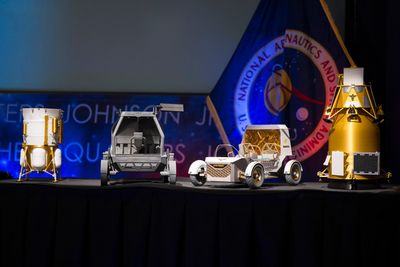


NASA is going full throttle with its Moon plans. Just two months since the Ignition event, the space agency has now announced several missions launching this year as well as some more exciting plans for the next few years.
The current plan will see a Moon Base being established across the early 2030s and the human return to the Moon in 2028 with Artemis IV. While there are questions as to whether this is feasible, following a delay to Artemis III, the Moon Base plan appears to be going ahead at speed.
Landers, rovers, and ways to navigate the Moon
In a press conference, NASA announced that three missions will launch this year, providing crucial tests for lunar technology. The first, taking place no earlier than fall 2026, will see Blue Origin’s Blue Moon lander taking NASA's scientific payload to the Moon.
Blue Moon is one of the two possible Human Landing Vehicles – together with SpaceX’s Starship – selected to take humans from lunar orbit to the lunar surface. While the Mark 1 traveling this year is not human-graded, it will be a crucial test for future crewed missions.
The payload will also feature cameras to study how lander thrusters deal with the lunar surface and a Laser Retroreflective Array, which will continue to test a way to navigate around the Moon using artificial landmarks and laser light.
That is the Moon Base I mission, which will be followed by Moon Base II, where Astrobotic’s Griffin lander will take more payload, including Astrolab’s FLIP rover.
Private companies Astrolab and Lunar Outpost have been awarded around $220 million each to develop the first lunar terrain vehicle (LTV). FLIP is an important test, ahead of the two LTVs being sent up in 2028.
The third mission, Moon Base III, will bring more scientific payload, including experiments from ESA (the European Space Agency) and the Korea Astronomy and Space Science Institute.
It’s only just the beginning
The Moon Base will be constructed around the lunar South Pole, and while the conference focused on the awarded contract for the first three missions and more, one particular fact has apparently captured the imagination: the area of the Base will be enormous.
“We envision the Moon Base to be hundreds of square miles, with different assets all building up to the objective of permanent lunar presence on the Moon,” Carlos García-Galán, NASA Moon Base program executive, said in the press conference.
Now, do not imagine a sprawling city. Chicago, for example, is 606 square kilometers or 234 square miles. The idea is that the Moon Base will not comprise a single outpost that features everything. It will have a dispersed distribution of habitats, research areas, and power generation systems such as the proposed nuclear reactors, to cover different scientific and safety needs.
So yeah, the astronauts might have to commute on the Moon as well; that’s why those LTVs will be very important. The final designs for them are expected to be delivered within the next 18 months.
“There's no one spot that covers all the science, all the technology, all the habitation needs of the surface, and even within the local area, you have to consider the terrain,” NASA's Nujoud Merancy, chief architect of the Moon Base program, added during the Q&A.
“So, you'll have the habitats on the tops of the hills where they get sunlight,” she continued. “Power systems, nuclear systems, need to be a kilometer or more away for the radiation protection, so all of these things, when you start putting them together, end up sprawling a little bit more like a city as you start building it out.”
Next step: drones and geopolitics
NASA has also announced what’s next for MoonFall. This mission will feature four drones developed by the Jet Propulsion Laboratory. They will move independently across a single lunar day to photograph the lunar terrain in preparation for the human landing on the Moon.
Once the lunar day is over, equivalent to 14 Earth days, their remaining fuel will freeze and they’ll enter night mode. They will continue to operate, and they could be used for navigation and communication once astronauts are around and on the Moon.
“The Moon Base will be America’s and humanity’s first outpost on another celestial world,” NASA Administrator Jared Isaacman said in a statement.
“Every mission, crewed and uncrewed, will be a learning opportunity as we return to the lunar surface, build the infrastructure to stay, and master the skills required to live and operate in one of the most demanding and dangerous environments imaginable.”
There were a lot of comments and questions about international collaboration, as well as around ownership of a permanent base on the Moon with respect to the Outer Space treaty.
The second article of the treaty states that no nation can claim sovereignty over the Moon by means of use or occupation, so the legal interpretations of the use of space in the coming years are bound to be interesting.
During the Q&A, Ars Technica's Eric Berger asked García-Galán and Isaacman directly about the MoonFall drones and if they will delineate a US area on the surface.
“I think it's important for us to get there first. [...] I think the idea that there are areas of great interest on the lunar surface,” Isaacman said. “We do want to get there and explore them, and we also obviously want to be very mindful of the Outer Space Treaty so that we are respectful of other nations that are putting assets on the lunar surface. We would expect that to be reciprocal."