Space and Physics
 PUBLISHED


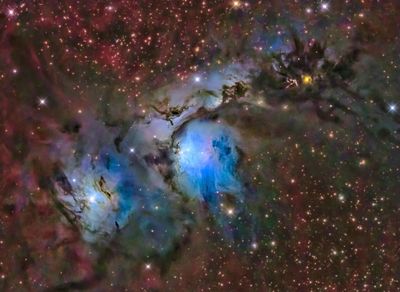


The first detection of the sugar erythrulose has been made in a dust cloud near the center of our galaxy. Erythrulose is produced by raspberries and is used in some cosmetics. From a scientific point of view, however, the more interesting aspect of the discovery is that it adds to evidence the early Earth may have received sugars from space, forming a potential resource for early life.
If you leave aside the lethal radiation and the fact that the particles are billions of times too thinly dispersed to breathe, let alone drink, the center of the galaxy sounds like a fun place for raspberry fans. More than a decade ago, astronomers found the spectrum of ethyl formate (C3H6O2) coming from the dust cloud Sagittarius B2. Ethyl formate helps give raspberries their flavor, and is also a contributing ingredient in rum.
Like most biological products, however, raspberries are much more complex than a single molecule. At the time of that discovery, Arnaud Belloche of the Max Planck Institute warned The Guardian, “There are many other molecules that are needed to make space raspberries.” Now erythrulose (C4H8O4)has been crossed off that astronomical shopping list.
It's not just raspberries all the way down in space, though. Other recognizable scents include seared steak, almonds (cyanide), gunpowder, and rotten eggs.
Sweet, sweet discovery
From a chemist’s point of view, sugars are much more than glucose and fructose that make up too much of the modern diet. They’re a class of simple molecules with two or more carbon-carbon bonds and a specific range of ends to their chains. Sugars require a minimum of three carbon atoms, but the most familiar ones have six. Erythrulose has four, and while not widespread in nature, is popular for the way it makes skin look tanned without exposure to sunlight.
Sugars have been found in meteorites, suggesting they exist in space, but until this discovery, none had been detected outside the Solar System. Clouds of gas and dust, particularly towards the Galactic Center, contain a rich array of molecules, some complex enough to pose a challenge as to how they could form with no solid surface, let alone a biological mechanism.
Dr Izaskun Jiménez-Serra of Spain’s Center for Astrobiology and colleagues turned two radio telescopes on the cloud G+0.693−0.027 to expand the list of 340 molecules detected in the space between the stars. Since the simplest sugars have just three carbon atoms, these might be expected to be the most abundant, if any could be found. Instead, the only sugar whose molecular signature could be detected was erythrulose. Three-carbon sugars must be at least eight times less abundant to have escaped detection.
According to the study authors, “Quantum chemical and astrochemical models indicate that erythrulose forms efficiently on interstellar dust grains from simpler two-carbon aldehydes and alcohols.” They also note that “Erythrulose, with 14 atoms in its structure, represents the largest non-cyclic molecular species identified so far in the [interstellar medium].”
The discovery “Takes us to a higher level in the ladder of interstellar chemical complexity, suggesting that other prebiotic (and potentially chiral) molecules could also form and survive under the extreme conditions.”
Chiral molecules, those that can never be translated into their mirror images, are common biological products, but this is only the second found outside the Solar System.
The early Earth got so hot that it would have destroyed any organic molecules that formed an original ingredient. Moreover, conditions are thought to have been unsuitable to produce them in quantity before life evolved.
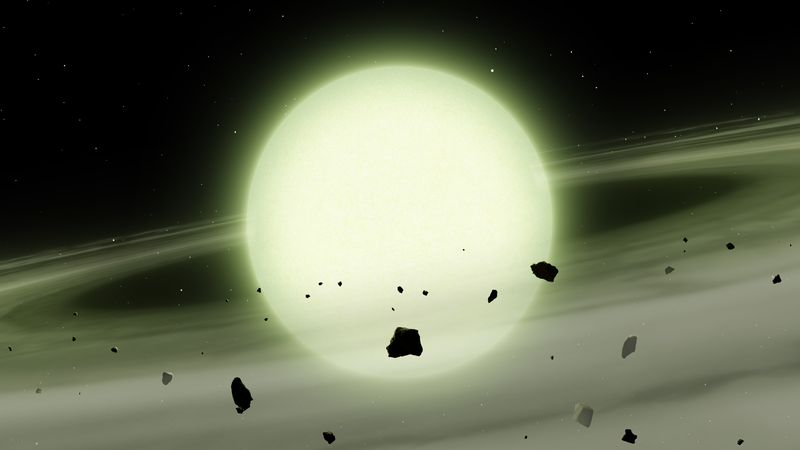
However, if erythrulose and other sugars were in the Sun’s protoplanetary disk, some of them could have safely been incorporated into asteroids and then delivered to Earth once things had cooled down. In water, erythrulose and similar molecules can turn into aldoses, another category of sugar, widening the sugary variety.
The presence of such a smorgasbord of molecules to feed on makes it easier to understand how the first life-forms could flourish, starting the long chain to us, and actual raspberries.
The study is published in Nature Astronomy