Ad

space-iconSpace and Physicsspace-iconAstronomy
clock-iconPUBLISHEDFebruary 23, 2026
share21

IFLScience We Have Questions: What Do Other Worlds Smell Like?

Turns out space stinks, but how do we know what cosmic objects smell like and can we recreate it here on Earth?

Dr. Alfredo Carpineti headshot

Dr. Alfredo Carpineti

Alfredo has a PhD in Astrophysics and a Master's in Quantum Fields and Fundamental Forces from Imperial College London.

Space & Physics Editor

Alfredo has a PhD in Astrophysics and a Master's in Quantum Fields and Fundamental Forces from Imperial College London.View full profile

Alfredo has a PhD in Astrophysics and a Master's in Quantum Fields and Fundamental Forces from Imperial College London.

View full profile
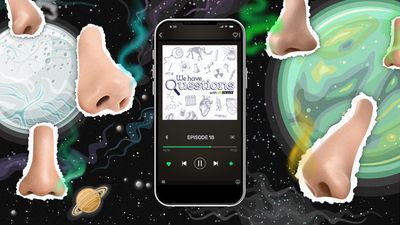
A smartphone showing an episide of IFLScience's We Have Questions podcast about what other worlds in space smell like

Episode 18 of We Have Questions.

Image credit: Picture Store, Pixel Shot, mihmihmal/Shutterstock.com; modified by IFLScience  

Recently, IFLScience visited the Space: Could Life Exist Beyond Earth exhibition at the Natural History Museum, London, and we were curious to come across opportunities to take in the scents of asteroid Bennu, Mars, and even Saturn’s moon Titan. We understand that space smells, in an abstract way; we’ve even covered it before, but being able to get an actual whiff sparked many questions. Who created these smells, based on what, and how?  

The rest of this article is behind a paywall. Please sign in or subscribe to access the full content.

Enter Marina Barcenilla, astrobiologist and fragrance designer – and now major exhibition contributor – with her own artisan perfumery AromAtom, where she uses chemistry to create the smells of cosmic environments, from the surfaces of planets to distant nebulae. So, we asked Barcenilla: How does one become a perfumer for the stars? 

You can listen to this episode and subscribe to the podcast on all your favorite podcast apps: Apple Podcasts, Spotify, Podbean, Amazon Music, and more. 

This interview first appeared in Issue 38 of our digital magazineCURIOUS.


Add us as a Google preferred source to see more of our
trusted coverage in Search