Space and Physics
 PUBLISHED





What you'll discover in this article:
- Our galaxy might have been flipped like a pancake around 10 to 11 billion years ago.
- The 90-degree flip would have been caused by the bizarrely named Gaia-Enceladus-Sausage.
- The researchers told IFLScience how this event explains a mysterious feature of our galaxy today.
Our galaxy, the Milky Way, is a fairly large one in our part of the universe. In part, its size is thanks to several minor mergers in which it gobbled up smaller galaxies that came too close. One of these encounters, though, might have led to something a lot more dramatic, flipping the disk of the Milky Way.
The Milky Way is a fairly typical barred spiral galaxy. It has a central density of stars, known as the bulge, which is elongated – hence why it is called a bar. Beyond the bar, the stars are distributed in four long spiral arms located in the disk, a thinner but much wider region.
There are a few stars spread further afield in a spherical distribution known as the stellar halo, and all that sits within a dark matter sphere known as the dark matter halo.
Using observations from the European Space Agency’s Gaia observatory, researchers have found that the stellar halo moves extremely slowly, which has been a bit of a puzzle, as there was no clear reason why it should.
How the sausage gets made
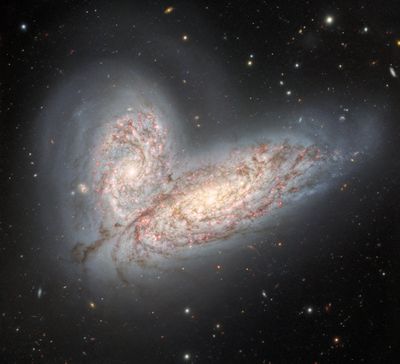
A team of researchers has now used highly detailed simulations to find a successful explanation: a face-on collision could have flipped the galactic disk, slowing down the stellar halo.
“The main question we were trying to answer was to identify what factors define the magnitude of the rotation of stellar halos in Milky Way-like galaxies,” lead researcher Kirill Batrakov at Durham University, UK, told IFLScience.
I think not many people know how beautiful these simulations are.
The collision in question could have been with a galaxy called Gaia-Enceladus-Sausage. This is a known merger and an important one in the Milky Way's past, in which a dwarf galaxy smashed face-on into it.
The interaction left a group of stars within our galaxy that are now distributed in a peculiar sausage shape visible in data from the Gaia observatory.
Gaia-Enceladus was the serious attempt at naming it, referencing a giant in Greek mythology. Fortunately, the sausage stuck, and this new work suggests it might have done even more than we thought.
“We found that the two most important factors for [a slow stellar halo] are the presence of Gaia-Enceladus-Sausage-like substructures and also the presence of disk flips in the past history of galaxies,” Batrakov told IFLScience.
It's very impressive how similar to real galaxies they can be and how much detail we can infer from these simulations
Stars in the stellar halo move at about 25 kilometers (15 miles) per second, which is a small fraction of the speed the Sun goes around the galaxy. More importantly, the simulations suggest that the average velocities should be closer to 50 or 60 kilometers (31 to 37 miles) per second.
Batrakov and his team analyzed the evolution of 25 Milky Way-like galaxies with the Auriga suite of cosmological simulations. He found that the slow halo is the product of a disk flip, and that such a flip could have been caused by a galactic merger (though, in some scenarios, it can happen even without a merger).
Batrakov praised the simulation as key for these insights: “I think not many people know how beautiful these simulations are. They're always very hard to run, so I'm not running them myself, just analyzing the data,” Batrakov told IFLScience.
“It takes huge teams of tens of people to fully develop a simulation. Each simulation contains, in the case of Auriga, millions of particles representing stars, dark matter, and gaseous cells.”
“It's very impressive how similar to real galaxies they can be and how much detail we can infer from these simulations.”
A slow and steady collision
The fact that the stellar halo is so dispersed means it takes a very long time to evolve. On the other hand, the stellar disk can change a lot more quickly, and so a flip could have taken between 150 million years and just over 1 billion years to occur.
Given the current timings for the merger and the possible flip, the Sun and the Solar System didn't exist when all this was going on. We also shouldn’t picture these events as cataclysmic. The interaction would have been extremely slow, and it only looks dramatic on fast-forward.
Atronomers suspect the galaxy continued to evolve significantly after the merger and the possible flip. It has been posited that the bar didn't form until just before the birth of the Sun, about 5 billion years ago.
This work also links the rotation of our galaxy's stellar halo with the rotation of the dark matter halo. Maybe the two evolved together, shaped by the several galaxy mergers the Milky Way experienced.
This work was presented at the Royal Astronomical Society's National Astronomy Meeting in Birmingham, UK, on July 21, 2026.