Space and Physics
 PUBLISHED


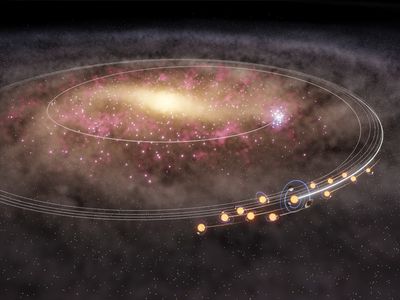


The Sun orbits in the thin disk of the Milky Way. It's located 27,000 light-years (8.3 kiloparsecs) from the Galactic Center, on the inner edge of the Orion spiral arm. It orbits around the galaxy every 240 million years, and it formed 5 billion years ago – but not where we are now. It is believed that it formed much closer to the center of the Milky Way. That scenario, though, has had a big hurdle up to now. Quite literally.
The Milky Way is known as a barred spiral galaxy. Its central distribution of stars is not a sphere, but an elongated bar-like structure. Astronomers are not sure if bars are constant or temporary structures in galaxies, or even if they could come and go. The presence of a bar makes migration from the center impossible.
A solution is that the bar is a later addition to the galaxy, but in that case, when did it form? A Japanese team led by Assistant Professors Daisuke Taniguchi from Tokyo Metropolitan University and Takuji Tsujimoto from the National Astronomical Observatory of Japan looked for solar twins, stars that have similar properties to our star and likely formed around the same time.
Using the data from the European Space Agency's Gaia satellite mission, which contains over 2 billion stars, they found a catalog of 6,594 Sun twins, more than 30 times larger than a previous similar catalog. The team was able to divide these twins into two groups based on age.
The age distribution shows a narrow peak at 2 billion years ago, and the team believes that these are stars that formed locally, away from the center of the Milky Way. There is also a broader bump between 4 and 6 billion years; this is probably the group that formed together with the Sun.
The dynamics of this latter group and the presence of many of these stars in the solar neighborhood suggest that the Sun likely formed 10,000 light-years closer to the center of the Milky Way than it is today. And that is not all. It also gives a possible timeline for the formation of the bar.
The bar might have formed just before, and that formation triggered both the formation of the Sun and its twins, and their migration to their outer orbit in the galaxy.
Two papers discussing this scenario and the catalog are published in the journal Astronomy & Astrophysics.