Space and Physics
 PUBLISHED





At 1.35 am EST on August 5, a large chunk of rocket hit the Moon.
The sizable piece of space junk was the upper stage of a Falcon-9 rocket that took the Blue Ghost mission to the Moon. SpaceX says the discarded piece of rocket was meant to come back to Earth and burn up in the atmosphere, but it continued towards the Moon where it has now produced a dark splotch on the surface.
The impact was in an awkward place for observations from Earth.
The rocket crashed at the edge of the near side of the Moon, which is the lunar face we can see from Earth, hitting near the Einstein crater. Weighing 4,000 kilograms (8800 pounds) and 14 meters long (46 feet), NASA estimated that it left behind a crater 18 meters (59 feet) wide and 4 meters (13 feet) deep.
The first confirmation of the impact came from the Very Large Telescope in Chile, although they didn't spot the actual collision. Instead, they saw the plume of material kicked up following the impact. This stayed above the surface for around 5 to 10 minutes.
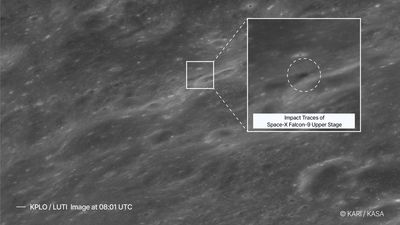
The first visual confirmation came from the Korea AeroSpace Administration's (KASA) mission Danuri. While the orbiter was the first to spot the newly formed crater, other orbiters might be able to take even better pictures of what has happened. At the moment, all we can really see is a dark smudge on the surface.
Danuri is an intriguing mission. The Moon hasn’t got a global magnetic field like Earth, but there are localized ones, and Danuri was the first to report a peculiar difference in magnetic field strength between the near side and the far side.
Since that discovery, many more discrepancies between the two hemispheres have emerged.
The mission also carries a gamma-ray detector and measured the most powerful gamma-ray burst ever detected: the Brightest Of All Time. It was not even orbiting the Moon yet when the burst reached Earth in October 2022.
The SpaceX lunar collision is the second time a large piece of space junk has hit the Moon. On March 4, 2022, a mysterious object slammed into the lunar surface and left behind an unusually shaped double crater.
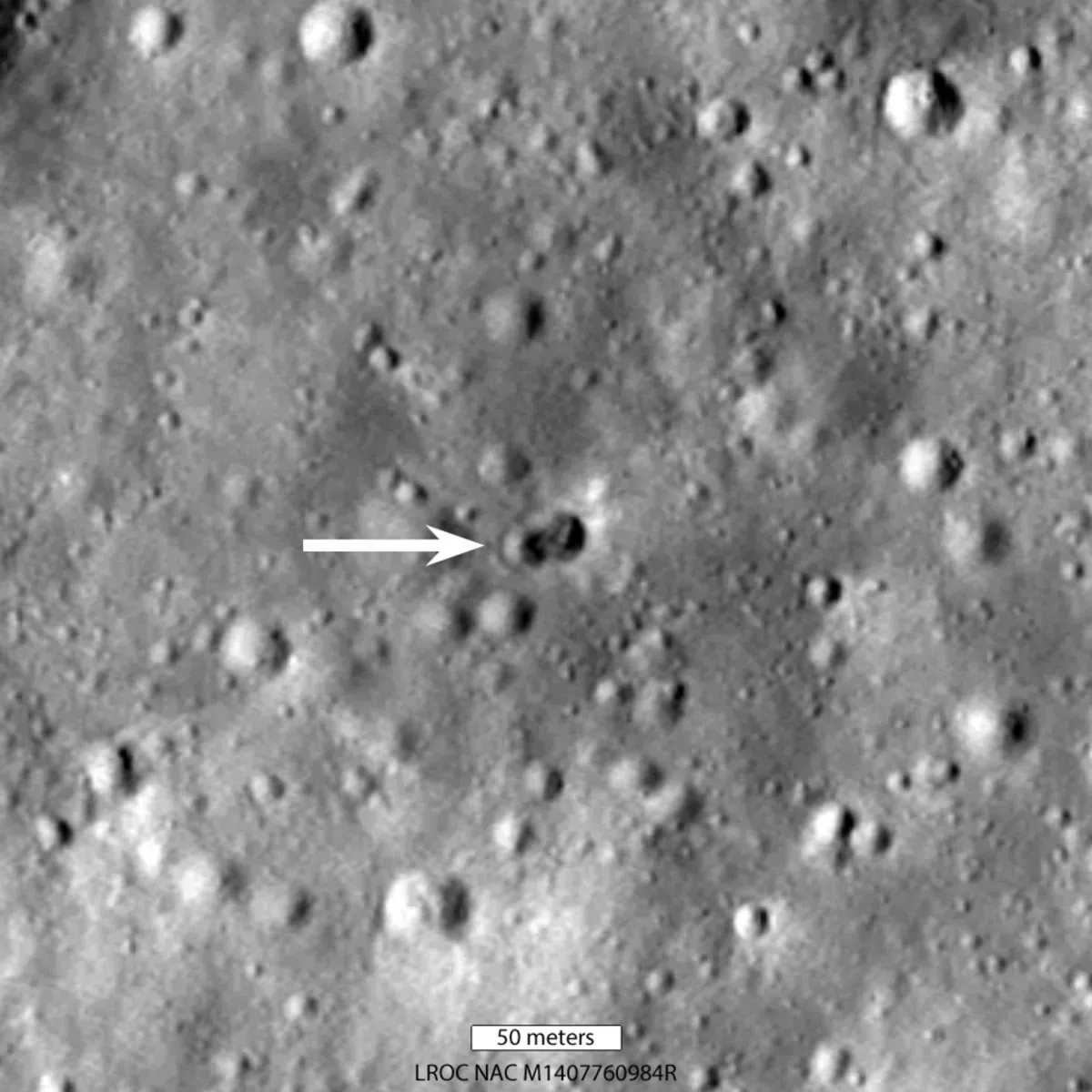
It was initially suspected to be another SpaceX rocket, but further analysis suggested that the piece of space junk was a booster from the Chang'e 5-T1 lunar mission. China denied any involvement, but celestial mechanics confirmed its origin. You can’t deny physics.
This event was not particularly dangerous, and the Moon has plenty of similarly sized natural impacts. Still, the event had many discussing the growing problem of space junk and the lack of regulation when it comes to what goes on in the heavens.