Space and Physics
 PUBLISHED



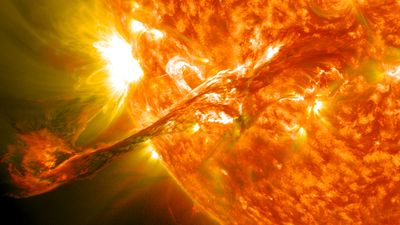


We might have underestimated how powerful our Sun's solar flares can get. New analysis of the largest recorded sunspot of the last century suggests our star has the capacity to produce something called a superflare.
Solar flares are powerful releases of energy from the Sun. They can cause power blackouts, affect Earth’s ionosphere, and are often accompanied by releases of plasma that can produce spectacular auroras even at lower latitudes.
The most powerful flare on record is the Carrington event of 1859. It wasn't measured with modern instruments, so we can only estimate how strong it was. In the current solar cycle, Solar Cycle 25, the most powerful flare was an X9.0 flare on October 3, 2024. The Carrington event is hypothesized to have reached X45.
A superflare is defined as having an energy greater than 1034 ergs, which is between 10 and 100 times greater than the standard energy of powerful flares from the Sun. That's equivalent to over 200 times the energy of the Chicxulub impact, which wiped out non-avian dinosaurs and many other species at the end of the Cretaceous period.
We know other stars can make superflares, but the unanswered question is whether the Sun is capable of such massive eruptions.
Energy-wise it takes the Sun a few seconds to output a superflare's worth of energy across its entire surface, but to accumulate it in a relatively small region like a sunspot to produce a flare takes rather a lot more time.
A model published in 2024, which was admittedly described as simplistic by the authors when they spoke with IFLScience, showed it would take eight years for the Sun to charge up a superflare. A long time to accumulate energy, but not necessarily impossible.
“From even this simple calculation, I suggested [the superflares] as a possibility," Professor Kazunari Shibata at Kyoto University told IFLScience at the time. "And of course, this is a big challenge I put to Solar Dynamo theorists. And I encourage many theorists to really study whether this is correct or not.”
Months later, a team from the Max Planck Institute for Solar System Research (MPS) looked at 56,450 Sun-like stars and found evidence supporting the scenario that a superflare might happen from a Sun-like star about once every century.
Now the same MPS team have turned their attention directly to our own Sun and looked at the largest sunspot since the Carrington event. It happened in 1947, and they estimate it had the capacity to produce a flare that would be classified as a superflare today.
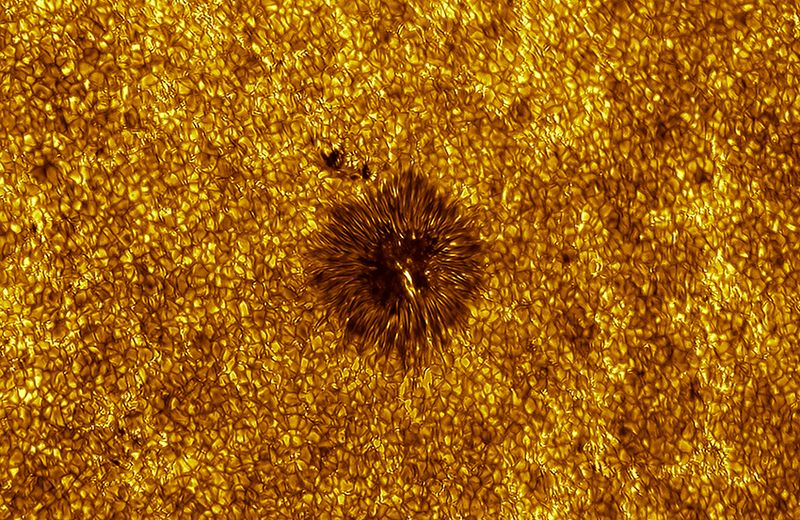
The Great Sunspot of 1947 might have been more than twice as wide as the one responsible for the Carrington event (the uncertainty comes from not knowing how large the Carrington event's sunspot would have been). It was 40 times wider than Earth and covered 0.6 percent of the solar surface.
Luckily for us, it didn't release a flare as far as we can tell. Certainly not one directed at Earth. If it had, the researchers calculate its typical energy would have been 2.31 × 1033 erg, and, under some scenarios, it could have exceeded 1.25 × 1034 erg and qualified as a superflare.
“Our Sun has superflare potential. It can produce massive sunspots that, in principle, can serve as the starting point for the most extreme bursts of radiation,” lead researcher Natalie Krivova, an MPS scientist, said in a statement.
So our little yellow star could theoretically pack a mighty punch, but if it has actually released a superflare, it remains to be seen.
A paper describing the results was published in the journal Philosophical Transaction of the Royal Society A.