Space and Physics
 PUBLISHED


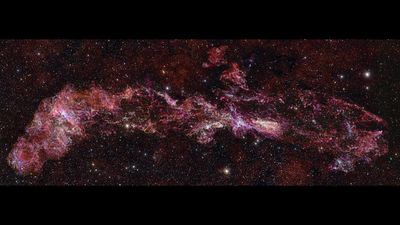


The Central Molecular Zone of the Milky Way is a fascinating area at the core of our galaxy. It's rich in a variety of chemical elements, filled with the building blocks of stars, planets, and even molecules that are important for life. For the first time, astronomers conducted a census of the cold gas in this region, at a level of detail never reached before.
Using the Atacama Large Millimeter Array (ALMA), the image of this region is the largest ever produced by the observatory. The core of the Milky Way hosts a supermassive black hole, Sagittarius A*, stars, and a lot of gas clouds. The CMZ encompasses that and a lot more, spanning over 650 light-years.
“It’s a place of extremes, invisible to our eyes, but now revealed in extraordinary detail,” Ashley Barnes, an astronomer at the European Southern Observatory (ESO) in Germany who is part of the team that obtained the new data, said in a statement. “It is the only galactic nucleus close enough to Earth for us to study in such fine detail.”
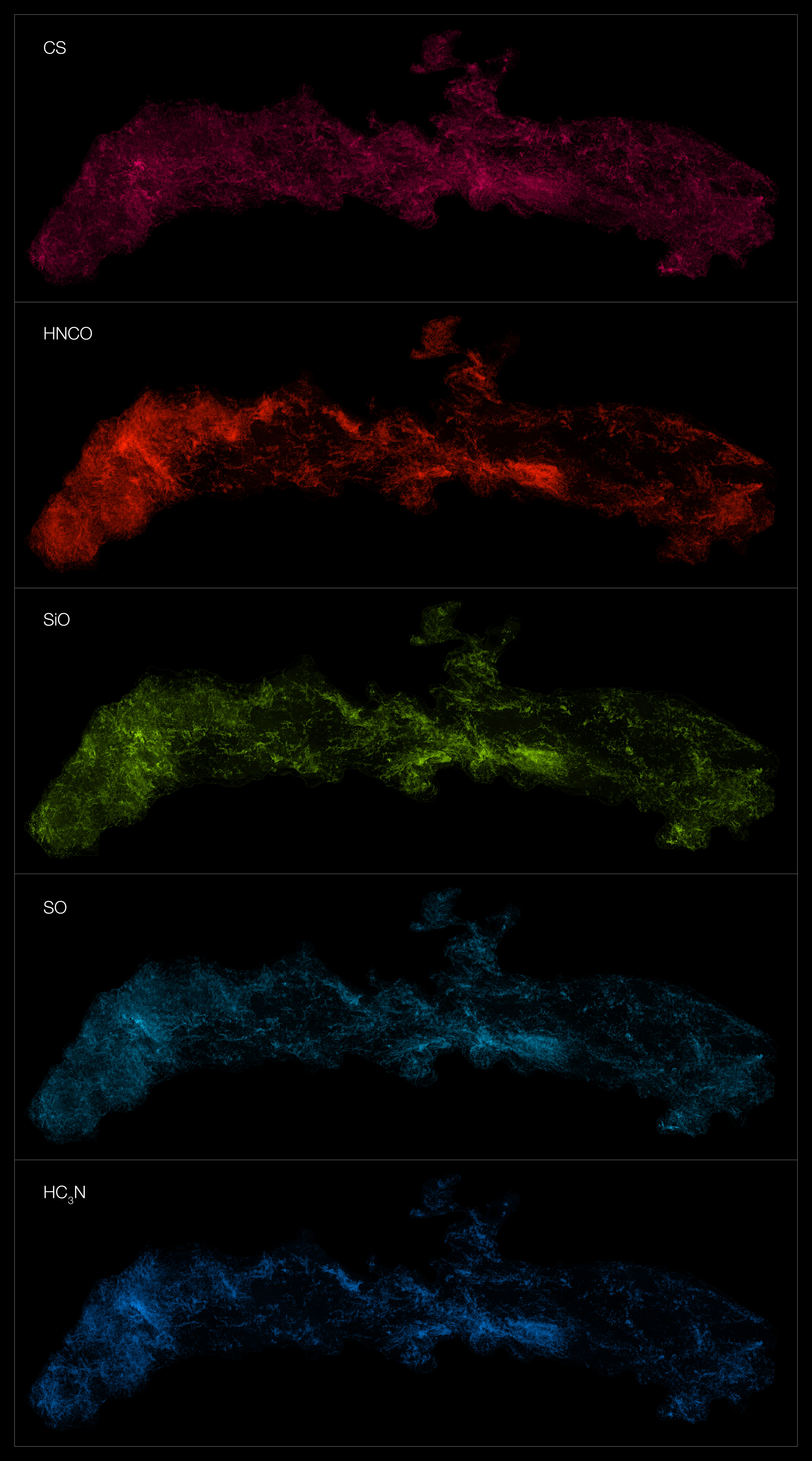
The observations were part of a program called ACES — the ALMA CMZ Exploration Survey — that is exploring the chemical composition of the cold gas around the center of the Milky Way. The goal is to understand how some of the extreme objects in our galaxy end up forming there. The CMZ is also an interesting target to possibly understand dark matter.
“The CMZ hosts some of the most massive stars known in our galaxy, many of which live fast and die young, ending their lives in powerful supernova explosions, and even hypernovae,” explained ACES leader Steve Longmore, a professor of astrophysics at Liverpool John Moores University, UK.
“By studying how stars are born in the CMZ, we can also gain a clearer picture of how galaxies grew and evolved,” Longmore added. “We believe the region shares many features with galaxies in the early Universe, where stars were forming in chaotic, extreme environments.”
The image is a combination of many observations stitched together in a detailed mosaic, and it would be as large as three Full Moons in the sky. The observatory observes in different wavelengths and so can capture the specific emissions of different molecules, some simple like silicon monoxide, as well as more complex organic ones like methanol, acetone, or ethanol.
“We anticipated a high level of detail when designing the survey, but we were genuinely surprised by the complexity and richness revealed in the final mosaic," stated Katharina Immer, an ALMA astronomer at ESO who is also part of the project.
The data from this survey are publicly available and discussed in six papers, five of which have already been accepted for publication in the Monthly Notices of the Royal Astronomical Society, with the sixth undergoing minor revisions. The overview paper can be read here.

 1
1