Space and Physics
 PUBLISHED



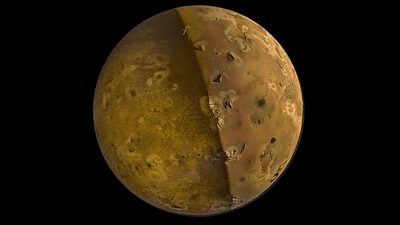


In a surprise discovery, NASA's Juno team has measured the temperature beneath the surface of Jupiter's moon Io for the first time, revealing the stress and strain the moon is subjected to because of its proximity to the giant planet.
As well as giving us a better look at this distant world and its volcanic activity, the research could help us better understand volcanoes on Earth.
Thanks to past missions to Jupiter, as well as a little modeling, we have a pretty good idea of the surface temperatures on Io, the smallest of the four larger Galilean moons.
It's generally pretty cold, at around -143°C (-230°F), but there's a large hot spot where it reaches a comfortable 17°C (60°F), thought to be the result of volcanic activity.
This kind of geological activity makes the moon particularly interesting, though it doesn't sound like a comfortable experience: all that activity is likely caused by Io being stretched and squeezed as it dances around its enormous host planet.
"Owing to Io’s eccentric orbit, its distance from Jupiter varies by about 3,500 km, leading to variations in Jupiter’s gravitational pull," a paper on the topic explains.
"Similar to tides on the Moon raised by Earth, these gravitational variations cause tidal deformation on Io, which is theorized to serve as the primary energy source for the intense volcanic activity and infrared emission observed on Io’s surface."
That's no small thing, with Jupiter's gravity causing Io's surface to bulge up and down by as much as 100 meters (300 feet).
Now, thanks to data from two flybys during the Juno mission in late 2023 and early 2024, and the teams who analyzed the hell out of them in the time since, we have our first real look at Io's interior.
While previous observations measured the temperature only in infrared, giving us a good idea of what's going on at the surface, this team used Juno's Microwave Radiometer (MWR) instrument to detect microwaves emitted at a wide range of wavelengths.
“The technique is novel in that each wavelength explores different depths, providing a new way to characterize the deep atmosphere of giant planets and the subsurface crusts of icy and rocky moons,” Scott Bolton, study coauthor and Juno’s principal investigator at Southwest Research Institute in San Antonio, explained in a NASA statement.
“At Ganymede and Europa, we explored tens of miles below the surface, assuming their ice shells were mostly pure water, but the ability to probe into the volcanic rock at Io was an unexpected discovery.”
Hot under the collar
Data from the flybys, which took the spacecraft just 1,500 kilometers (930 miles) above the moon's surface, showed a few surprises. Though the surface is largely cool, you don't have to dig far to find more hot spots.
“The instrument measured Io’s thermal emission at depths ranging from a few inches down to tens of feet,” Shannon Brown, the paper’s lead author at NASA’s Jet Propulsion Laboratory in Southern California, added.
"Everywhere we looked, we found the temperature rising by more than 40 degrees Fahrenheit just several feet into the surface – a gradient far steeper than solar heating alone can explain."
At the moment, it's not clear exactly what is going on, though the team has proposed a few explanations. One is that the gradient is the result of heat rising steadily through the crust. Another is that the signal is caused by lava flows, topped by solidified crust, or that hot vents cover around 10 percent of the surface.
“Io provides a unique window into learning how tidal heating works throughout the cosmos, a fundamental process that provides energy and heat to worlds that are far from their parent star,” Bolton added.
“This process can not only create the most volcanic body in the solar system, in the case of Io, but also fuels the subsurface oceans on the moons of giant planets, such as Europa and Ganymede."
"Up until this point we could only observe the heat escaping at the surface or through eruptions. Now we can characterize how the heat is moving from the interior toward the surface.”
Remarkably flat
As well as these findings, the flybys revealed Io to be surprisingly smooth at the surface and composed of a low-density material, more like pumice or a volcanic ash than solid pieces of rock.
These smooth patches seen by Juno stretch on for over 100 kilometers (60 miles), with the researchers describing them as similar to the Great Plains of North America.
Remarkably, the techniques attempted in space could be used to help us study Earth's own geology.
“The Juno Microwave Radiometer directly observed Io’s heat output by looking below the surface,” Scott Bolton, study coauthor and Juno’s principal investigator at Southwest Research Institute in San Antonio, added.
“The surprising discovery that we could see below a rocky moon’s surface has important implications for studying Earth’s volcanoes. Juno has taught us that if we look with an MWR-type instrument near a volcano on Earth, we might see a similar signature in the subsurface temperature gradient, providing new information on how terrestrial volcanoes work.”
The study is published in JGR Planets.