Space and Physics
 PUBLISHED




On July 20, 1976, Viking 1 became the first successful Mars lander to get to the planet’s surface and work (sorry, Mars 3). The historic achievement was soon to be matched by its twin spacecraft, Viking 2. Over the following days, the Viking 1 orbiter began to look down on Mars both to help with the selection of a landing site for the second craft and to conduct its mission.
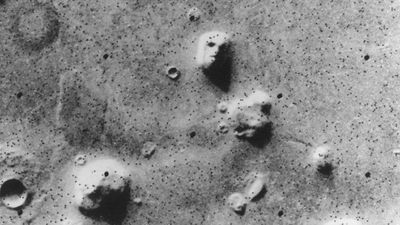
On July 25, the Viking 1 orbiter photographed a region we now call Cydonia, after a city-state from ancient Crete. That image was about to become one of the most famous space pictures ever taken.
Among the craters, looking back at the orbiter, appeared to be a face. It became known as the “Face on Mars," and despite being immediately identified as a trick of the light, it became a sensation.
A case of interplanetary pareidolia
It is extremely easy to make humans see a face in something. We do it all the time. From plugs to houses to an extensive list of stone formations around the world that look like sphinxes or old people.
It is helpful for humans to recognize faces, but it seems that we see faces even when there are none. This is known as face pareidolia.
A study a few years back put forward an explanation as to how we may be programmed to do so: basically, neural mechanisms that encode the features of human faces – pretty important to our species – also come into play in the processing of other images.
Just 35 orbits later, Viking 1 was back on Cydonia and snapped more photos. In a different light, the face persists, and it is not alone. Sharp mountains are seen in that panorama that looked a bit like pyramids.
What’s the Matter...horn?
A sphinx-like face and pyramids? Mars’ Cydonia seemed ripe for the conspiracy theories. It's possible the Doctor Who serial Pyramids of Mars, which aired several months before, helped stick the connection in the public consciousness.
Still, the pyramids were not pyramids but simple rocky formations, like many pyramid-shaped rock formations on Earth. However, people love to link pyramids with mystery, so just like when a pyramidal-shaped mountain was found in Antarctica, the conspiracy theorists went wild.
It doesn’t matter that these types of peaks are very common, including Mount Bulandstindur in Iceland and the Matterhorn in the Alps (which features on an extremely well-known chocolate brand).
Basically, if there’s something that can be latched upon, someone out there will find a link.
No, not that conspiracy theory… the other one!
Sometimes one layer of conspiracy theory is not enough. Some people may believe that the "Face on Mars" is not the real Face on Mars, and that it is actually a carved face on the surface of the Red Planet. They are, of course, wrong – not just because there aren't faces on Mars but because they have been looking at it upside down.
The claim is the face is a carved structure but not the one we can immediately recognize. But if you flip it upside down, it is the head and shoulders of an alien. UFO enthusiasts call it a "Gray."
If all this was not enough, the Face on Mars is indirectly responsible for the term "intelligent design", the attempt at legitimizing creationism using scientific language. The term was used in a news piece on the “space face” as reported in a book on the subject by Larry Witham.
The work of Vikings 50 years on
Fifty years later, the Viking mission is not remembered for giving the world a beloved Martian conspiracy theory but for its groundbreaking work in establishing Mars as a complex planet. A planet that might have had, or could still host, life, even if that life didn’t build giant face monuments.
From orbital images to soil chemistry, the mission was a resounding success and paved the way for what is being investigated on Mars today. One experiment had some interesting results that at first appeared to be a positive result for the presence of living organisms.
.jpg "a colorful view showing better resolution of the face and the area")
It is broadly believed that it was a false positive due to chemical reactions in the soil. Still, the idea Viking might have found life persists, even in a scenario where the very experiment found life to immediately, accidentally kill it.
What is the Face on Mars?
When new missions reached Mars with higher resolution cameras, we finally got a good look at what the formation was. It was exactly what scientists always thought it was: a 2-kilometer-long (1.2 miles) mesa.
"A detailed analysis of multiple images of this feature reveals a natural-looking Martian hill whose illusory face-like appearance depends on the viewing angle and angle of illumination," NASA wrote in a post about it.
It might be just a mesa, but it will never be just any mesa. It will always be the Face on Mars.