Space and Physics
 PUBLISHED


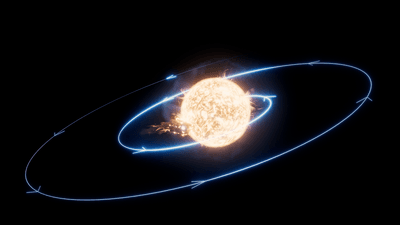


Early in the history of the Solar System, the Sun might have engulfed a sizable rocky planet, several times the mass of the Earth at least. This suggestion might account for some of the unexplained features of the Sun that currently remain perplexing. The evidence of such an event might persist deep within our star.
It is likely that our Solar System had more than its eight canonical planets and five-plus dwarf planets at the beginning. Theia, the Mars-sized world that hit Earth to form the Moon, was definitely an extra one. Proposals suggested that Jupiter might have kicked a large planet out of the Solar System too.
Super-Earths (likely rocky planets several times the mass of our own) are common in the universe, but there are none around us (well, maybe if it exists, Planet 9). The possibility that one existed close to the birth of the Sun is exciting, even though it is now gone.
"Our new study suggests that a planet several times more massive than Earth may have fallen into the young Sun and left a lasting chemical imprint deep inside it,” Professor Mutlu Yildiz, of Ege University in Turkey, said in a statement.
"By modelling the Sun's evolution and comparing the results with precise observations of its interior, we find that the ingestion of a super-Earth could help explain long-standing differences between standard solar models and observations, including subtle changes in the Sun's internal structure and its depleted lithium abundance."
Helioseismology is the study of how sound waves move through the Sun. This allows solar scientists to study the deeper layers of our star. It also has its share of complications, such as understanding precisely just how big the Sun is.
Some discrepancies that have existed between the helioseismic observations and the models include the sound speed structure just below the convection zone and the depth of that very zone. Models also fail to account for the depletion of lithium from the solar surface.
"We were interested whether these problems might have a common origin in the early chemical history of the Sun," Professor Yildiz explained. A planet would bring different chemicals to the Sun, which might still affect our star today.
The team used the MESA stellar evolution software program to explore several different alternative accretion histories. The output was different solar models with specific helioseismic and surface abundance properties.
The model that is favored to match the current Sun the best sees our star engulfing a super-Earth between five and 10 times the mass of our planet.
"We thought planetary engulfment might affect the solar structure but did not expect the calculations to converge on such a specific super-Earth mass range," said Professor Yildiz. "That was one of the most interesting outcomes of the study."
Could there have been a super-Earth in the early Solar System? A paper from a decade ago suggested that it is indeed possible for such planets to have formed within the orbit of Mercury.
That work did not speculate on how those hypothetical planets disappeared. This new work instead investigated if they could explain the peculiarities of the Sun and what evidence might exist today that supports the engulfing scenario.
"The next step is to see if these fingerprints can be independently detected," Professor Yildiz concluded.
The study is published in Monthly Notices of the Royal Astronomical Society.