Space and Physics
 PUBLISHED




What you'll discover in this article
- Researchers used about 100 fast-radio bursts to study matter not easily seen between galaxies.
- They were able to work out how this matter is clumping.
- "These millisecond-duration radio bursts are really changing what we believe about galaxy formation physics," lead author Kritti Sharma told IFLScience.
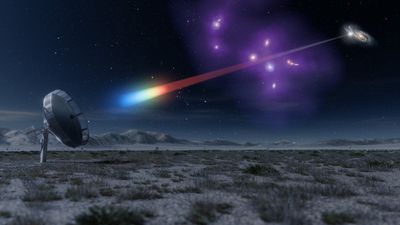
Fast-radio bursts (FRBs) are very brief and very powerful emissions of radio waves. The events last a few milliseconds and have an energy equivalent to what the Sun produces over a few days. Their origin is not fully understood, but their light is being used to study the invisible matter around and between galaxies.
We are not talking about dark matter, the hypothetical substance that is indeed expected to surround galaxies and stretch between them. The regular matter that makes us – AKA baryonic matter – is easily visible once it is nice and compressed into shining stars or in gas clouds.
But there is plenty of regular matter that we have been missing. The location of about 40 percent of it was uncertain, and that’s where FRBs came in. They literally shone a light on this matter and allowed researchers to see this missing component and measure how clumpy it is.
“Just exactly how the sunlight breaks into colors as it passes through a prism, the different FRB frequencies are arriving at different times. Using that, we can quantify how much gas it interacted with along the line of sight,” lead author of a new study Kritti Sharma, from Caltech, told IFLScience.
Clumpiness is getting suppressed
The team analyzed about 100 FRBs. The new work shows that the FRBs can be used to estimate how clumpy matter is in the large scale of the universe.
The clumpiness of regular matter doesn’t depend exclusively on gravity. It depends on the unknown quantity of the universe, dark matter – mentioned above – and dark energy, which is believed to be responsible for the accelerated expansion of the cosmos.
We are really building a new picture [...] using fast radio bursts.
Kritti Sharma
There are also neutrinos, tiny and fast particles that hardly interact with matter, as well as internal galactic processes such as the release of hot gas from active galactic nuclei (AGNs), supernovae, and more.
“We've taken the next step where we are directly measuring how suppressed the degree of clumping of matter is due to the feedback from galaxies, from AGNs, from supernova explosions, et cetera,” Sharma told IFLScience.
FRBs are believed to be emitted by magnetars, a type of neutron star with prodigious magnetic fields. Neutron stars are formed in certain supernovae, and magnetars are so magnetically powerful that one halfway between the Earth and the Moon would wipe out all credit cards on Earth. Some FRBs, though, might not have this kind of source.
This FRB analysis is exciting. It proves once again that despite not fully understanding FRBs, we can use them to study complex cosmological problems, and this is just the beginning.
“These millisecond-duration radio bursts are really changing what we believe about galaxy formation physics,” Sharma told IFLScience.
“How galaxies are formed, how the matter is moving around in the galaxy, going out, coming back in, etc. We are really building a new picture independently using fast radio bursts.”
In the coming years, radio observatories such as Caltech's Deep Synoptic Array (DSA) and others will be coming online. They are expected to find tens of thousands of FRBs. Combined with precision maps of galaxies from Euclid, the Nancy Grace Roman Space Telescope, and the Vera Rubin Observatory, we will have an amazing tool to track what we can’t easily see.
“Larger FRB samples when combined with galaxy information like positions of galaxies can help us actually map down how the gas distribution is around those galaxies,” Sharma told IFLScience.
The study is published in the journal Nature Astronomy.