Space and Physics
 PUBLISHED





What you'll discover in this article
- Last November a team of cosmologists claimed the expansion of the universe might be decelerating, arguing that our usual methods for measuring it had a fatal flaw.
- Brodie Popovic at the University of Southampton tells us he and his team reject these findings and are confident that an accelerating expansion is still our best explanation.
- Much of the argument comes down to the idea of a "standard candle," which is really important to cosmologists trying to figure out the nature of the universe.
Exactly what our universe is doing at a large scale is one of the major problems of cosmology. While we have a standard cosmological model that generally works really well, the past several years have seen it come under some severe strain.
One big attack was in last November, when researchers challenged a crucial way we estimate the universe's rate of expansion. Now, a new paper has rebuked that result.
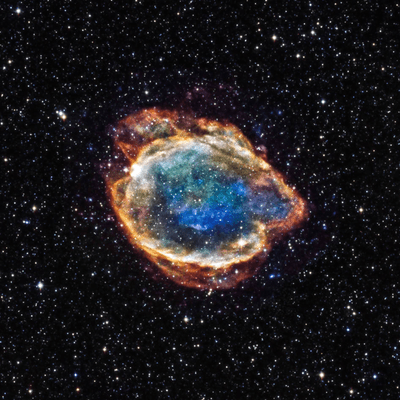
The crux of the matter is a specific type of cosmic event called a Type Ia supernova. These can happen in binary star systems featuring a regular star and a white dwarf – the exposed, contracted core that remains after the death of a star like our Sun.
White dwarfs don't normally go supernova. But when one steals material from its companion, it gets heavier and heavier, eventually reaching a threshold at 1.4 times the mass of our Sun. At that point, it goes boom.
Since the mass is always the same, the explosion always has approximately the same luminosity. This means Type Ia supernovae are what astronomers call standard candles, events of fixed luminosity that can be used to measure the distance of galaxies and thus the expansion of the universe.
In November, a team from South Korea published a study suggesting there was a problem with this method. They found that the age of the white dwarf affected the luminosity, bringing the whole idea of a standard candle into question.
According to their research, this would change our understanding of how the universe is expanding and force us to conclude that the rate of its expansion is slowing down rather than speeding up.
A new study rejects those findings, arguing that recent work is a case of scientific misunderstanding.
Just by incorporating this mass step, it does account for basically the entirety of their argument. I'm pretty confident in our results.
Brodie Popovic
“What we found is a lot of our results stand,” Brodie Popovic at the University of Southampton in the UK told IFLScience.
Popovic talks of Type Ia supernovae not as standard candles but as "standardizable candles."
He said that while properties of the progenitors and their environment do affect the exact luminosity, a simple correction can be employed to standardize what is seen.
“Back in 2011, we found that the brightness really depends on the host environment; it was actually Mark Sullivan here at Southampton that did that,” Popovic told IFLScience.
“This was known as the mass step because the stellar mass of the host galaxy is just easier to get. As it turns out, this mass correlates really strongly with the age of the stars and the age of the progenitors, which is what they use. It's not perfect, but it gets us most of the way there.”
“Just by incorporating this mass step, which we've been doing for 15 years now, it does account for basically the entirety of their argument. I'm pretty confident in our results, as it turns out.”
The problem of dark energy
One of the claims from the Korean team is that their results accord with another recent and surprising result. The largest-ever map of galaxies, published earlier this year, suggested dark energy – the mysterious force pushing the expansion of the universe – might be weakening.
Popovic said that a broad range of cosmological ideas could fit within those findings from the Dark Energy Spectroscopic Instrument and that, while there is interest in seeing the data from the full map, the standard model of cosmology continues to be the current best model we have.
"Extraordinary claims require especially careful testing,” Nobel laureate Adam Riess said in a statement. "What we find is that when we calibrate these supernovae, accounting for different host environments and populations, the evidence for cosmic acceleration remains remarkably consistent."
Previous work led by Riess has shown that the many different indicators of the expansion rate of the universe can be combined so that even if one of them is limited or biased, the combination is not affected.
The paper was published in Monthly Notices of the Royal Astronomical Society.