Space and Physics
 PUBLISHED
 1
1




What you'll discover in this article
- Astronomers accidentally found the faintest planet ever imaged from Earth (a gas giant) after a decade-long galactic game of hide-and-seek.
- The exoplanet has a whopping 91-year orbit – most known gas giant exoplanets orbit in weeks if not days.
- Lead author Dr Ben Sutlieff told IFLScience more planets, including rocky worlds, may be hiding in the system; the next generation of ground-based telescopes should be capable of directly imaging them.
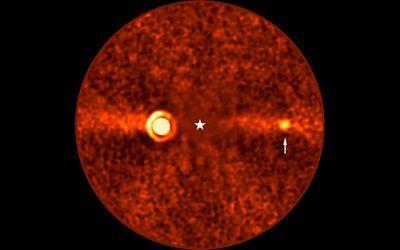
An international team of astronomers has reported the detection of a third planet going around Beta Pictoris, the second brightest star of the southern constellation Pictor (the easel). The new planet has been playing a big game of hide-and-seek with astronomers for over 10 years.
Beta Pictoris b was one of the first exoplanets directly imaged and is quite bright. We knew there was a second planet, Beta Pictoris c, also present in the system, which is 63 light-years away from us. It turns out, Beta Pictoris b's glare was hiding the signature of a third companion planet, a much fainter world, that we now know as Beta Pictoris d.
It's 100 times fainter than Beta Pictoris b.
Dr Ben Sutliieff
“We found a third exoplanet orbiting Beta Pictoris, a very famous exoplanet system,” co-lead author of the new study Dr Ben Sutlieff, from the University of Edinburgh, told IFLScience.
“It was the first system in which we ever imaged a circumstellar debris disk, and also the system where Beta Pictoris b, which was one of the first directly imaged planets, was found."
The new Beta Pictoris d is the faintest planet ever directly imaged from the ground. It is much lighter than other directly imaged worlds. While the other two planets in the system are about 10 times the mass of Jupiter, this one is still a gas giant but only 2.4 times the mass. It also orbits much farther out, going around the star – which is much larger and brighter than our Sun – every 91 years. That is a huge orbi. Most known gas giant exoplanets orbit their stars in days or weeks.
A serendipitous discovery
The team actually set out to look at Beta Pictoris b, using the ERIS instrument on the European Southern Observatory’s Very Large Telescope (VLT) to directly image and study how the exoplanet changed over time. However, when they looked at their images, they realized they were seeing something else there, too.
Sutlieff stressed just what a technical achievement this discovery is. Other methods of discovering exoplanets make use of the star’s light and seeing changes due to wobbles, as planets pull on their stars, or by transit, with the planet eclipsing a tiny bit of the star.
Direct imaging requires seeing the planet, so it needs to be bright enough to show up against its bright star and also, in this case, against its companions.
“It's 100 times fainter than Beta Pictoris b,” Sutlieff told IFLScience. “It's quite exciting to be able to push to find fainter and lower-mass exoplanets using direct imaging.”
To confirm their detection, they used new processing techniques for archival data to look through ESO's archive observations and found the planet had been hiding in these archives for decades.
Sometimes there are treasures still waiting to be found in old data or in systems that are well known.
Dr Ben Sutlieff
This system is only the second multi-planet system with more than two planets directly imaged. The first one is called HR 8799. Multi-planet systems are incredibly important in studying the evolution of planets and how location and masses can shape that.
“If they formed in the same system, they formed from the same material; they're all roughly the same age,” Dr Sutlieff told IFLScience. “This really lets us understand how the way that these planets form and where they form can have an impact on what they end up being like in their later life.”
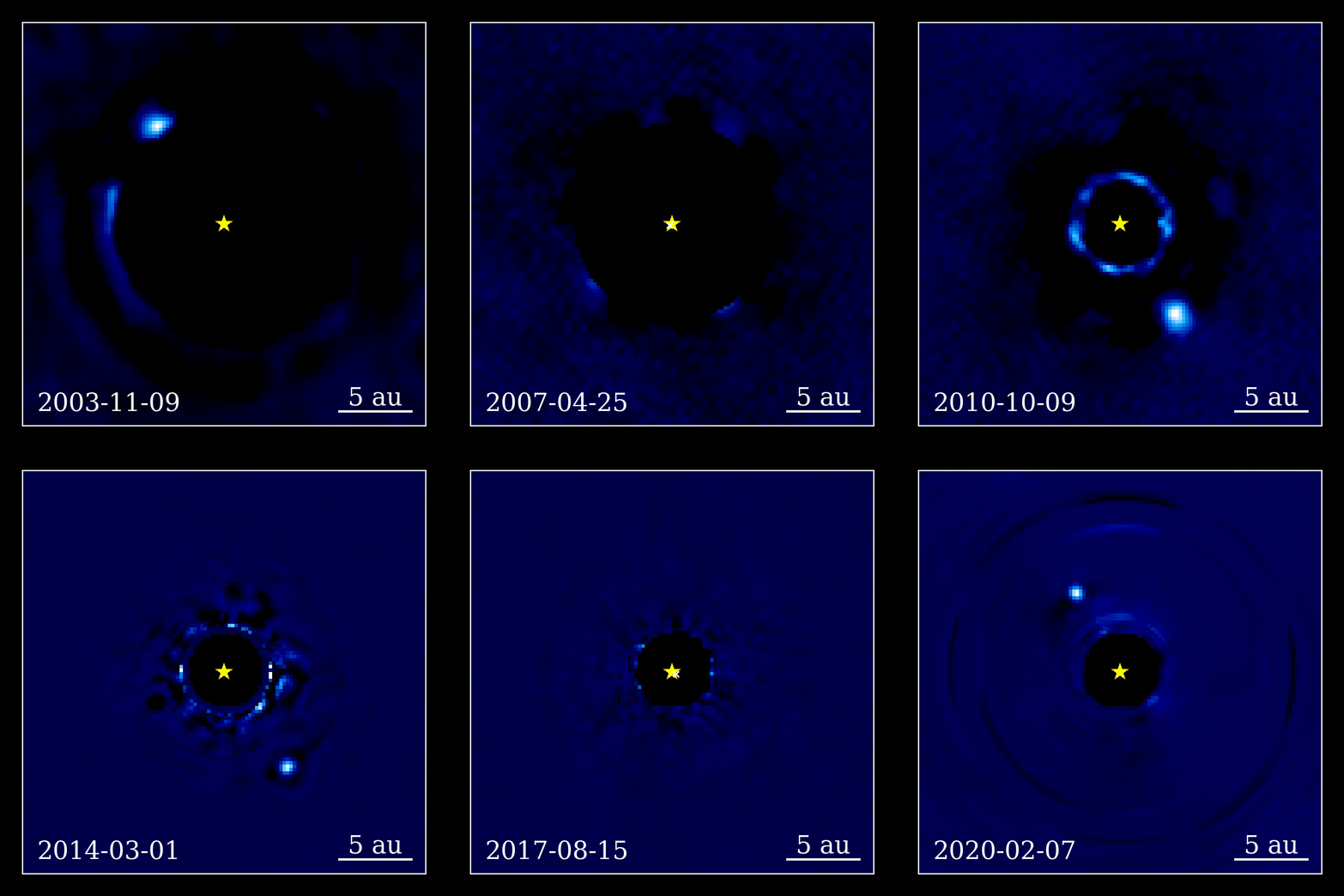
The work also stresses the importance of reinvestigating known objects and systems because you never know what has been missed by older instruments and techniques.
“Sometimes there are treasures still waiting to be found in old data or in systems that are well known,” Dr Sutlieff told IFLScience.
The team led by Sutlieff and Markus Bonse, an ESO astronomer in Germany, were not the only ones that had this idea. An independent team led by Aidan Gibbs at the University of California used JWST to also discover this planet.
While the Sutlieff-Bonse team could get a better handle on the orbit of the system, the JWST observations were able to capture insight into the planet’s atmosphere, which appears to be rich in carbon dioxide.
More follow-up studies will be necessary on this system to characterize this new planet. Maybe there are more hiding here. The next-generation telescopes coming online in the next few years – ESO’s Extremely Large Telescope (ELT) and the Giant Magellan Telescope, which should be capable of directly imaging rocky worlds – might reveal more planets hiding in this and other systems.
“I would not be at all surprised if there are rocky planets in Beta Pictoris,” Dr Sutlieff told IFLScience. “With ELT, the Giant Magellan Telescope, maybe we're going to be able to start detecting those as well!”
Both papers are published in The Astrophysical Journal Letters.