Space and Physics
 PUBLISHED


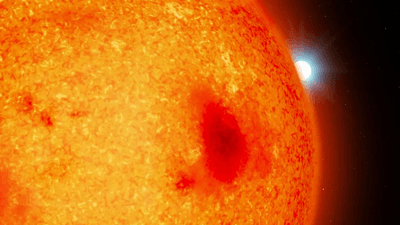


An international collaboration of astronomers has discovered four new white dwarfs in the solar neighborhood that had so far eluded detection. White dwarfs are the dense cores of dead stars that were not massive enough to go supernova. The Sun will end up becoming a red dwarf in several billion years.
What these four dead stars have and the Sun lacks is a red dwarf companion. These four objects were all binaries and all within 65 light-years of Earth, and the veteran Hubble Space Telescope was able to differentiate between the small white dwarfs and their brighter and larger companions.
“Because the white dwarfs are twice as hot as their red dwarf binary companions, their light is brightest at a different part of the electromagnetic spectrum. The red dwarfs are bright in visible light, the light our eyes can see. But white dwarfs are brighter in the ultraviolet instead," lead author Dr Mairi O’Brien of the University of Warwick told IFLScience.
Usually, one would look at the universe in ultraviolet light, and the white dwarf would be there, outshining the companions. The issue in binaries with red dwarfs is that the red dwarfs flare in the ultraviolet range, which makes it very confusing for astronomers. Lots of red dwarfs show false signals of white dwarf companions.
“We therefore couldn’t just use any broad-band ultraviolet data, we needed highly accurate spectroscopy (the splitting of light into colours) from the Hubble Space Telescope to disentangle the signal of the white dwarf from that of the red dwarf,” Dr O’Brien told IFLScience.
By studying these stellar remnants we are looking into the future of our own Sun and Solar System.
Dr Mairi O’Brien
A particularly puzzling system is G 203-47, which is located 25 light-years away and it is now the ninth closest white dwarf to the Sun. What’s peculiar about this system is that the two objects are not tidally locked – they do not always show each other the same face.
Gravitational forces tend to lead to this tidal locking, just like the Earth and the Moon. But in the case of G 203-47, despite the pull they exercise on each other, the red dwarf spins every 100+ days and the white dwarf every 14.9 days.
The fact that these two stars are not tidally locked despite the gravity suggests that maybe they had a different evolutionary path to get to where they are, unlike the other pairs.
We know there’s an intense gravitational pull not just from theory, but from measured wobbles on the red dwarf. The gravity of the white dwarf shakes its companion. This is what alerted the astronomers to the presence of these objects – and how they are going to look for more.
“We would like to find more candidates using the upcoming data release from the Gaia satellite at the end of the year. The Gaia data will show us if any nearby red dwarfs demonstrate the characteristic wobble caused by a hidden white dwarf companion,” Dr O’Brien told IFLScience.
“The only telescope that can currently provide ultraviolet spectroscopy to confirm these candidates is Hubble, and we would definitely like follow-up some more nearby candidates.”
Theoretical estimates placed four to five red dwarf-white dwarf pairs within 65 light-years of the Sun, so the discovery is perfectly in line with those estimations. It also shows how there are still surprises waiting for us in the solar neighborhood.
Also, it’s always good to learn more about white dwarfs.
“The stars we have observed are white dwarfs – dead stars that have run out of fuel to burn. In billions of years, the Sun will become a white dwarf, so by studying these stellar remnants we are looking into the future of our own Sun and Solar system,” Dr O’Brien told IFLScience.
The study is published in the Monthly Notices of the Royal Astronomical Society.