Space and Physics
 PUBLISHED


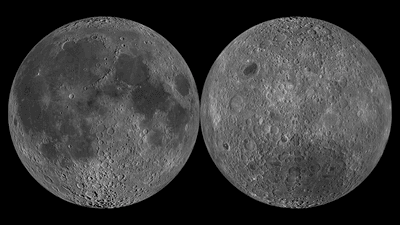


As Artemis II is about to go around the Moon, there is a renewed interest in the slightly less than half of the Moon we cannot see from Earth. The astronauts are about to see regions that no other human has seen directly with their naked eyes, and we have seen many online talking about how the crew is seeing the dark side of the Moon. As the images already show, that is not the case. They are seeing the far side of the Moon; the dark side changes all the time.
The Moon is tidally locked to the Earth. This means that it always gives us the same face, more or less. The Moon seems like it doesn’t rotate on its axis like the Earth does, but this is not the case. The rotation of the Moon takes about 29 days, which is roughly the same time it takes our lovely Luna to go around the Earth. This makes sure the same side is always pointing at Earth.
While the spinning remains constant, the speed of the Moon around our planet changes. This is due to the shape of the Moon’s orbit, which is close to but not exactly a circle. Thanks to this slight difference in timings, we see a bit more than half of the near side part of the Moon. Everything else is the far side, the hemisphere that only became discoverable once we were able to send spacecraft around the Moon.
The near side has its large basaltic plains, the maria or seas of the Moon. There are a lot more craters on the far side too. The differences between them are not just surface-level. They are bone-deep.
“Our study shows that the Moon’s interior is not uniform: the side facing Earth (the nearside) is warmer and more geologically active deep down than the far side. This difference is linked to the Moon’s volcanic history and explains why the two sides look so different,” planetary scientist Dr Ryan Park, senior research scientist at NASA's Jet Propulsion Laboratory, told IFLScience while discussing a recent study about those differences.
“The Moon’s nearside and far side look very different, as shown by differences in topography, crustal thickness, and the amount of heat-producing elements inside. These differences may come from variations deep within the Moon, causing one side to be warmer and more volcanic. Until now, there hasn’t been clear proof of these deep differences.”
The Moon, going around the Earth, changes position with respect to the Sun; so just like our planet, half of it is experiencing night at any given time. Due to the orbital period, the night of the Moon is over 14 days long. When the Moon is full, the far side is the dark side of the Moon, but it is constantly shifting. During the new Moon, when our satellite is on the Sun-side of the Earth, the near side is the dark side.