


 Space and Physics
 PUBLISHED




What you'll discover in this article
- Astronomers have discovered the fastest star in our galaxy.
- It's the star that "comes the closest" to our supermassive black hole, co-lead author Stefan Gillessen told IFLScience.
- It will allow for an unprecedented measurement that opens new ways to test the limits of our physics.
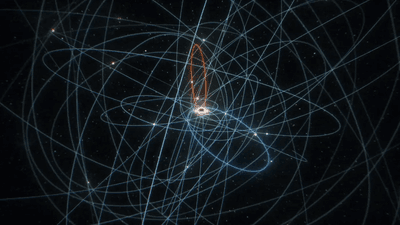
Meet S301, the fastest known star in the Milky Way and the one that gets the closest to Sagittarius A*, the supermassive black hole at the core of our galaxy.
An international team of astronomers discovered this faint object, and this might lead to a major new understanding of that very black hole.
Sagittarius A*, also known as Sgr A* or Sag A*, has a mass of 4.3 million times the mass of the Sun and a diameter of 25 million kilometers (15.5 million miles).
As supermassive black holes go, it is certainly not the biggest, but it is ours. And it is a phenomenal testbed for cutting-edge physics.
It's the star that comes closest to Sag A* of all the stars that we know.
Stefan Gillessen
A black hole is not exactly a cosmic plughole. Things can orbit it without being sucked in. Many stars have been found in orbit, but S301 beats all of them by a factor of 10 – dramatically closer.
At its closest approach, it is a mere 12 times the distance of Earth to the Sun from Sagittarius A*. And it is moving at 25,000 kilometers (15,500 miles) per second; that’s like 100,000 times faster than a commercial plane or just above 8 percent of the speed of light.
“We have discovered a star which immediately drew our attention because it's on an orbit which comes immensely close to Sag A*,” co-lead author Stefan Gillessen from the Max Planck Institute for Extraterrestrial Physics told IFLScience.
“It's the star that comes closest to Sag A* of all the stars that we know.”
Feeling the black hole like no other object
The star goes around the black hole every nine years. Beyond the record breaking, this is an incredible opportunity. The orbit of the star is affected massively not only by the gravity of the black hole, but also by its spin.
One thing we have not been able to measure is the spin of such a black hole. It is expected that it is rotating, like anything else in the galaxy. Spinning massive objects produces an effect known as frame-dragging, basically twisting spacetime as they rotate. This effect should physically shift the orbit of S301 over time.
“The closeness means that star is one that actually will feel the rotation of the black hole,” Gillessen told IFLScience.
Previous record-holders such as star S2 would be affected in the same way, but only in a matter of many decades.
If the goal is to measure the spin of Sag A*, studying S301 will provide insight into the spin after astronomers have collected data over at least two revolutions around the black hole.
“Let's continue to observe how this object is moving around the black hole and give us another decade or one and a half decades, and we most likely will have seen how the black hole is rotating,” Gillessen told IFLScience.
S301 is not alone
Finding this star was not easy, as it is fainter than other objects in the center of the Milky Way. It was possible thanks to the GRAVITY+ instrument on the European Southern Observatory’s Very Large Telescope Interferometer (ESO’s VLTI).
They have found several faint stars, but S301 is the one orbiting closest to the black hole.
With new observatories like the Extremely Large Telescope and the Giant Magellan Telescope coming online in the coming years, we'll be able to gather more precise measurements of this star's motion and with that the measurements of the black hole's rotation.
In the coming decades, we might even measure the shape of the black hole – if it rotates, it should be flattened a bit at the poles. Having these measured properties of a supermassive black hole would allow us to test general relativity and black hole theory like never before.
“I think that's a very exciting prospect, which I'm not sure if it will happen in my lifetime, but for sure a star which is suitable for that [test] is now found,” Gillessen told IFLScience.
The study is published in the journal Nature.


 1
1