Space and Physics
 PUBLISHED


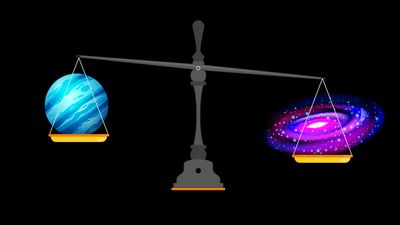


Whenever we talk about space objects, we are very often discussing their physical properties. Are they big? Are they heavy? Their sizes are usually easy to estimate by working out how big they appear in the sky and how far away they are.
Figuring out their masses, on the other hand, can become a complicated endeavor. Some approaches are only possible under specific conditions, others require detailed knowledge of the system in question, and others still are just guesswork.
Physicists are often annoyed about the fact that weight and mass are used interchangeably by people, while scientifically, they are different. Mass is simply the amount of matter an object has, while weight is the force exerted on an object due to gravity. If you were here or on the Moon, your mass would stay the same, but your weight would change since the Moon has lower gravity.
Still, mass and gravity are related, and in most cases, the way we estimate masses relates to working out the subtle (or not subtle) effects of gravity.
How do we weigh planets?
The rule of thumb that we will use over and over again is that if you have something big being orbited by something small, and you can measure their distance and the period, you can work out the mass. This is just Kepler’s third law of planetary motion.
For planets in the Solar System, this is easily done. And not just planets; the same can be done for other objects as long as you have orbital parameters. But what about further afield?
We are yet to confirm the existence of exomoons, and we might not be able to work out details with enough precision to provide us with a really good estimate. Fortunately, there are other options.
How do we weigh exoplanets?
It remains very difficult to see planets directly. Discoveries tend to happen when planets create a tiny eclipses by passing in front of their star (the transit method) or by creating wobbles in the star (radial velocity method).
The latter gives astronomers direct information since those wobbles depend on the gravitational pull of the planet. With the transit method, it is the presence of other planets causing small variations in the timing of the eclipses that provides those additional details. And they can be used together.
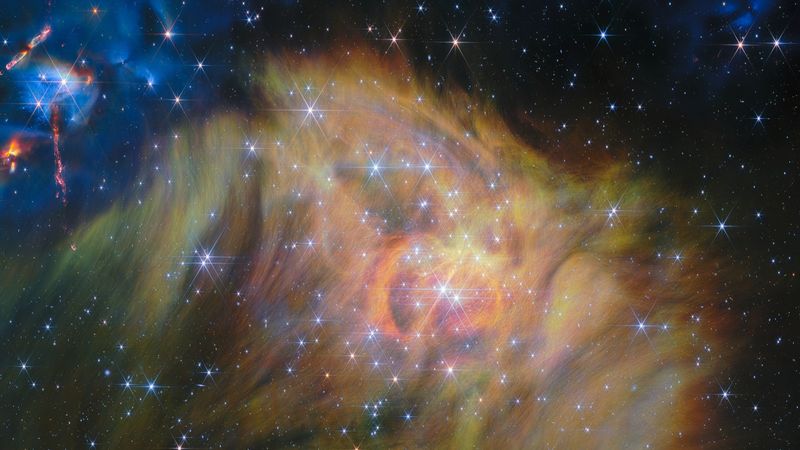
The planets do not have to be fully formed to be estimated. Telescopes like ALMA have discovered protoplanetary disks. These are the birthplaces of planets; they sport dark grooves where planets are forming.
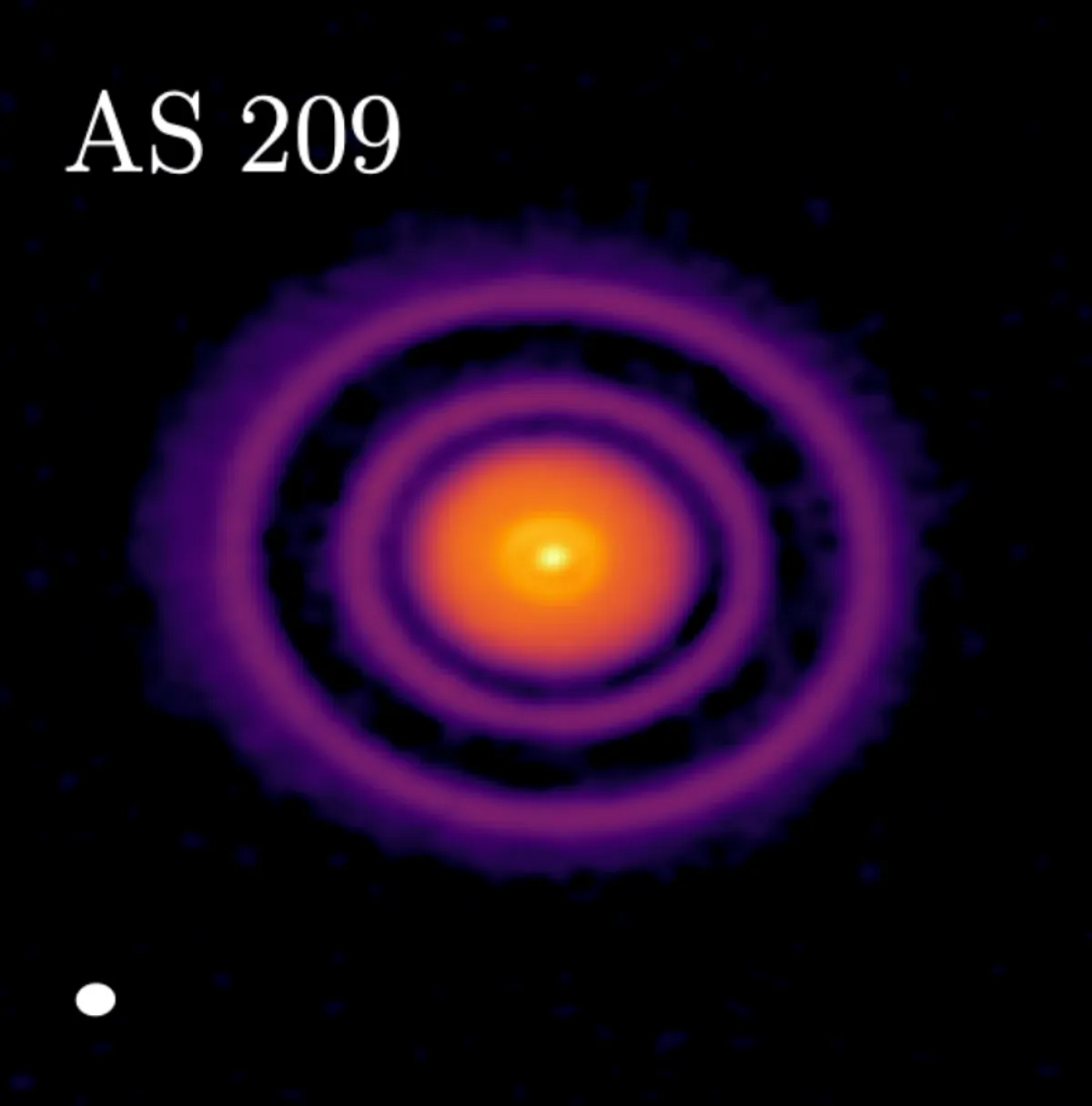
Traditional methods have measured the velocity of gas close to the planet and elsewhere, and comparing the two, they estimate how much pulling might be happening thanks to the fledgling new world. A new method instead looks at the properties of the bright rings of material between the grooves to work out the mass of the forming planets.
“This new approach is very exciting as it looks at the properties of the rings that planets create in a planet-forming disc to essentially “weigh” the planet. In particular, by looking at how wide the ring is, where exactly the peak of the ring is (which can be seen by looking at where the ring is the brightest) and how the gas pressure changes either side of the brightest part of the ring, we can link all of this to the mass of a possible planet in the disc,” senior co-author Dr Farzana Meru, associate professor at the University of Warwick, told IFLScience.
“These ring properties change depending on the planet's mass. By looking at these properties, we are essentially playing “detective” and putting all the clues together to work out what mass planet could be causing the ring that observers see in the planet-forming discs.”
This detective game is something that is really enabling us to push the boundaries of what we know.
Dr Farzana Meru
New observatories might push the precision of these observations even further, and with more details, the mass of these worlds (but also how they are growing) will become an even better constraint.
“This detective game is something that is really enabling us to push the boundaries of what we know – by putting all the clues together we are able to figure out the masses of planets that we are currently not able to directly see,” Dr Meru told IFLScience.
“Additionally this is not something that can be done just with observations or just with theory. We are now in this beautiful era of astronomy where the observations and the theory are moving forward hand-in-hand – the two together is truly greater than the sum of the parts.”
How do we weigh stars?
Obviously, if you know about planets around a star, you can apply the usual simple Keplerian trick to get the mass. If you don’t have a planet, you better hope that the stars are in a binary pair. Then you can measure how they move around each other and work out the total mass of the system.
To go one step forward, you need to know how they are moving around their common center of mass. That’s the key piece of information that allows you to separate the two masses from the total.
What about lone stars? If you are lucky, your star will pass in front of something luminous in the background and act as a gravitational lens; from the lensed image, you work out the mass of the lens.
For all the other stars, the guesswork depends on the mass-luminosity relationship. This can provide a ballpark figure, and while not as tight as dynamical constraints, it remains better than nothing.
How do we weigh black holes and supermassive black holes?
For black holes, we have the chance to do more dynamic approaches. Though we often do not see (at least in visible light) what stars are orbiting around, if their motion suggests that they are orbiting an invisible but very massive, dense object, you can bet that there’s a black hole lurking in there.
This is the case for two of the closest known black holes discovered by the Gaia observatory.
It is not the only way to estimate a black hole mass. If they are accreting, the material around them gets really hot and bright. From the luminosity, you can estimate the mass of the black holes. This is particularly useful for the supermassive black holes at the center of galaxies.
And not the only way to make such an estimate. There are some other relationships that link the motion of stars in the wider galaxy to the actual mass of the supermassive black hole. The relationships are well established and provide a good ballpark figure when necessary.
Lensing, too, can come into play, similar to the way that it is done for stars. This has been done even very recently, with Hubble determining the mass of a solitary black hole just 5,000 light-years from us.
Gravitational lensing also came into play with a groundbreaking observation conducted recently. Thanks to the sharp eye of JWST and the lensing effect of a galaxy cluster, researchers were able to measure the motion of the stars around a dormant black hole, pushing the record for a measurement such as this over 15 times further.
“These two techniques have enabled us to get down to an angular resolution that's equivalent to looking at a coin on the surface of the moon,” senior author Richard Ellis at University College London told IFLScience when the study came out a few weeks ago.
“The route is now open for something that was completely impossible before.”
Now, we know there’s a dormant black hole of about 6 billion times the mass of the Sun in a galaxy over 10 billion light-years away.
There’s also a very direct way to measure the mass of black holes, but that is specific to certain events: collisions between them. Thanks to gravitational waves and our excellent theoretical understanding of how they are emitted, researchers can work out the mass of the progenitors and final black holes during a collision.
How do we weigh galaxies and clusters of galaxies?
There are multiple methods to do this. You can still use dynamical tracers – in this case globular clusters rather than a moon – but galaxies are so big that you are no longer measuring how long it takes to go around. You can measure how fast they spin, something that alerted astronomers to the presence of an invisible form of matter known as dark matter.
You can also estimate a mass based on how bright a galaxy is. This gives you an indication of the number of stars, and knowing the possible population of stars, one can ballpark a galaxy’s mass.
A step up is the estimation of mass for galaxy clusters. Groups of galaxies can contain a few large ones and many tens of small galaxies. Clusters can have thousands of members. You do not have to measure each individual galaxy and make a census to work out the total mass.
Galaxy clusters often produce gravitational lensing effects, which can be used to work out their mass. The motion of galaxies inside the cluster can also inform the assembled mass in the cluster.
The mass of a galaxy cluster is not exclusively in galaxies. There is dark matter and a lot of hot gas spreading between them. Dark matter, as we have said, can’t be seen. But the gas is in the 0 to 100 million degrees range, and it emits X-rays. Through that emission, researchers can estimate the mass of the cluster.
The gas also comes into play in another method. The Sunyaev-Zel’dovich effect happens when the light from the cosmic microwave background is affected by high-energy electrons, like in the superheated gas of clusters. This, too, can provide an estimate of how heavy a cluster is.
It is important to stress that most methods, especially for things that are far away, have limitations. A combination of them is usually the best one can do to reduce the uncertainty. As we have said, there is not a cosmic bathroom scale for these objects, so we need to take what we know about them with what we don’t.