Space and Physics
 PUBLISHED





Is our little corner of the universe special? So far, it looks like Earth is pretty exceptional, as most worlds we have spotted in the three decades since the first exoplanet discovery have been very large and hot. But this is partly due to limitations in our ability to spot smaller, cooler exoplanets, meaning our "pale blue dot" may not actually be as unique as it appears.
Over the next few years, a raft of new observatories is set to change that. These include the launch of the European Space Agency (ESA) missions PLATO (early 2027) and ARIEL (2031). PLATO will find those worlds, while ARIEL will study atmospheres of known exoplanets in more detail.
“Plato is a groundbreaking mission that is not only going to find us new exoplanets, especially Earth-sized, Earth-mass exoplanets on one-year orbits, but also tell us about the ages of stars and those worlds,” Maximilian Günther at ESA told IFLScience. “We're really going to have a bit of a paradigm shift in terms of our understanding of other worlds… that is extremely exciting!”
A tiny dot that will tell us a lot
Another change that is set to reinvigorate the hunt for an exo-Earth is the development of a larger class of observatories. One of them is even set up to be capable of photographing an Earth twin directly.
It’s important to know that we are not talking about having the same level of resolution as, for example, Artemis II's view of Earth from orbit. We will be looking at a few pixels. Those pixels, though, might be enough to tell us if life could exist there.
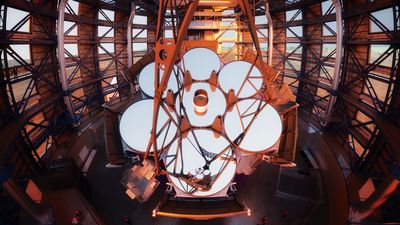
That this is even a possibility is thanks to the upcoming Giant Magellan Telescope in Chile's Atacama Desert. This ground-based telescope is being developed by a consortium of 16 research institutes from seven countries and will have an enormous primary mirror, 25.4 meters (about 83.5 feet) made of seven circular segments. Its resolving power will be 10 times greater than Hubble and four times greater than JWST.
Telescopes need large mirrors, but ultimately, they also need incredible instruments to make use of them. One major issue is that, while you and I might enjoy the air we breathe, when it comes to ground-based observatories, that air is a big nuisance, with turbulence in the atmosphere creating distortions in the images.
To solve that, observatories use ultrafast computers and deformable mirrors to correct the image, delivering something crystal clear. The main instrument set to do this for the Giant Magellan Telescope is called GMagAO-X.
The AO in GMagAO-X stands for adaptive optics, and it is a system of 21,000 actuators controlled at over 2000 hertz to adjust the shape of the mirror in response to atmospheric fluctuations. The system also has a coronagraph that blocks the light of individual stars, so the Giant Magellan Telescope will only see that light once it has reflected off a planet orbiting that star.
“GMagAO-X is a coronagraphic imager that works with extreme adaptive optics, meaning it gets even better adaptive optics resolution than the telescope itself,” Rebecca Bernstein, Giant Magellan Telescope’s chief scientist and a Carnegie astronomer, told IFLScience.
“It will be able to take direct images, literally watch planets orbit around stars. It will be able to take direct images of cool Earth-sized planets for the first time.”
And this isn't the only thing that makes this telescope special. The Giant Magellan Telescope Consortium Large Earth Finder (G-CLEF), the telescope's spectrographic analysis instrument, will also help in the search and characterization of these possible worlds, as well as studying extragalactic objects.
The appropriately named Extremely Large Telescope, from the European Southern Observatory, will have a bigger (39.3-meter or 130-foot) mirror, but it won't have an instrument like G-CLEF. “It is the only high-resolution visible spectrograph planned for the first decade of use on the three ELTs,” Bernstein told IFLScience.
“The Large Earth Finder will measure the masses of Earth-like planets outside of our Solar System and search for biosignatures, such as oxygen, in their atmospheres,” she said. “We are looking to get first light in the early 2030s.”
Thanks to the instrument, we will know the mass and motions of those exoplanets with an incredibly higher precision and even be able to measure much smaller exoplanets compared with what can be done today.
“It's really a spectacular next step in the kind of research that we do on planets,” said Bernstein.
Change is afoot in exoplanet research
Even in advance of something like this observatory, there are more exoplanet discoveries to come. These include atmospheric discoveries by JWST and large numbers of possible worlds thanks to a new analysis of data collected by NASA’s Transiting Exoplanet Survey Satellite (TESS).
“I think what I'm most excited about is that this is a sign of this transition in exoplanetary science as a whole, that we're sort of transitioning from the study of individual systems to having the facilities and the instruments and telescopes to perform these huge demographic-based surveys that hopefully really shine light on some of the planetary environments that we just haven't been able to probe,” Joshua Roth, a graduate researcher at Princeton University, told IFLScience.
When it comes to data collection, the most astronomical increase (excuse the pun) will come from the Vera Rubin Observatory, which is expected to deliver several hundreds of thousands, if not millions, of alerts every night. An observatory like the Giant Magellan Telescope will be able to chase fainter events to deliver even more insights.
The seven primary mirrors of the observatory have been cast, several instruments are already far along, and the site in the Atacama is being prepped. Some hurdles remain, but the team feels confident they will be able to make their case during their final review in summer 2027.
“We are also working to get everything to the final design phase so that we can do that final design review with the National Science Foundation next July,” Bernstein told IFLScience.
“The goal is to bring the National Science Foundation and the US federal government on as a partner. Then we would be the largest private-public partnership for pure research in a facility of this kind in the history of US science.”
The current observatories have changed exoplanet research as a whole. The one that will soon have their first light will provide a revolution in the search for worlds just like the one we are standing on.