Space and Physics
 PUBLISHED




Ask the average person, and they’ll tell you that the atmosphere is pretty important. Ask an astronomer, and they'll tell you all the ways that it is a nuisance. Sure, it keeps us alive, but at what cost to observations? Luckily some clever people worked out ways to get around the pesky air, and it can involve shooting lasers and creating artificial stars.
These artificial stars are part of adaptive optics approaches. The atmosphere has turbulence even on windless nights – that’s why stars twinkle. Adaptive optics uses deformable mirrors and computers to correct, in real-time, the distortion caused by atmospheric turbulence. To do that, your telescope needs a nice bright reference star near your target of observation. If you’re lacking a star, do not worry. You can easily make one at home. With a laser!
The lasers used by the telescopes of the European Southern Observatory (ESO) make the stars out of sodium. There are sodium atoms at about 90 kilometers (56 miles) of altitude, almost the conventional limit where space begins. The laser excited some of those atoms, creating the artificial stars. Knowing exactly what that star is supposed to be like, the computer can correct the image.
ESO’s Very Large Telescope Interferometer is made of four telescopes, each one 8 meters (25 feet) across. What’s incredible about this setup is that the telescopes can be combined into a virtual telescope as wide as the distance between the four, allowing them to resolve every minute detail. This virtual telescope setup only works if there is high precision and the atmospheric distortion is corrected.
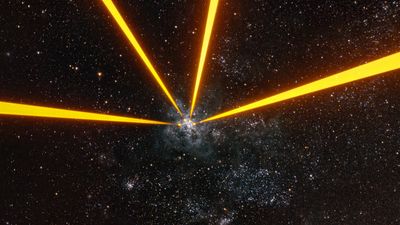
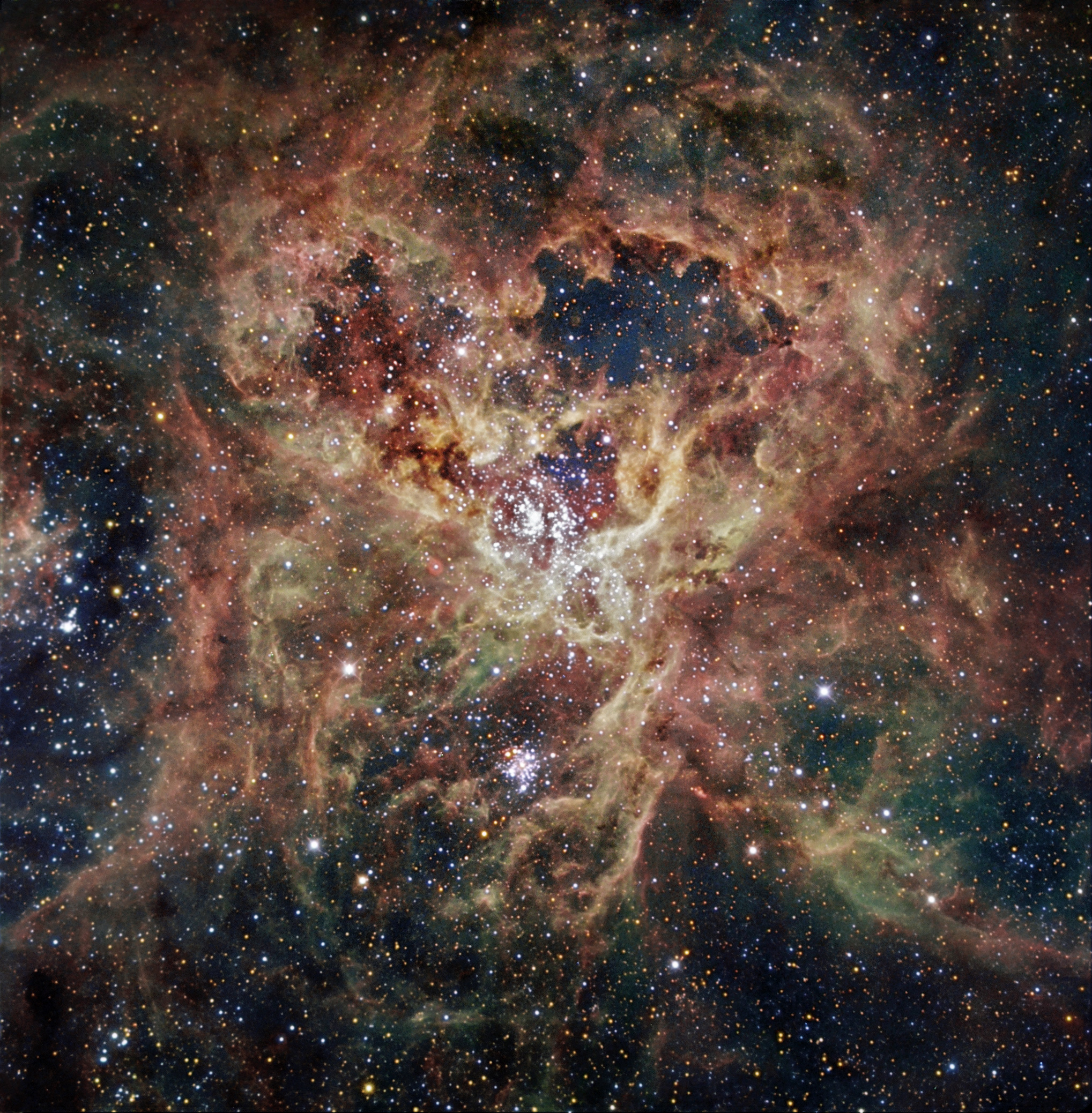
Last November, the telescopes were upgraded as part of the GRAVITY+ program with new lasers, and in this extraordinary image, we see them being shot at the Tarantula Nebula. This is a massive star-forming region in the Large Magellanic Cloud, one of the dwarf galaxies orbiting the Milky Way. It is about 160,000 light-years away.
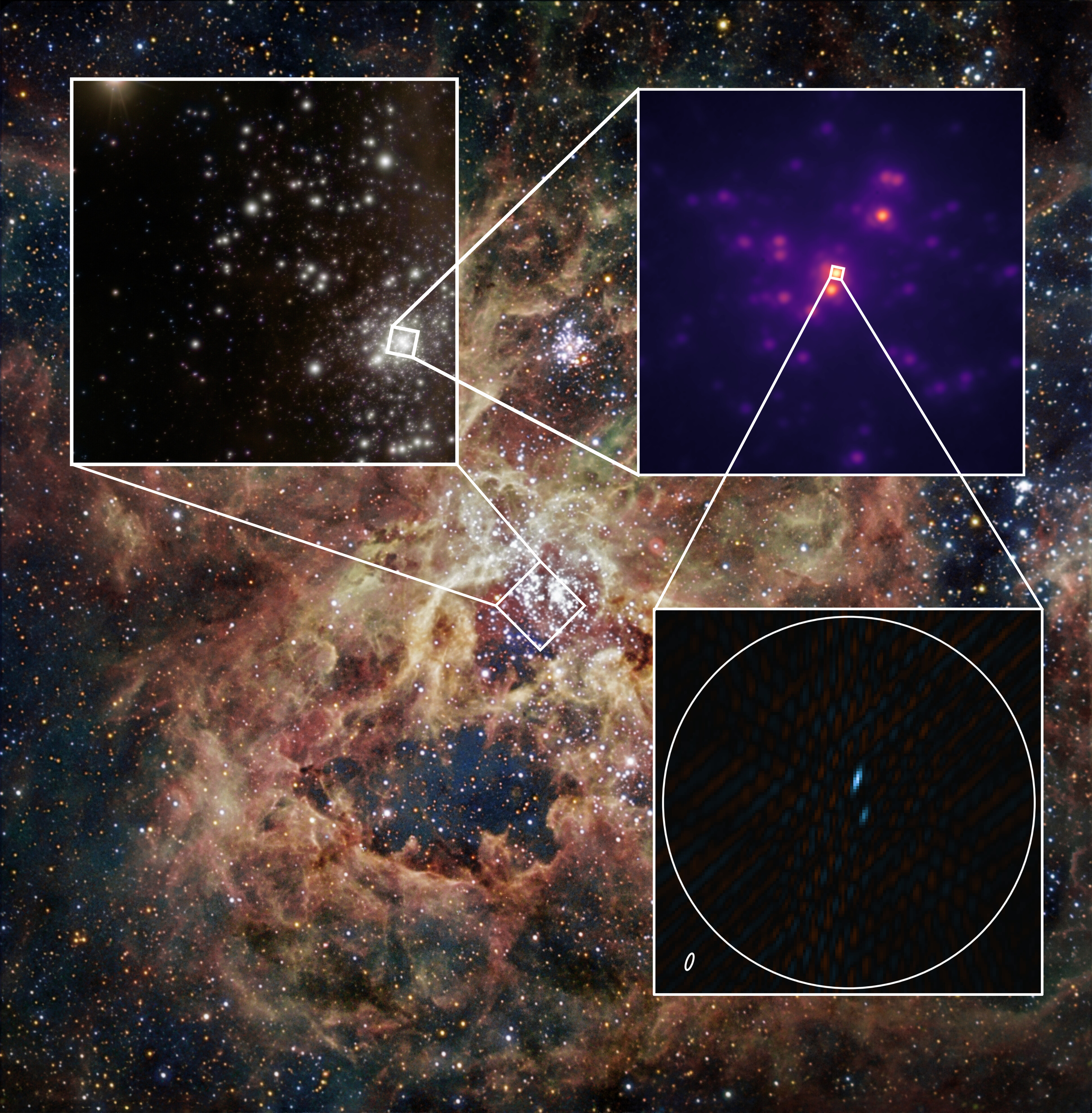
The results speak for themselves. The VLTI/GRAVITY+ image of the Tarantula Nebula shows such high definition that the team was able to see two binary stars as separate objects within the dense stellar cluster of the nebula. An extraordinary feat, and an ability that places the VLTI on par with space telescopes.
The laser photo was not taken by the telescopes but by astronomer Anthony Berdeu, who took part in the GRAVITY+ testing activities, from outside of the telescopes.