Space and Physics
 PUBLISHED



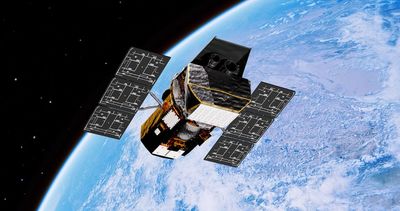


After almost 22 years in orbit, an incredible number of scientific observations and papers, and a daring but unsuccessful rescue attempt, the Neil Gehrels Swift Observatory is close to meeting its end.
The extraordinary gamma-ray observatory has re-activated several of its scientific instruments to conduct its last set of operations. NASA believes it will to continue doing science for a couple of weeks at most.
Space isn't as much of a vacuum as we might think. Of course, you can’t just walk around the space station unprotected, but there is still enough atmosphere – up to a certain point – to create drag. Drag slows spacecraft down, and by virtue of being slower, they drop in altitude.
Eventually, this feedback loop ends with the satellite in question falling into dense atmosphere and burning up.
The Swift observatory was launched on November 20, 2004, to study gamma-ray bursts, the most powerful explosions in the universe. It was planned to work for two years in an almost circular orbit around the planet. It would get as close as 585 kilometers and as far as 604 kilometers (364 to 375 miles).
Unlike the International Space Station, which is regularly raised, over the past 21 years and 10 months, Swift’s orbit has been steadily decaying. Back in November 2025, it was calculated that there was a 50 percent chance the telescope would fall back to Earth and burn up in the atmosphere by June 2026 and a 90 percent chance that this would happen before 2027.
A daring rescue attempt
For this reason, NASA tasked the space company Katalyst to quickly design a craft that could rendezvous and lift Swift. The space telescope hadn't been designed with a raising mission in mind, which added to the complications already present in this highly accelerated mission.
To give Katalyst a better chance, the telescope stopped doing science and was placed in a drag-reducing configuration. The company ultimately launched its LINK spacecraft on July 3, and at first it looked as though everything was on track to save Swift. Alas, it wasn't meant to be.
By late July, Katalyst announced that LINK had begun to spin uncontrollably due to issues with its reaction wheels (internal wheels that can be spun to adjust the spacecraft's attitude) and thrusters. In the end, those issues could not be overcome.
“From the beginning, this was a high-risk, high-reward mission,” Shawn Domagal-Goldman, Astrophysics Division director at NASA Headquarters, said in a statement.
“Without intervention, Swift was going to re-enter the atmosphere by year’s end. And while we’ll be sad to see Swift’s mission come to a close, we knew this boost effort would be valuable to the agency on multiple levels — advancing U.S. spacecraft servicing technology, challenging us to meet unprecedented mission timelines, and testing how we operate satellites to extend their time in low Earth orbit.”
“We’re very proud of how quickly this team got so far, and we’re capturing lessons learned to ensure we’re ready to go even farther.”
Its fate now sealed, the science team turned two of Swift's instruments back on in August and another last week. Might as well go out with a bang, and it now has a chance to catch a few more of the universe's biggest explosions before it goes dark.
Swift is currently on a 325-kilometer (202-mile) altitude orbit, but the moment it drops below 300 kilometers (185 miles) – expected between early and mid-October – NASA predicts the science will cease.